


Table of Contents
Introduction
The global fitness industry continues to evolve as commercial gyms, boutique studios, rehabilitation centers, and home fitness brands demand equipment tailored to specific users and training methods. While innovative concepts are essential, successful fitness equipment design requires much more than an attractive appearance. The real challenge is converting an idea into a product that can be manufactured efficiently, assembled reliably, and used safely for years.
Many promising products fail because manufacturability is considered only after the design is complete. This often leads to expensive redesigns, production delays, tooling modifications, and higher manufacturing costs.
A structured engineering approach ensures that customised fitness equipment moves smoothly from concept to production while balancing performance, durability, safety, and cost.
In this article, we explore the complete product development journey and explain how Design for Manufacturability (DFM) helps create production-ready fitness equipment.
Why Manufacturability Matters in Fitness Equipment Design
Unlike consumer electronics, fitness equipment experiences repeated dynamic loading, vibration, impact forces, and user misuse. Every component, from the structural frame to moving joints, must withstand continuous operation without compromising safety.
Considering manufacturability early provides several advantages:
- Reduced production costs
- Faster product development
- Easier assembly
- Improved product consistency
- Better structural performance
- Lower warranty claims
- Simplified maintenance
Whether designing strength equipment, cable machines, benches, racks, or rehabilitation systems, manufacturability directly influences profitability.
The Journey from Concept to Production
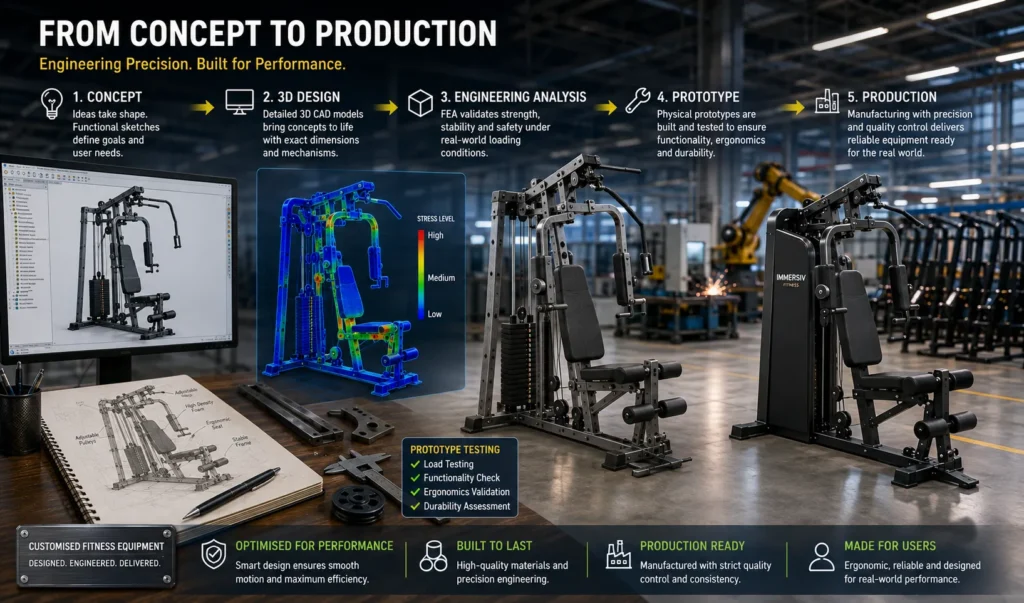
1. Understanding User Requirements
Every successful fitness equipment design begins with understanding how the product will be used.
Engineers typically define:
- Target users
- Exercise functionality
- Weight capacity
- Biomechanical requirements
- Safety standards
- Available manufacturing processes
- Budget targets
This stage converts customer ideas into measurable engineering requirements.
2. Concept Development
Multiple concepts are generated before selecting the best design.
During concept development, engineers evaluate:
- User ergonomics
- Equipment footprint
- Structural layout
- Mechanism selection
- Ease of adjustment
- Serviceability
- Manufacturing feasibility
Instead of designing purely for aesthetics, engineers balance functionality with production efficiency.
Designing for Manufacturing (DFM)
One of the biggest factors affecting production cost is how easily parts can be manufactured. Design for Manufacturability focuses on simplifying production without reducing product quality.
Key DFM considerations include:
1. Material Selection
Fitness equipment commonly uses:
- Mild steel
- Stainless steel
- Aluminum alloys
- Engineering plastics
- Rubber components
- High-strength fasteners
Material selection depends on:
- Strength
- Corrosion resistance
- Cost
- Weldability
- Machinability
- Powder coating compatibility
2. Sheet Metal Optimization
Many commercial fitness products rely heavily on sheet metal fabrication.
Proper sheet metal design includes:
- Standard bend radii
- Uniform thickness
- Minimum welding
- Laser-cut features
- Easy fixture positioning
- Reduced material waste
Well-designed sheet metal components improve production speed while lowering fabrication costs.
3. Weldment Design
Fitness equipment often consists of welded tubular frames.
Engineers optimize:
- Weld accessibility
- Joint strength
- Distortion control
- Manufacturing sequence
- Fixture requirements
Reducing unnecessary welds saves labor while improving production consistency.
4. Standard Components
Using readily available components reduces manufacturing complexity.
Examples include:
- Bearings
- Bushings
- Linear guides
- Fasteners
- Gas springs
- Pulleys
- Wheels
- Adjustment knobs
Standardization simplifies maintenance and spare part availability.
Ergonomic Design is Equally Important
Modern customised fitness equipment must accommodate users with varying body sizes and training goals.
Engineers evaluate:
- Reach distances
- Joint movement
- Handle positions
- Seat adjustments
- Foot placement
- Cable routing
- Exercise motion paths
Digital human simulations help identify ergonomic issues before physical prototypes are built.
Structural Engineering and Safety Validation
Safety is non-negotiable in fitness equipment.
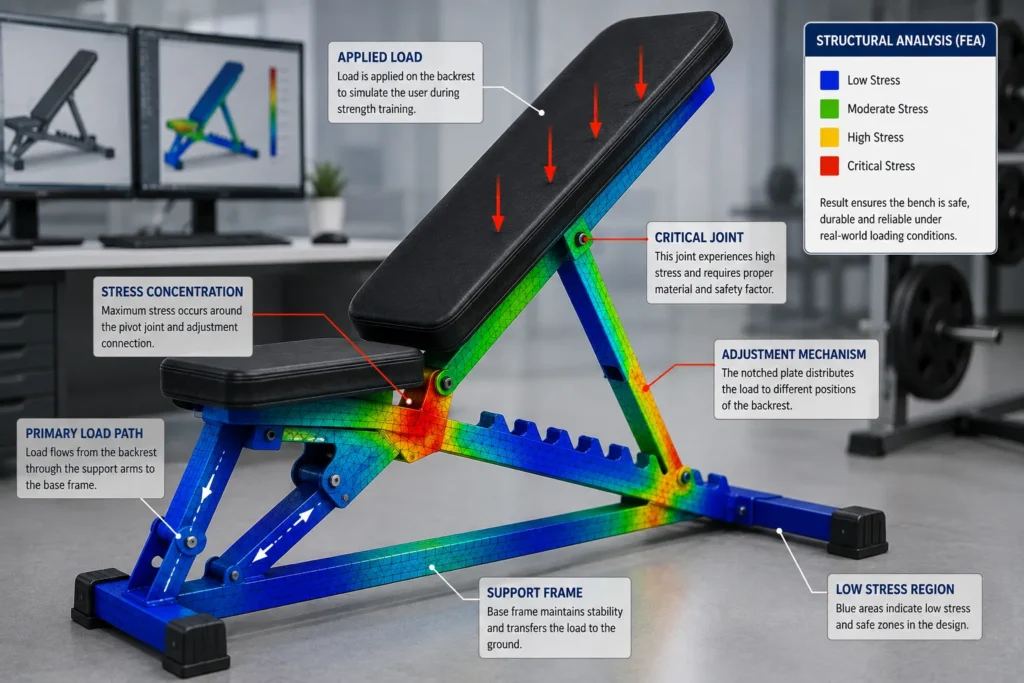
Structural engineers validate designs using Finite Element Analysis (FEA) before manufacturing begins.
Typical simulations include:
- Static load analysis
- Dynamic loading
- Fatigue analysis
- Buckling analysis
- Weld strength evaluation
- Deflection analysis
- Safety factor calculations
Simulation helps identify weak areas early, reducing costly physical testing iterations.
Mechanism Design for Smooth Operation
Many fitness machines contain moving assemblies.
Examples include:
- Cable systems
- Linkages
- Pivot arms
- Sliding rails
- Adjustable seats
- Weight stack mechanisms
Mechanical engineers optimize:
- Motion paths
- Bearing selection
- Friction
- Clearance
- Assembly tolerances
Proper mechanism design improves user experience while extending product life.
Designing for Assembly (DFA)
A product that is easy to manufacture should also be easy to assemble.
Design for Assembly reduces production time by:
- Minimizing part count
- Using modular assemblies
- Standardizing fasteners
- Improving tool accessibility
- Reducing assembly errors
Simpler assembly lowers labor costs while improving product quality.
Prototyping Before Mass Production
Digital validation cannot replace physical testing.
Prototypes help verify:
- Ergonomics
- Motion quality
- User comfort
- Structural rigidity
- Assembly process
- Manufacturing accuracy
Prototype feedback often results in valuable design improvements before tooling investment.
Preparing Production Documentation
Once the design is finalized, detailed manufacturing documentation is created.
Production packages typically include:
- 3D CAD models
- Manufacturing drawings
- Assembly drawings
- Weldment drawings
- Bill of Materials (BOM)
- DXF files
- STEP files
- Exploded assembly views
- Hardware specifications
- Surface finish requirements
Clear documentation minimizes production errors across manufacturing teams.
Supporting Multiple Product Variants
Many manufacturers offer the same equipment with different:
- Sizes
- Colors
- Weight capacities
- Attachments
- Frame configurations
- Branding
A well-planned product architecture enables faster development of new variants while reducing engineering effort.
Using configurable CAD models and automation further accelerates the design process for product families.
Common Manufacturing Challenges
Manufacturers frequently encounter issues such as:
- Excessive welding
- Difficult assembly access
- Heavy components
- Poor tolerance control
- Unnecessary custom parts
- Material wastage
- Late engineering changes
Addressing these challenges during the design phase significantly improves production efficiency.
Digital Engineering Accelerates Product Development
Modern engineering teams increasingly rely on digital tools throughout product development.
These include:
- Parametric CAD modeling
- Motion simulation
- Finite Element Analysis
- Sheet metal design
- Weldment modeling
- Design automation
- Product configurators
- Manufacturing documentation automation
Digital workflows shorten development cycles while improving design accuracy.
How Immersiv Techsphere Supports Fitness Equipment Manufacturers
At Immersiv Techsphere, we help manufacturers transform innovative ideas into production-ready products through engineering-driven design.
Our capabilities include:
- Fitness equipment design and development
- Customised fitness equipment engineering
- Mechanical product design
- Sheet metal design
- Weldment design
- Structural validation using FEA
- Design for Manufacturability (DFM)
- Prototype-ready CAD models
- Production drawings and BOM creation
- CAD automation for configurable product families
Whether you’re developing a new commercial gym machine, home fitness product, rehabilitation equipment, or strength training system, our engineering team focuses on creating designs that are efficient to manufacture, assemble, and scale for production.
Frequently Asked Questions (FAQ)
Fitness equipment design is the engineering process of developing exercise machines that meet functional, ergonomic, structural, and manufacturing requirements while ensuring user safety and product durability.
Design for Manufacturability helps reduce production costs, simplify fabrication, improve assembly, minimize material waste, and accelerate product development without compromising quality.
Engineers typically use parametric CAD software, sheet metal design tools, weldment modeling, motion simulation, and Finite Element Analysis software to develop production-ready fitness equipment.
Most fitness equipment uses mild steel, stainless steel, aluminum alloys, engineering plastics, rubber components, bearings, and standard mechanical hardware depending on the application.
Yes. By following DFM principles, modular product architecture, and standardized components, customised fitness equipment can be efficiently manufactured at scale while maintaining consistent quality.
Conclusion
Successful fitness equipment design is more than creating an attractive product, it is about engineering solutions that perform reliably, can be manufactured efficiently, and deliver long-term value to both manufacturers and end users.
By integrating Design for Manufacturability, ergonomic engineering, structural validation, and digital product development from the earliest stages, companies can reduce costs, shorten development cycles, and bring customised fitness equipment to market with greater confidence.
Whether you’re launching a new product line or refining an existing design, investing in manufacturable engineering is the key to scalable, high-quality production.
Have a Project in Mind?
Need help with 3D animation, industrial visualization, HSE training animation, or product visualization? Tell us about your project and our team will get back to you.