

Table of Contents
Introduction
In manufacturing businesses, preparing a quotation is no longer just a sales activity. Every quotation involves engineering validation, configuration checks, manufacturing feasibility, pricing calculations, and documentation.
For companies producing configurable products, even a minor engineering mistake during quotation can result in production delays, incorrect BOMs, expensive rework, or dissatisfied customers.
A Rule-Based Configurator integrated with a CPQ (Configure Price Quote) system eliminates these challenges by ensuring every product configuration follows predefined engineering rules before a quotation is generated.
Instead of relying on manual engineering reviews for every customer inquiry, manufacturers can automate product configuration while maintaining engineering accuracy.
Why Engineering Errors Happen During Quotation
Many manufacturers still depend on spreadsheets, catalogs, manual calculations, and engineering teams to validate customer requirements.
A typical quotation process often looks like this:
- Sales receives customer requirements.
- Engineering verifies feasibility.
- Components are selected manually.
- Pricing is calculated separately.
- Drawings are reviewed.
- BOM is prepared.
- Quotation is finally released.
Every manual step increases the possibility of errors.
Common issues include:
- Incorrect component combinations
- Missing accessories
- Invalid dimensions
- Wrong material selections
- Incorrect manufacturing options
- Pricing inconsistencies
- Human calculation mistakes
As product complexity increases, these errors become more frequent.
What Is a Rule-Based Configurator?
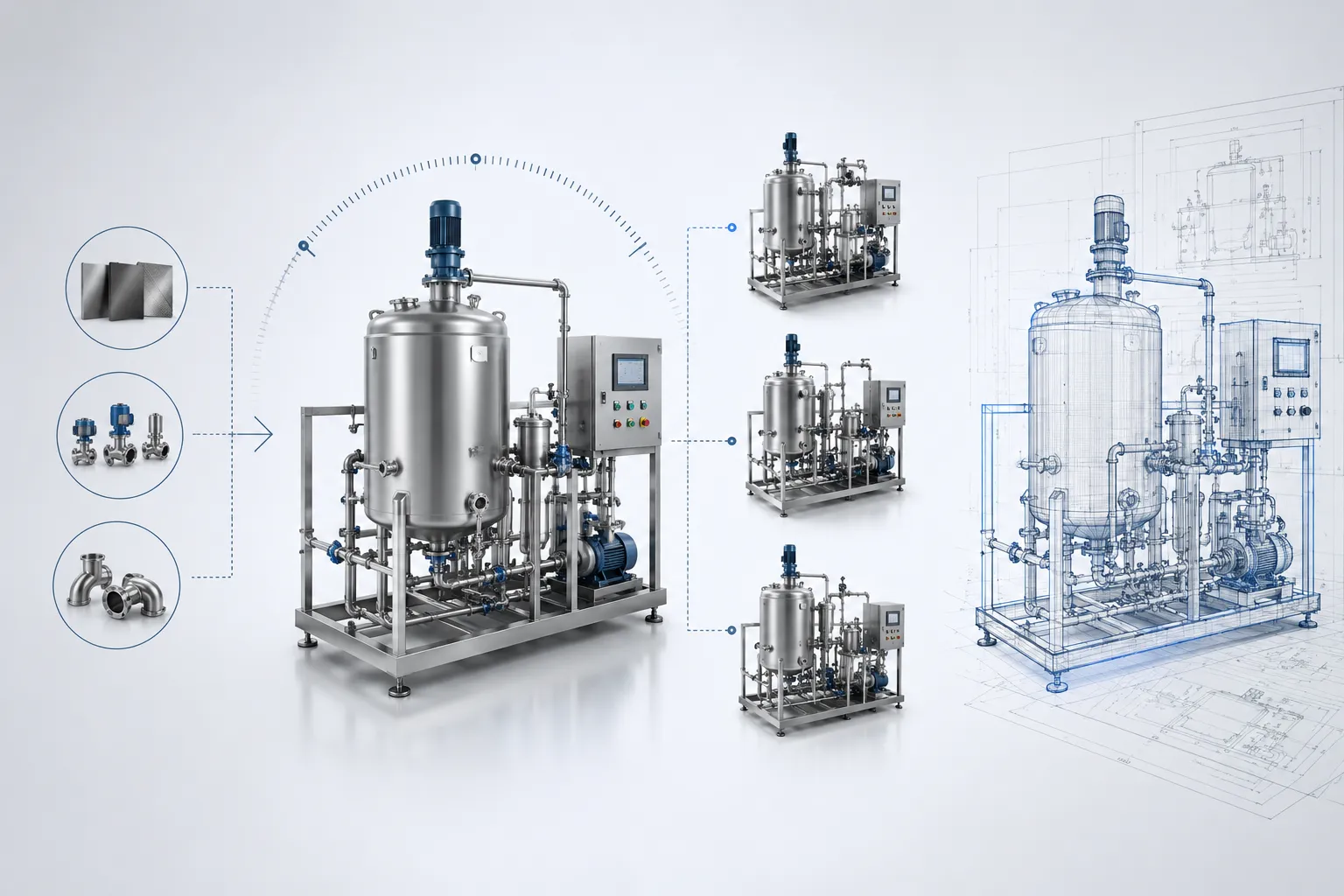
A Configurator is software that automatically creates valid product configurations based on predefined engineering rules.
Instead of allowing every possible combination, the configurator only permits configurations that are technically feasible.
These engineering rules are defined once by experts and reused across every quotation.
For example:
If a customer selects:
- Product Width = 1500 mm
- Material = Stainless Steel
- Load Capacity = 500 kg
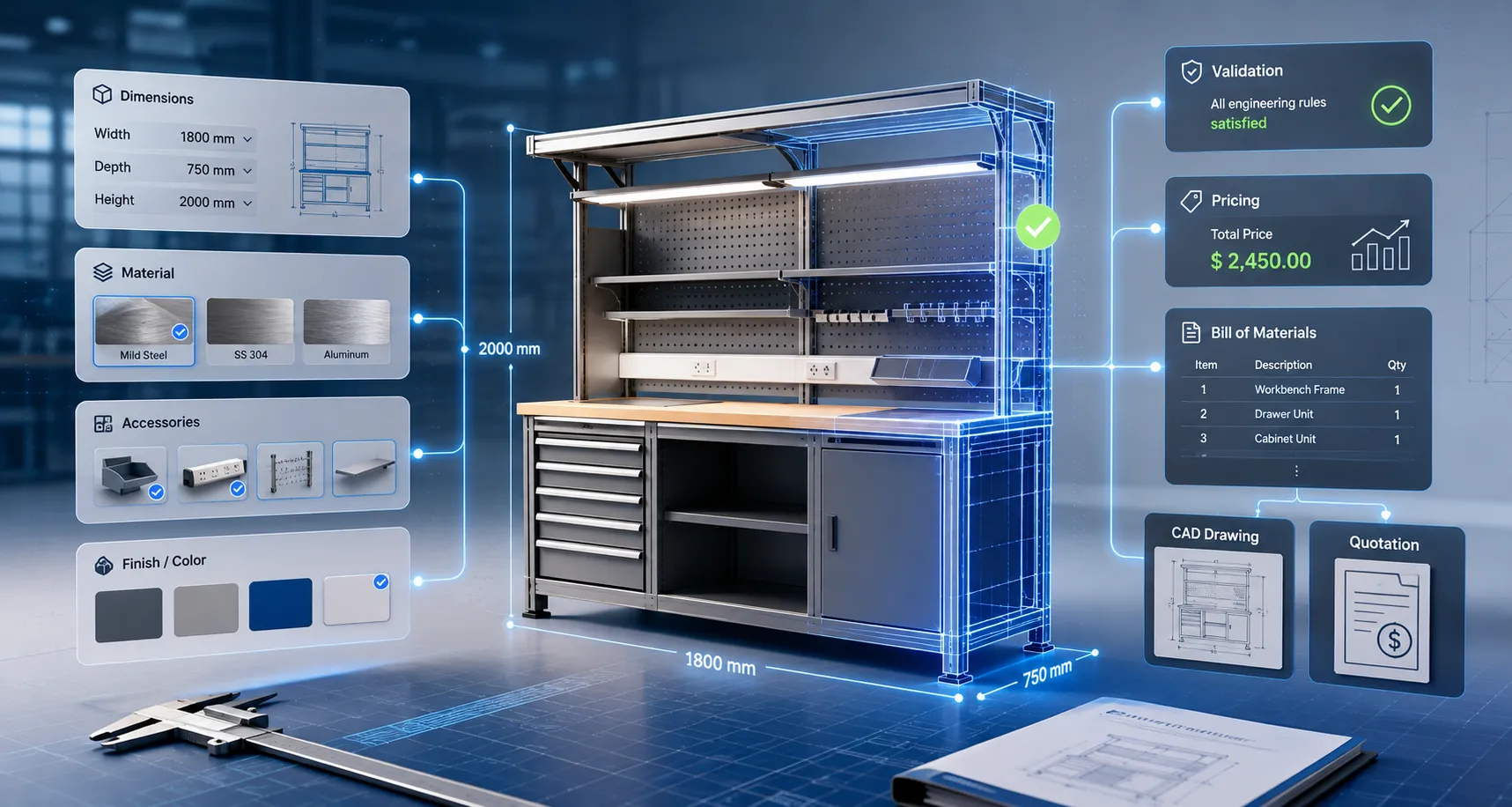
The configurator automatically:
- Selects the correct structural members
- Chooses compatible hardware
- Updates manufacturing dimensions
- Calculates weight
- Selects appropriate fasteners
- Generates pricing
- Creates BOM
- Produces CAD models if required
No manual engineering intervention is needed.
What Is CPQ (Configure Price Quote)?
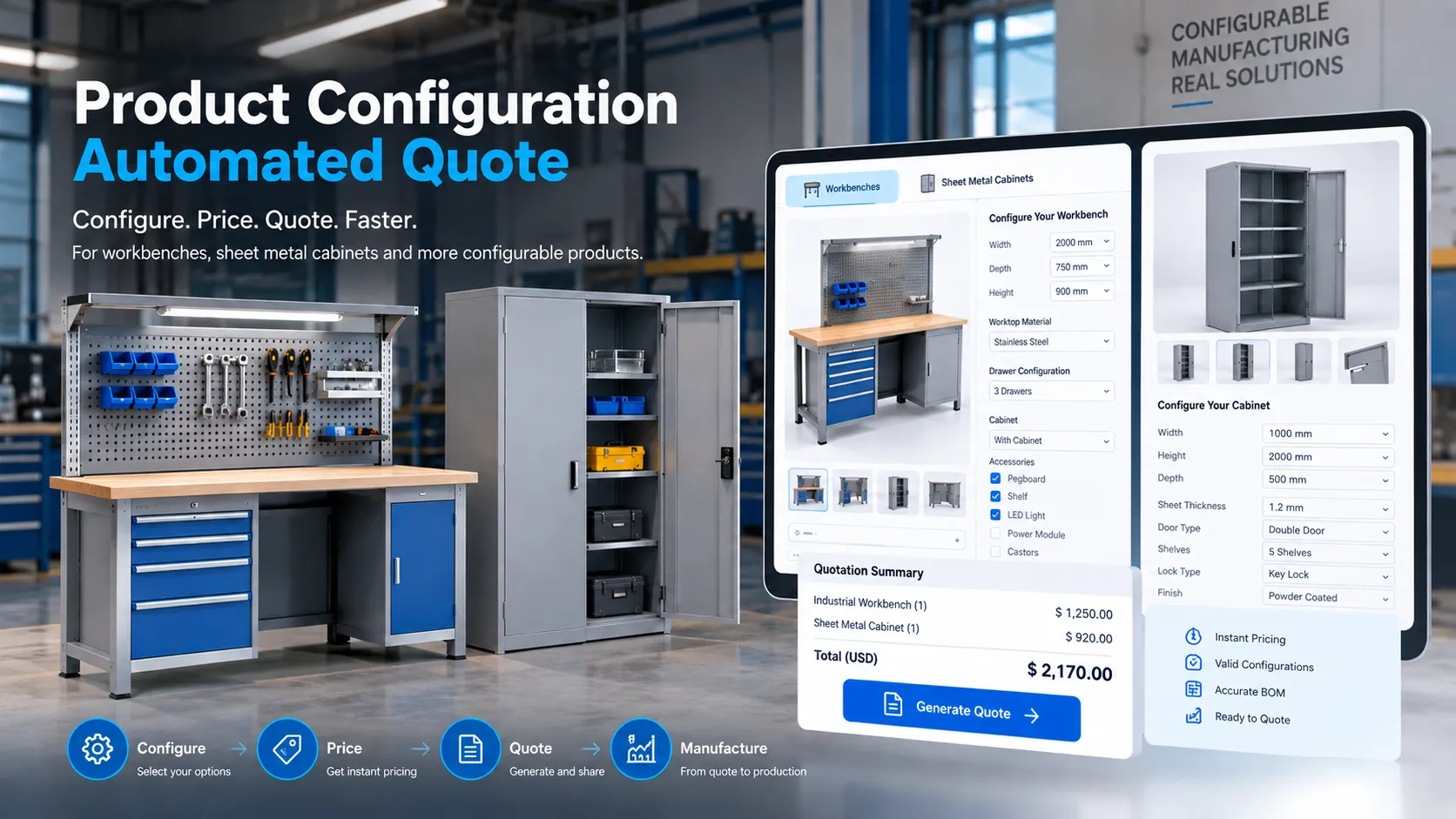
CPQ (Configure Price Quote) is software that combines product configuration, engineering logic, and pricing into a single automated workflow.
Instead of creating quotations manually, CPQ allows sales teams to configure products while the software automatically:
- Validates engineering rules
- Calculates pricing
- Applies business logic
- Generates quotations
- Produces product documentation
- Creates manufacturing-ready information
This significantly reduces quotation time while improving engineering accuracy.
How Rule-Based Configurators Prevent Engineering Errors
1. Only Valid Configurations Are Allowed
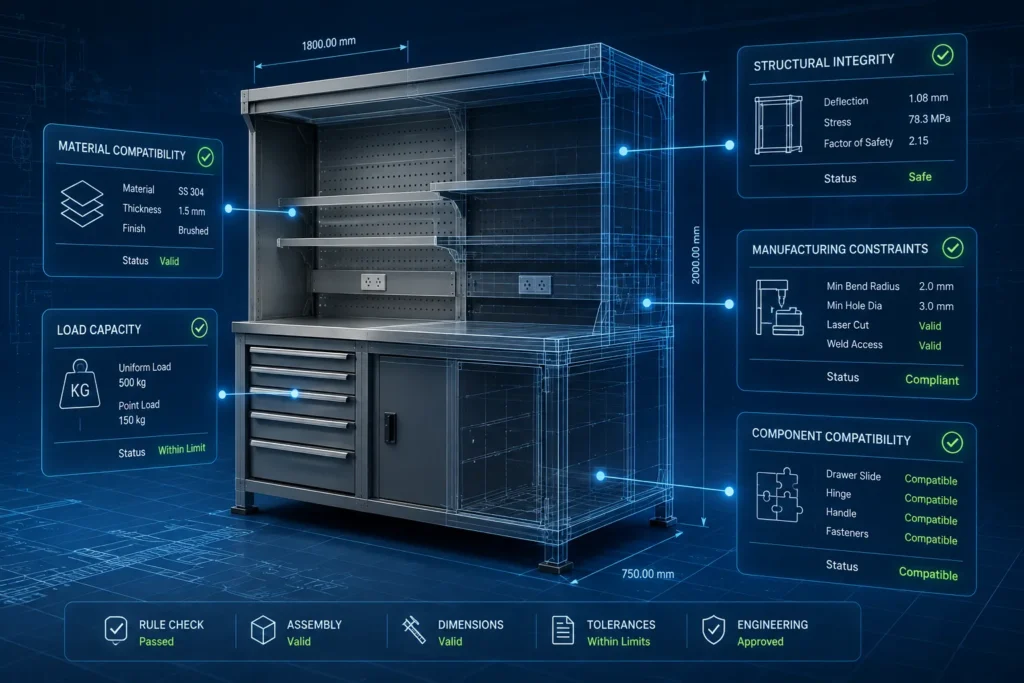
One of the biggest advantages of a rule-based Configurator is that invalid product combinations simply cannot be selected.
For example:
- Large motors cannot be paired with undersized gearboxes.
- Heavy-duty frames cannot use lightweight supports.
- Pressure ratings remain within allowable limits.
- Material compatibility is automatically verified.
This prevents engineering mistakes before they happen.
2. Engineering Knowledge Is Standardized
Many companies rely heavily on experienced engineers who possess years of product knowledge.
When that expertise exists only in individuals, organizations face risks such as:
- Inconsistent quotations
- Knowledge loss
- Long training periods
- Different engineering decisions
A rule-based Configurator captures engineering knowledge and makes it available to everyone.
Every quotation follows the same engineering standards regardless of who prepares it.
3. Automatic BOM Generation
Manual BOM creation is both time-consuming and error-prone.
A Configurator automatically generates:
- Complete Bill of Materials
- Purchased parts
- Standard components
- Manufacturing quantities
- Assembly information
This eliminates missing or duplicate components.
4. CAD Models Can Be Generated Automatically
Modern CAD automation enables Configurators to integrate with design software such as:
- SOLIDWORKS
- Autodesk Inventor
- Siemens NX
After product configuration, the system can automatically generate:
- 3D Models
- Manufacturing Drawings
- Assembly Drawings
- DXF Files
- STEP Files
- PDFs
This removes repetitive CAD work while ensuring consistency across designs.
5. Pricing Remains Accurate
Manual pricing often involves:
- Multiple spreadsheets
- Old price lists
- Incorrect formulas
- Human errors
A CPQ system automatically calculates:
- Material costs
- Labor costs
- Machine hours
- Purchased components
- Profit margins
- Regional pricing
- Discounts
Every quotation follows standardized pricing rules.
6. Faster Engineering Approval
Since every configuration already complies with predefined engineering rules, engineers spend less time reviewing standard quotations.
Engineering teams can instead focus on:
- New product development
- Custom engineering
- Innovation
- Process improvements
Industries That Benefit Most
Rule-Based Configurators are particularly valuable for manufacturers producing configurable products.
Common industries include:
- Industrial Equipment
- Process Equipment
- Laboratory Furniture
- Sheet Metal Products
- Material Handling Systems
- Electrical Enclosures
- HVAC Equipment
- Pumps and Valves
- Furniture Manufacturing
- Automation Equipment
- Machine Builders
- Packaging Machinery
- Agricultural Equipment
Typical Workflow Using a Configurator and CPQ
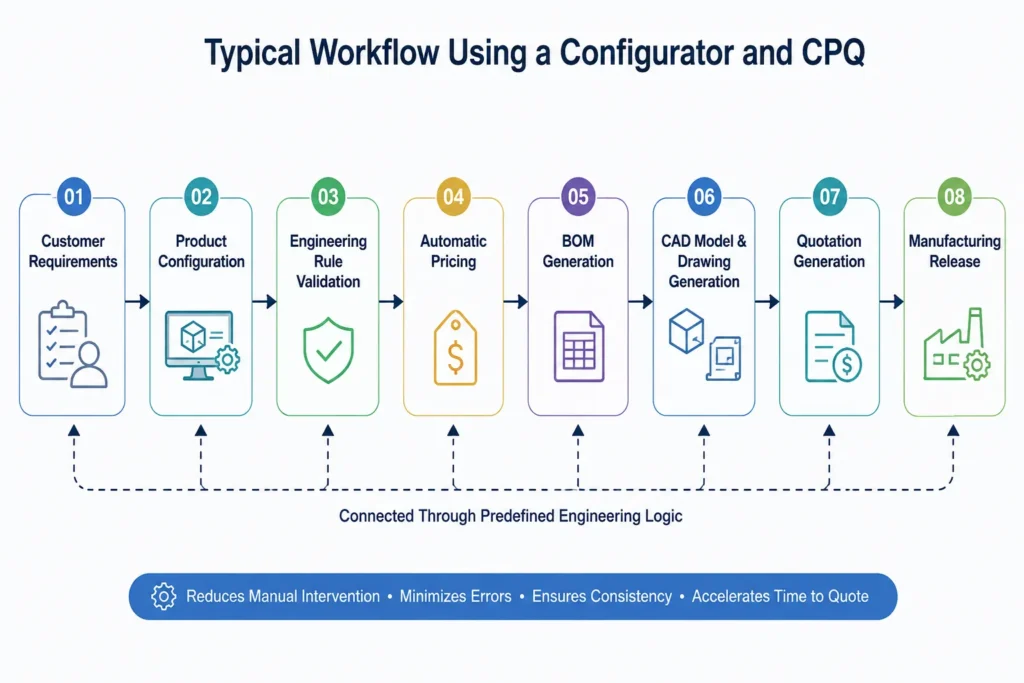
Every stage is connected through predefined engineering logic, reducing manual intervention and ensuring consistency.
Business Benefits of Rule-Based Configurators
Organizations implementing a Configurator with CPQ typically experience:
| Business Area | Improvement |
|---|---|
| Quotation Time | Reduced from days to minutes |
| Engineering Errors | Significantly reduced |
| Sales Productivity | Higher quotation capacity |
| Manufacturing Accuracy | Improved BOM consistency |
| Customer Experience | Faster response times |
| Engineering Workload | Reduced repetitive tasks |
| Pricing Accuracy | Standardized calculations |
| Knowledge Retention | Centralized engineering rules |
When Should a Manufacturer Invest in a Configurator?
A Rule-Based Configurator delivers the greatest value when your business:
- Offers configurable or customizable products
- Frequently prepares similar quotations
- Experiences engineering mistakes during sales
- Uses repetitive CAD modeling
- Relies on manual pricing spreadsheets
- Has long quotation turnaround times
- Faces repeated BOM errors
- Wants to scale sales without increasing engineering workload
If these challenges sound familiar, implementing a Configurator with CPQ can streamline your quotation process while improving engineering accuracy.
Future of Engineering Quotations
Manufacturing is rapidly moving toward digital engineering workflows where sales, engineering, and production operate on a unified platform.
Modern Configurator and CPQ solutions are increasingly integrating with:
- CAD Automation
- ERP Systems
- PLM Platforms
- Manufacturing Execution Systems (MES)
- AI-assisted product configuration
- Cloud-based engineering tools
This connected approach enables manufacturers to deliver faster quotations, reduce engineering effort, and maintain consistency from customer inquiry through production.
FAQs
A Rule-Based Configurator is software that uses predefined engineering rules to generate only technically valid product configurations, eliminating manual configuration errors.
CPQ stands for Configure Price Quote. It automates product configuration, pricing, and quotation generation while ensuring engineering and business rules are followed.
A Configurator prevents invalid product combinations, automates component selection, generates accurate BOMs, and applies standardized engineering rules across every quotation.
Yes. Modern Configurators can integrate with CAD platforms such as SOLIDWORKS, Autodesk Inventor, and Siemens NX to automatically generate 3D models, drawings, and manufacturing files.
Manufacturers of configurable products, including industrial equipment, sheet metal products, laboratory furniture, process equipment, machinery and material handling systems, benefit the most from Configurator and CPQ implementations.
Conclusion
Engineering errors during quotation are often caused by manual configuration, disconnected pricing processes, and inconsistent engineering validation.
A Rule-Based Configurator combined with a CPQ (Configure Price Quote) system eliminates these issues by enforcing engineering rules, automating product configuration, generating accurate pricing, and producing manufacturing-ready documentation.
For manufacturers handling configurable products, this approach shortens quotation cycles, improves engineering consistency, reduces costly mistakes, and creates a scalable foundation for future growth.
At Immersiv Techsphere, we develop customized Configurator, CPQ, and CAD Automation solutions that help manufacturers automate repetitive engineering workflows, standardize product configuration, and accelerate the journey from customer inquiry to production.
Have a Project in Mind?
Need help with 3D animation, industrial visualization, HSE training animation, or product visualization? Tell us about your project and our team will get back to you.