

Table of Contents
Introduction
Every manufacturing company faces the same challenge:
How do you ensure that assembly knowledge is transferred accurately from engineering teams to production workers, service technicians, and new hires?
For decades, assembly manuals have been the standard solution. Today, many manufacturers are replacing or supplementing them with assembly animation.
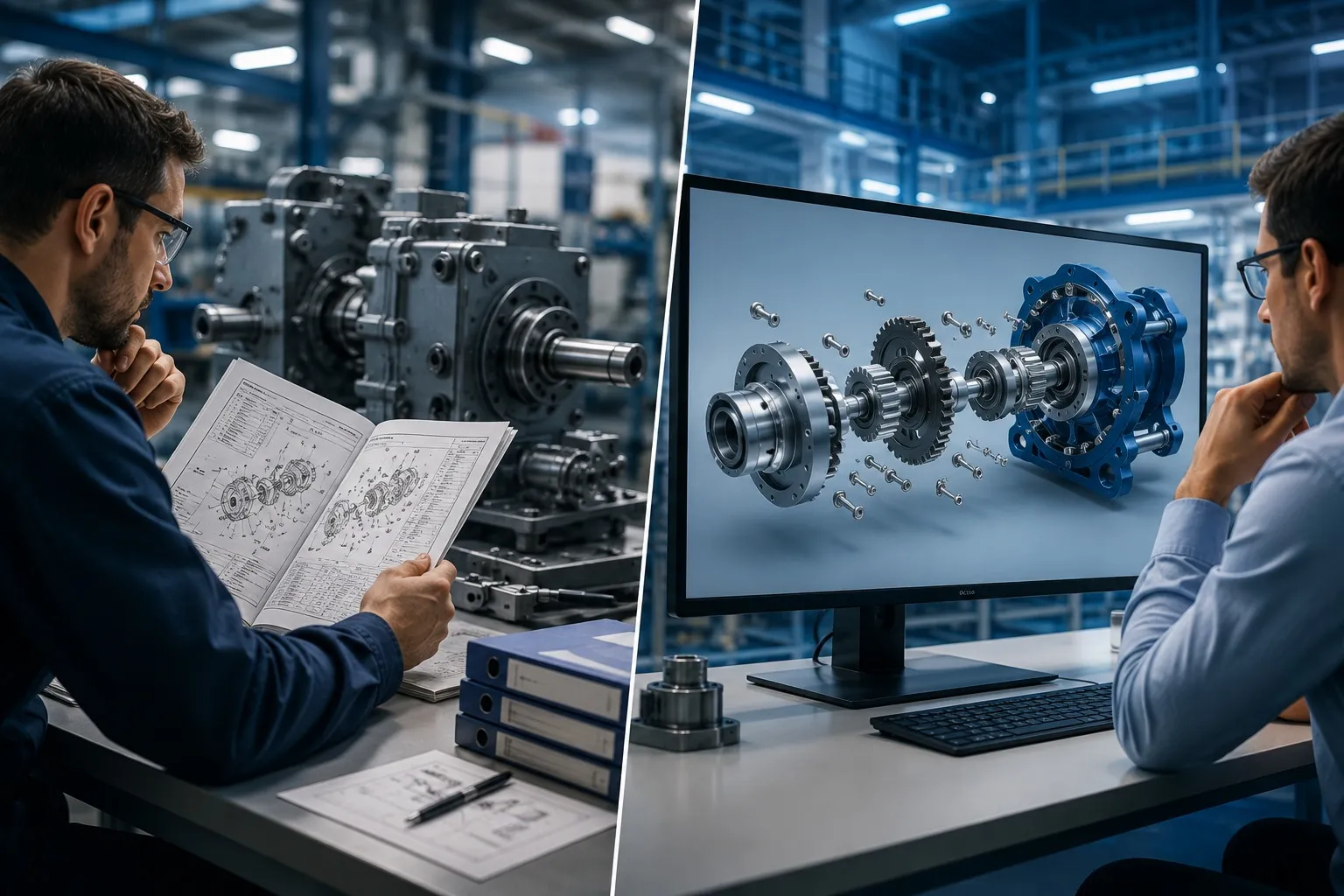
Both methods aim to communicate the same information, but they produce very different results when it comes to learning speed, retention, and error reduction.
So which one actually improves knowledge transfer?
Assembly animation is generally more effective for training and knowledge retention, while assembly manuals remain essential for documentation and compliance.
Let’s examine why.
What is Knowledge Transfer in Manufacturing?
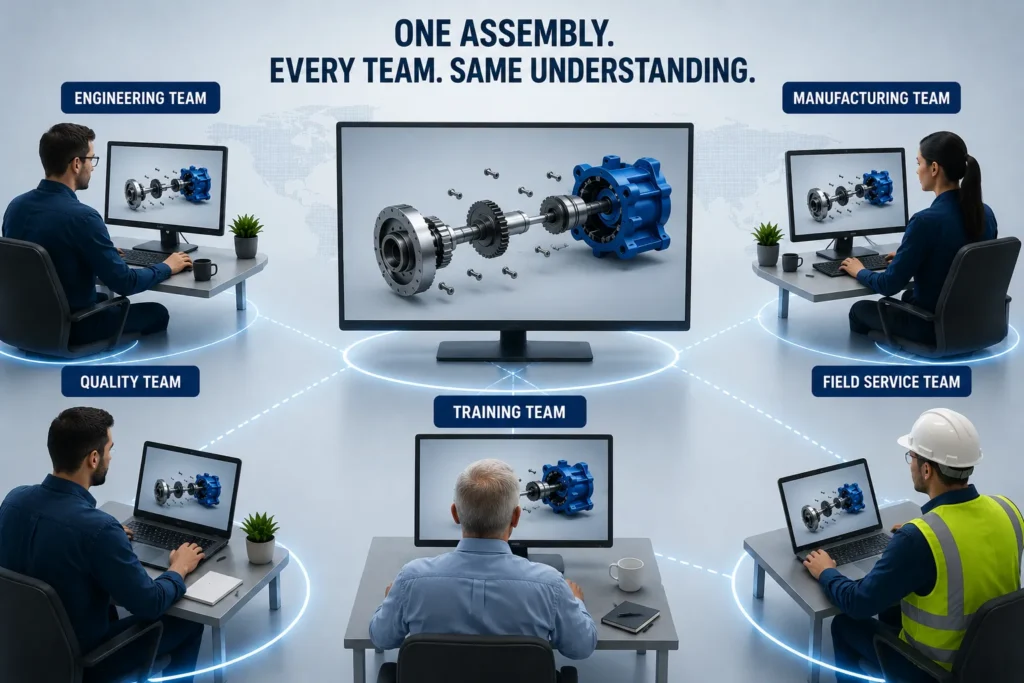
Knowledge transfer refers to the process of communicating assembly procedures, product knowledge, best practices, and operational instructions from one group of people to another.
Examples include:
- Training new operators
- Explaining assembly sequences
- Teaching maintenance procedures
- Documenting product installation methods
- Standardizing production processes
When knowledge transfer fails, companies experience:
- Assembly errors
- Rework
- Increased training costs
- Longer onboarding periods
- Quality issues
Assembly Manuals: The Traditional Approach
Assembly manuals rely on:
- Written instructions
- Engineering drawings
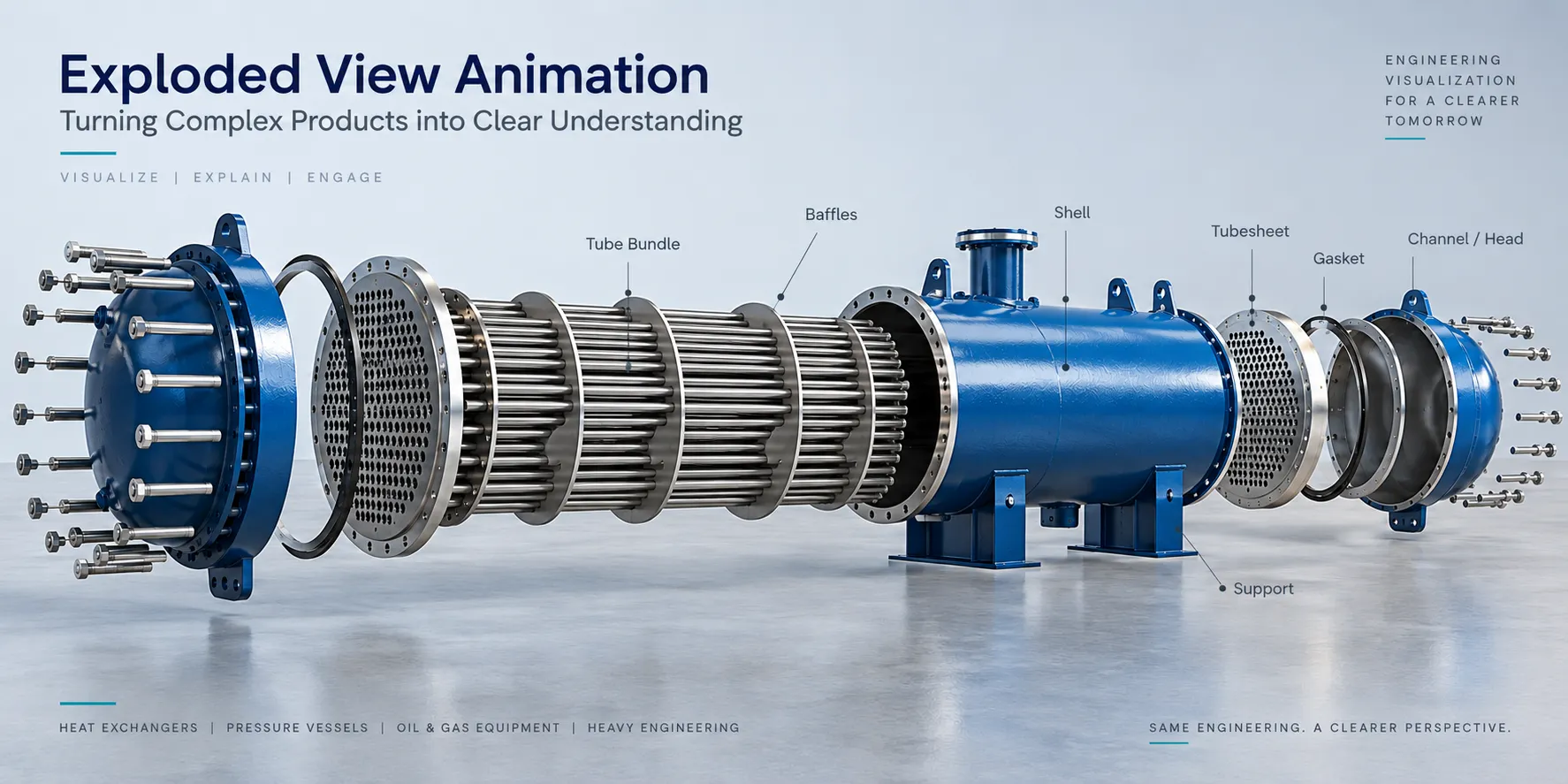
- Exploded views
- BOM references
- Sequential assembly steps
They are effective because they provide a permanent documented reference.
However, manuals require workers to interpret information rather than simply observe it.
This creates challenges when assemblies become complex.
Assembly Animation: The Visual Learning Approach
Assembly animation converts CAD data into a visual step-by-step process.
Assembly animation is one of the most effective applications of industrial animation, helping manufacturers communicate assembly procedures, maintenance workflows, and training processes through visual storytelling.
Instead of reading instructions, users watch the assembly procedure unfold.
Workers can instantly understand:
- Which component is installed first
- How parts align
- Which direction components move
- Where fasteners are placed
- Which tools are required
This dramatically reduces the need for interpretation.
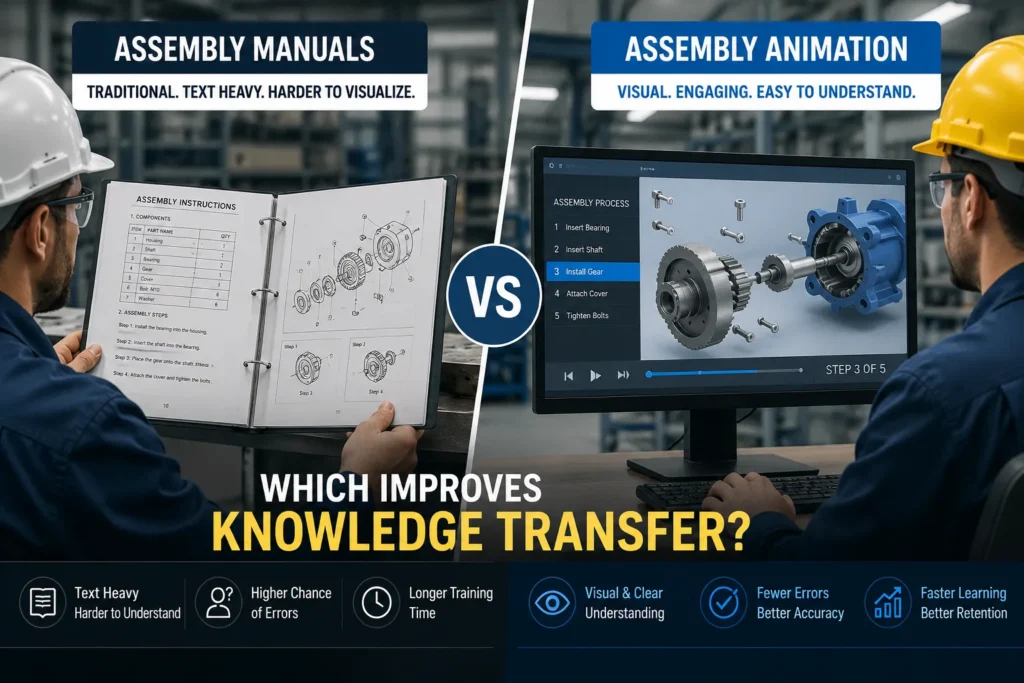
Assembly Manuals vs Assembly Animation: Side-by-Side Comparison
| Factor | Assembly Manuals | Assembly Animation |
| Learning Speed | Moderate | High |
| Information Retention | Moderate | High |
| Error Prevention | Moderate | High |
| Language Independence | Low | High |
| Training Effectiveness | Moderate | High |
| Compliance Documentation | High | Moderate |
| User Engagement | Low | High |
| Complex Assembly Communication | Moderate | High |
Why Assembly Animation Improves Knowledge Transfer
1. Humans Process Visual Information Faster
Workers can understand a moving assembly sequence in seconds.
The same procedure may require several pages of instructions in a manual.
Visual learning reduces cognitive effort and improves understanding.
2. Eliminates Interpretation Errors
One of the biggest causes of assembly mistakes is misunderstanding instructions.
Animations show exactly:
- What happens
- When it happens
- How it happens
There is far less room for interpretation.
3. Speeds Up Employee Onboarding
New employees often require weeks of supervised training.
Assembly animations provide repeatable visual training that can be viewed anytime, supporting more effective workplace training and faster onboarding.
This reduces dependency on experienced trainers while ensuring consistent knowledge transfer across teams.
4. Supports Global Manufacturing Teams
Assembly manuals often require translation.
Animations communicate processes visually, making them easier to understand across multiple languages and locations.
5. Makes Complex Assemblies Easier to Understand
Modern industrial equipment can contain hundreds or thousands of components.
A static image cannot always communicate:
- Assembly order
- Hidden components
- Internal mechanisms
- Motion paths
Animation solves this problem.
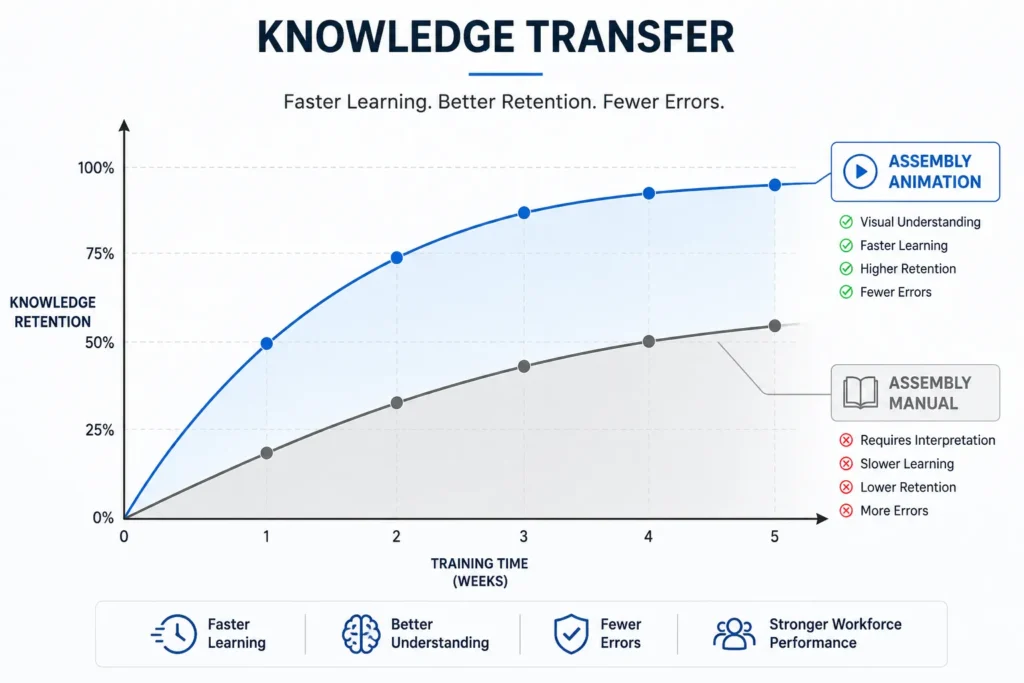
When Assembly Manuals Still Make Sense
- Assembly manuals remain valuable for compliance requirements, audit records, customer documentation, and adherence to engineering documentation standards.
- Manuals continue to play an important role in quality management systems and process documentation.
The most effective manufacturers do not replace manuals.
They combine manuals with animation.
The Best Approach: Use Both Together
The highest-performing manufacturers typically use:
Assembly Animation For:
- Training
- Onboarding
- Visual work instructions
- Customer demonstrations
- Service procedures
Assembly Manuals For:
- Documentation
- Compliance
- Technical reference
- Quality management systems
Together they create a complete knowledge transfer system.
How Immersiv Techsphere Helps Manufacturers Improve Knowledge Transfer
Immersiv Techsphere develops assembly animations that transform complex engineering data into clear, engaging visual instructions.
Our team works with existing CAD models to create:
- Product Assembly Animations
- Manufacturing Training Videos
- Installation Procedure Animations
- Maintenance Training Content
- Interactive SOP Visualizations
The result is faster learning, reduced assembly errors, and more effective knowledge transfer across manufacturing teams.
Beyond assembly training, manufacturers also use factory walkthrough animations to visualize production facilities, explain manufacturing workflows, and improve communication with stakeholders and project teams.
FAQs
For training and knowledge retention, yes. Assembly animation provides visual learning that is easier to understand and remember.
Yes. By clearly showing assembly sequences and component placement, animations reduce interpretation mistakes.
Yes. Manuals remain important for compliance, documentation, and technical reference purposes.
Industrial equipment, automotive, aerospace, furniture, machinery, and process industries all use assembly animations to improve training and communication.
Conclusion
If the goal is documentation, assembly manuals remain essential.
If the goal is knowledge transfer, workforce training and error reduction, assembly animation is the clear winner.
As manufacturing products become more complex and workforce training becomes more challenging, visual learning tools are no longer optional, they are becoming a competitive advantage.
Have a Project in Mind?
Need help with 3D animation, industrial visualization, HSE training animation, or product visualization? Tell us about your project and our team will get back to you.