

Table of Contents
Introduction
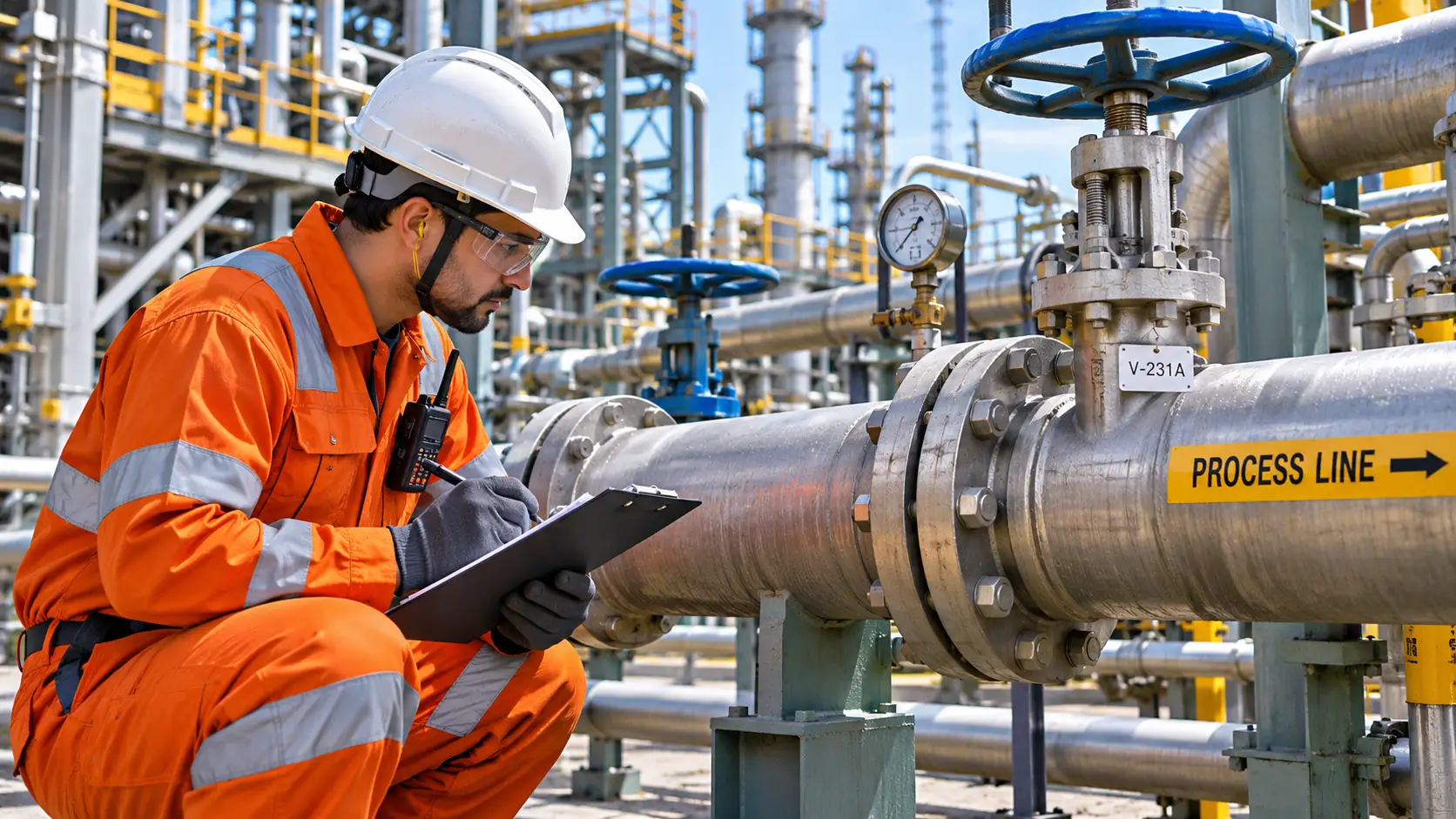
Opening a pipeline, removing a flange, disconnecting a pump or replacing a valve may appear to be routine maintenance activities in a process plant. However, these jobs can expose workers to hazardous chemicals, hot fluids, pressurised gases, toxic vapours and other dangerous substances.
This is where Line Breaking Safety becomes critical.
Line breaking is any activity that involves intentionally opening a pipe, pipeline, vessel, equipment or process system that contains or has previously contained hazardous substances. Even after a process is stopped, residual pressure or trapped material can remain inside the system.
A small mistake during isolation or depressurization can result in chemical exposure, fire, explosion, burns or serious injuries.
So, how can maintenance teams ensure that a pipeline is safe to open? The answer lies in a controlled line breaking procedure that includes proper isolation, depressurization, draining, purging and verification before work begins.
Let’s understand the essential safety steps.
What Is Line Breaking in Process Plants?
Line breaking refers to the intentional opening of a process system by loosening a connection, removing a component, cutting a pipe or breaking a flange joint.
Common line breaking activities include:
- Removing or replacing pipeline valves.
- Opening flanged connections for maintenance.
- Disconnecting pumps, compressors and process equipment.
- Removing strainers, filters and pipeline sections.
- Cutting or modifying existing pipelines.
- Opening equipment for inspection and cleaning.
- Replacing gaskets, fittings and mechanical connections.
These activities are common in chemical plants, refineries, oil and gas facilities, pharmaceutical manufacturing and other industrial environments.
However, the main concern is not simply opening the equipment. It is understanding what the pipeline contains, what energy remains inside it and whether the system has been made safe for maintenance.
Why Is Line Breaking Safety Important?
A process pipeline may contain hazardous materials even when the equipment is shut down.
Closing a valve does not automatically make a pipeline safe. Pressure can remain trapped between valves, liquid may collect in low points, and hazardous gases can remain inside the system.
Some of the major hazards associated with line breaking include:
1. Residual Pressure Release
Trapped pressure can cause sudden fluid or gas discharge when a flange or connection is opened. This can result in flying components, chemical spray or high-pressure exposure.
2. Chemical Exposure
Pipelines carrying acids, caustic chemicals, hydrocarbons or toxic substances can expose workers to harmful materials during opening.
3. Fire and Explosion
Flammable gases, vapours or liquid residues can ignite if they come into contact with an ignition source.
4. Thermal Hazards
Hot process fluids, steam and heated equipment can cause severe burns. Cryogenic materials can also cause cold burns and tissue damage.
5. Toxic Gas Exposure
Some process systems may contain hydrogen sulphide (H2S), ammonia or other toxic substances. Even a small release can create a serious exposure risk.
6. Unexpected Process Re-entry
Incorrect isolation, leaking valves or accidental operation of connected equipment can allow hazardous material to enter the work area again.
These risks make it essential to follow a documented and approved line breaking procedure rather than relying on assumptions.
Essential Steps in a Safe Line Breaking Procedure
A safe line breaking activity should be planned, authorised and controlled through the facility’s permit-to-work and energy isolation systems.
The exact procedure depends on the process, material, equipment design and site-specific risk assessment. However, the following steps form an important part of a typical line breaking safety process.
1. Identify the Pipeline and Assess the Hazards
Before starting any maintenance activity, identify the exact pipeline or equipment that needs to be opened.
The maintenance team should review the latest P&ID (Piping and Instrumentation Diagram), process information and equipment details.
Important information includes:
- Material handled by the pipeline.
- Operating pressure and temperature.
- Potentially toxic, corrosive or flammable substances.
- Direction of flow and connected equipment.
- Possible trapped pressure or liquid pockets.
- Nearby equipment and potential sources of process re-entry.
A Job Safety Analysis (JSA) or task-specific risk assessment should identify the hazards and define the required control measures.
2. Obtain the Required Work Permit
Line breaking should not begin without the necessary authorisation.
A permit-to-work system helps ensure that the relevant operations, maintenance and safety teams understand the work scope and associated risks.
Depending on the activity, additional permits or precautions may be required for:
- Line breaking.
- Hot work.
- Confined space entry.
- Working at height.
- Electrical isolation.
The permit should clearly define the equipment, work location, isolation requirements, responsible personnel and emergency arrangements.
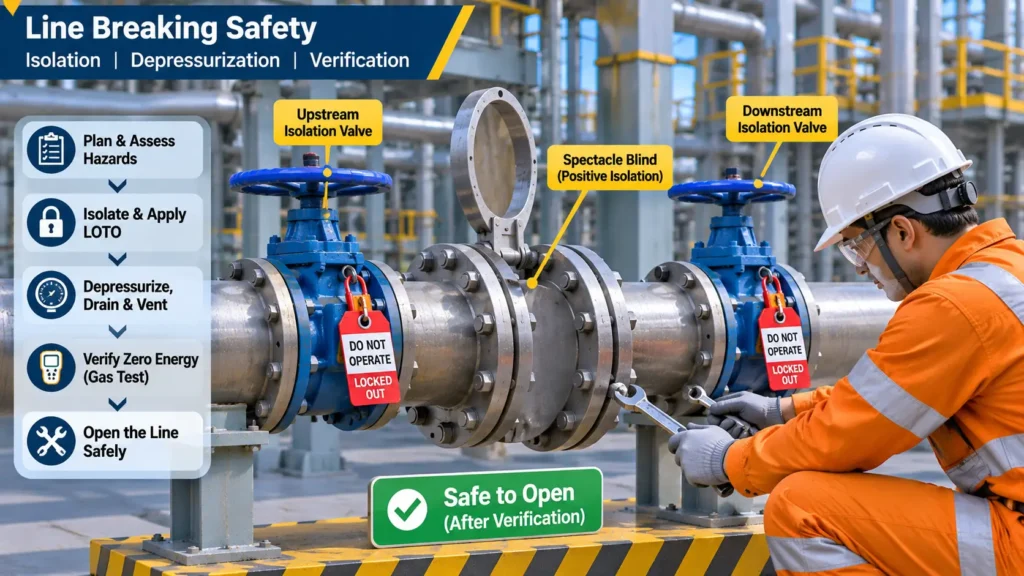
3. Isolate the Pipeline from All Energy Sources
Isolation is one of the most critical stages of line breaking safety.
The pipeline must be separated from all possible sources of hazardous material or energy. Simply closing a single valve may not provide adequate protection.
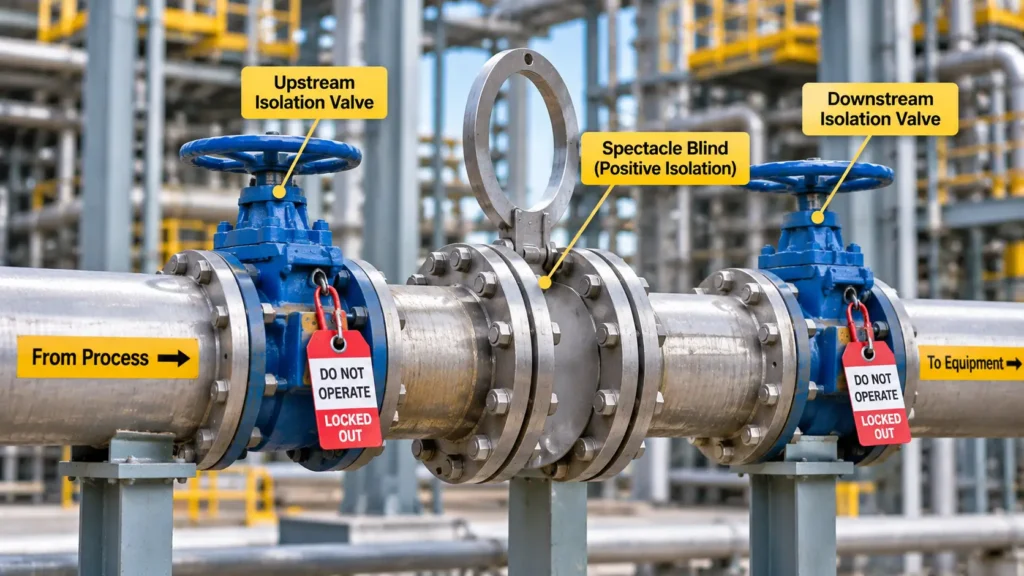
Depending on the system design and risk assessment, isolation methods may include:
- Positive isolation using blinds, spades or spectacle blinds.
- Physical disconnection or removal of a pipe section.
- Double block and bleed arrangements where approved and suitable.
- Other engineered isolation arrangements supported by the site’s isolation standard.
Positive isolation is generally preferred where the risk assessment requires a physical barrier between the work area and the live process.
The isolation points should be identified, checked and documented. Isolation devices should also be secured against accidental operation.
4. Apply Lockout/Tagout (LOTO)
Once the required isolation points are established, the applicable Lockout/Tagout (LOTO) procedure should be implemented.
LOTO prevents the accidental operation or re-energisation of equipment during maintenance.
Typical activities include:
- Locking isolated valves and relevant equipment.
- Applying identification tags.
- Isolating associated pumps, motors and electrical systems.
- Controlling stored mechanical, hydraulic or pneumatic energy.
- Recording isolation details in the isolation certificate or register.
Each isolation should be verified according to the facility’s energy control procedure.
It is important to remember that LOTO and process isolation are related but not interchangeable. A locked valve does not necessarily provide positive isolation from a hazardous process.
5. Depressurize, Drain and Vent the System
After isolation, the trapped material and stored pressure must be safely removed.
Depressurization involves reducing the internal pressure of the isolated pipeline or equipment to a safe condition.
Depending on the process, this may involve:
- Releasing pressure through designated vent points.
- Draining residual liquid through approved drain connections.
- Routing hazardous substances to a closed drain or recovery system.
- Purging the pipeline using an approved medium.
- Flushing or cleaning the system where required.
Never assume that a pressure gauge reading of zero means the pipeline is completely empty or free from hazardous material.
Blocked vents, trapped liquid pockets and faulty instruments can create misleading conditions.
The process must be completed in accordance with the approved operating and maintenance procedure.
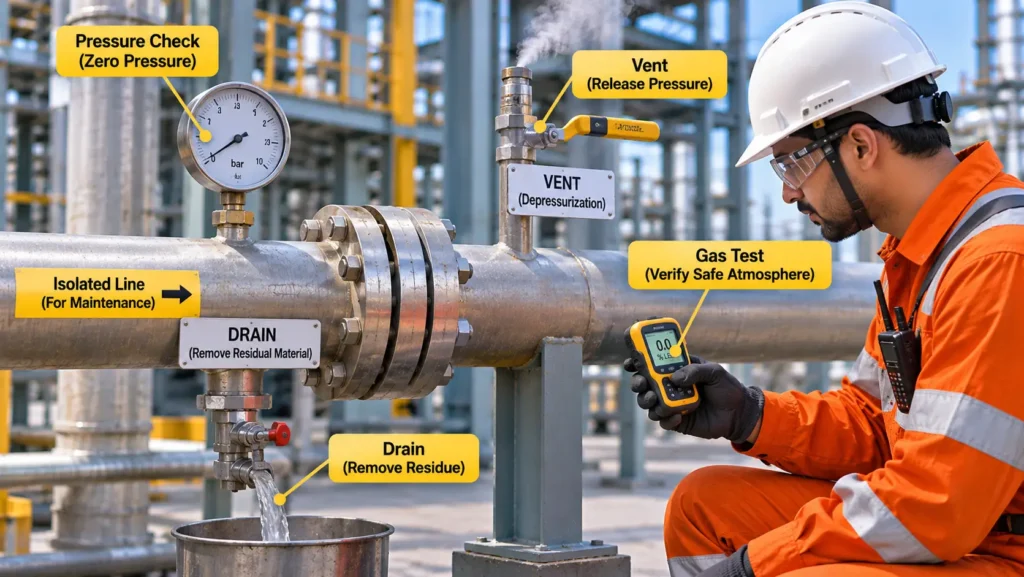
6. Verify Zero Energy and Safe Conditions
Depressurization is not complete until the safe condition has been verified.
This is one of the most important steps before physically opening a pipeline.
Verification may include:
- Checking pressure at appropriate points using suitable instruments.
- Confirming that designated vents and drains are clear and functioning.
- Checking for residual liquid or trapped material.
- Conducting gas testing where toxic, flammable or oxygen-deficient atmospheres are possible.
- Confirming that the isolation remains effective.
- Ensuring that the required equipment-specific zero-energy checks have been completed.
Gas testing should be performed by authorised personnel using calibrated and suitable gas detection equipment.
The type of testing will depend on the material previously handled and the hazards identified in the risk assessment.
Zero energy verification should not be treated as a single gauge check. It is a documented process to establish that all relevant hazardous energy and process materials have been controlled.
7. Prepare the Work Area and Use Appropriate PPE
Before opening the pipeline, ensure that the work area is prepared.
The maintenance team should confirm:
- Barricades and warning signs are installed.
- Unauthorised personnel are kept away.
- Emergency showers and eyewash stations are accessible where required.
- Suitable spill containment is available.
- Emergency response arrangements are understood.
- Workers have the required PPE.
PPE may include chemical-resistant gloves, protective clothing, safety goggles, face shields, safety footwear and respiratory protection, depending on the hazard assessment.
PPE should support engineering and procedural controls, not replace proper isolation.
8. Open the Pipeline Using a Controlled Method
Once all safety checks are completed and the permit is authorised for execution, the line can be opened using the approved method.
For flange breaking, workers should follow the site’s prescribed sequence and use suitable tools and equipment.
The initial opening should be performed cautiously, with personnel positioned away from the potential release path.
Where required by the risk assessment, additional containment, shielding or remote methods should be used.
If unexpected pressure, liquid, vapour or hazardous material is released, stop the activity, withdraw to a safe location and follow the emergency response procedure.
9. Monitor the Work and Restore the System Safely
Safety does not end once the pipeline has been opened.
The work area should be monitored throughout the maintenance activity. Any change in process conditions, isolation status or surrounding operations should be assessed.
After completing the maintenance:
- Confirm that all tools and temporary materials are removed.
- Inspect the pipeline and connections.
- Install the required gaskets, fittings and components.
- Complete the necessary pressure or leak testing.
- Ensure that personnel are clear of the equipment.
- Remove isolation devices only through the approved reinstatement process.
- Obtain the required authorisation before returning the system to service.
Proper documentation and handover are important to ensure that the process system is restored in a controlled manner.
Common Mistakes to Avoid During Line Breaking
Even experienced maintenance personnel can make mistakes when routine jobs are performed without sufficient planning.
Some common issues include:
Relying on a single closed valve: A valve may leak or fail to provide the required isolation. The isolation method must be based on the risk assessment and site isolation standard.
Assuming zero pressure means zero hazard: A pipeline may still contain toxic, flammable, corrosive or hazardous residues.
Ignoring trapped material: Low points, dead legs and blocked sections may retain liquids or gases.
Skipping gas testing: Hazardous atmospheres may remain even after draining and depressurization.
Using incorrect PPE: Protective equipment must be selected according to the chemical and physical hazards.
Starting work before permit approval: Maintenance should only begin after the required permits, isolation checks and authorisations are complete.
Avoiding these mistakes requires a combination of engineering controls, competent personnel, effective procedures and continuous safety awareness.
How 3D EHS Animation Can Improve Line Breaking Safety Training
Line breaking involves several sequential safety activities. Employees need to understand not only what each step involves but also why it is necessary.
Traditional training documents and toolbox talks are useful, but explaining hidden pipeline hazards, trapped pressure and isolation arrangements through static diagrams can be challenging.
This is where 3D EHS animation can make a difference.
A customised industrial safety animation can demonstrate:
- How hazardous materials remain trapped inside an isolated pipeline.
- The difference between valve isolation and positive isolation.
- Correct Lockout/Tagout procedures.
- Depressurization, draining and purging activities.
- Gas testing and zero-energy verification.
- Safe and unsafe methods of opening flanged connections.
- Possible consequences of incorrect line breaking practices.
For example, a 3D animated training sequence can show a maintenance worker opening a flange without proper depressurization, followed by a simulated release of pressurised process fluid. The animation can then demonstrate the correct isolation and verification sequence.
Such visual demonstrations help employees understand the consequences of unsafe actions without exposing them to actual workplace hazards.
3D EHS animations can be used for contractor induction, maintenance safety training, refresher programmes and task-specific safety communication.
How Immersiv Techsphere Supports Industrial Safety Training
At Immersiv Techsphere, we develop customised 3D EHS and HSE animation videos for industrial safety training and workplace awareness.
Our industrial animation capabilities help organisations convert complex engineering processes and safety procedures into clear visual learning content.
For activities such as line breaking, pipeline isolation, equipment maintenance and hazardous material handling, we can develop animations that demonstrate:
- Step-by-step safe work procedures.
- Correct isolation and LOTO practices.
- Depressurization and zero-energy verification.
- Potential hazards and consequences of unsafe practices.
- PPE requirements and emergency response actions.
These animations can be developed around a company’s actual equipment, plant layout, operating procedures and safety requirements.
The objective is to make technical safety information easier to understand, communicate and retain across different levels of the workforce.
Whether it is contractor induction, maintenance safety training or a customised industrial EHS training module, Immersiv Techsphere supports organisations in communicating safety procedures through visual storytelling.
Explore our Industrial EHS Animation Services to understand how customised 3D animation can support workplace safety training.
Frequently Asked Questions (FAQs)
Line breaking safety refers to the procedures and precautions followed before opening a pipeline, vessel or process equipment that contains or has previously contained hazardous substances. It includes hazard identification, isolation, depressurization, draining, verification and controlled execution.
Isolation prevents hazardous materials, pressure or energy from entering the section being opened. It helps protect maintenance personnel from unexpected releases, chemical exposure, fire and other process-related hazards.
Isolation separates the equipment from its energy or process sources. Depressurization removes stored pressure from the isolated section. Both are necessary, but neither automatically confirms that the system is free from hazardous residues.
Not necessarily. A closed valve may leak or fail to provide adequate protection. The required isolation method should be selected according to the process hazards, risk assessment and approved site isolation standard. Positive isolation may be necessary for higher-risk activities.
Zero-energy verification is the process of confirming that relevant stored energy and hazardous process conditions have been controlled before maintenance begins. It may involve pressure checks, drain and vent verification, gas testing and other equipment-specific checks.
Lockout/Tagout helps prevent the accidental operation or re-energisation of equipment during maintenance. It secures the identified energy isolation points and supports a controlled maintenance process.
PPE depends on the material, pressure, temperature and exposure risks. It may include chemical-resistant gloves, protective clothing, goggles, face shields, safety footwear and suitable respiratory protection. The selection must be based on the task-specific risk assessment.
3D EHS animation can visually demonstrate pipeline isolation, trapped pressure, draining, purging, gas testing and safe flange opening procedures. It helps employees understand complex safety steps and recognise the consequences of incorrect maintenance practices.
Conclusion
Line breaking may be a routine maintenance activity, but the hazards associated with opening process equipment should never be underestimated.
Proper isolation, depressurization, draining and zero-energy verification are essential before any pipeline or equipment is opened.
A documented line breaking procedure, effective permit-to-work system, competent personnel and appropriate PPE help reduce the risks associated with these activities.
Most importantly, every worker involved should understand the hazards and follow the approved site-specific safety procedure.
Because in process plant maintenance, confirming that a system is safe before opening it is just as important as completing the maintenance itself.
Have a Project in Mind?
Need help with 3D animation, industrial visualization, HSE training animation, or product visualization? Tell us about your project and our team will get back to you.