

Table of Contents
Introduction
Diwali is the festival of light, and for many families it is the happiest week of the year. However, Diwali fire incidents across India continue to raise serious concerns about public safety. Every year, firecracker accidents, residential fires and burn injuries turn celebrations into emergencies, affecting families, businesses and communities. Understanding the common causes of these incidents and following basic fire safety practices can help prevent accidents and make celebrations safer for everyone.
This article examines reported fire incidents during Diwali 2026, their impact on families and communities, and practical measures to prevent similar accidents.
Diwali Fire Incidents in 2026: Fires, Injuries and Lives Lost
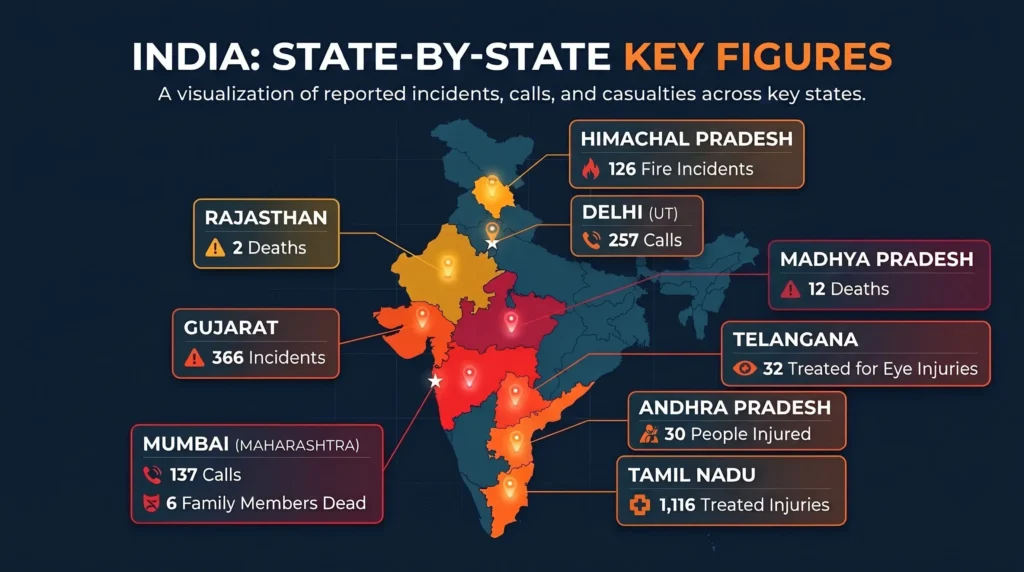
The figures below come from fire services, emergency-response agencies and news reports of Diwali night 2026. They are listed by region, with deaths reported in each. No official national count of Diwali-night fire deaths exists, and media tallies counted at least 23 deaths in fire incidents across India that night.
1. Delhi
Delhi Fire Services handled 257 emergency calls, with one fatality recorded. Of these, 214 were fire calls, and AIIMS reported 42 burn cases, 11 with major injuries.
The previous year’s tally was 269 calls, and 2024’s 318 calls were the highest in 13 years.
Deaths: a 10-year-old boy in Narela died after a firecracker exploded in his hand, and a 53-year-old man with 95% burns from a fire suspected to be firecracker-related died the next day.
2. Maharashtra
Mumbai: 137 firecracker-related fires were reported in a single day, more than the entire Diwali-period totals of 80 in 2024 and 113 in 2025, according to BMC data. Two women were injured. The Fire Brigade received 142 calls in all, and a Level-2 fire in Dongri destroyed more than 30 shacks and shops.
Pune: 63 fire incidents were recorded during Diwali.
Deaths: one person died in a residential building fire in Mumbai’s Lokhandwala. In Dharashiv, six members of a family died in a house fire that also housed a grocery store on the ground floor. The cause of death was asphyxiation, and police said preliminary reports suggest a diya.
3. Gujarat
Gujarat recorded 366 fire incidents on Diwali against a daily average of 55, and Surat and Ahmedabad topped the list.
The 108 service handled 5,934 calls against an average day’s 5,246, and 62 people had burn injuries.
No deaths from Gujarat appeared in the reports reviewed.
4. Madhya Pradesh
Deaths: twelve people died and four were injured in two fires in Seoni and Katni districts on Diwali night. Police said the cause had not been established, with a diya or electrical short circuit suspected. An elderly person also died in a fire in Ujjain. The state government announced ₹4 lakh ex gratia for each bereaved family.
5. Rajasthan
Deaths: two people were killed when a fire broke out at a firecracker shop in Falna, Pali district, around 10 PM, and three shops were gutted.
6. Odisha
Death: a 6-year-old boy died in a Cuttack house fire that fire officials said was triggered by late-night fireworks, after which three gas cylinders exploded.
7. Tamil Nadu
The Fire and Rescue Services reported 1,116 people treated for firecracker injuries, 131 of them admitted and 985 sent home after treatment.
Death: at least one child died of burn injuries.
8. Telangana
At least 32 people, mostly children, were treated for eye injuries at Sarojini Devi Eye Hospital in Hyderabad.
9. Andhra Pradesh
30 people were injured in Diwali-related fire incidents.
10. Himachal Pradesh
126 fire incidents were recorded during the Diwali period.
11. Uttar Pradesh
A scrap shop was gutted in Banda on Diwali night.
Sources: Delhi Fire Services data, The Tribune · ANI via India Gazette (214 fire calls, AIIMS burn cases) · Delhi 2025 calls, Business Standard · Delhi 2024 calls, The Tribune · Narela incident, Yahoo News · Fatalities across states, Deccan Herald · Mumbai BMC data, National Herald · Mumbai Fire Brigade, Time News · Pune and state-wise incidents, news · Dharashiv fire, Xinhua · Gujarat 108 data, Deccan Chronicle · Gujarat, Gujarat Samachar · Madhya Pradesh fires, ThePrint (PTI) · Madhya Pradesh cause, National Herald · Odisha, Telangana, Ujjain, ETV Bharat · Rajasthan, Mumbai and Uttar Pradesh, Kalinga TV · Tamil Nadu injuries, Wellthrise · National tally, Dainik Jagran · Andhra Pradesh, Deccan Chronicle · Himachal Pradesh, UNI
Property Damage and Business Losses from Diwali Fires
Firecracker accidents and residential fires can cause significant property damage during Diwali. A single spark can destroy homes, shops, stored materials and valuable belongings. Beyond the immediate damage, affected families and business owners may face financial difficulties and loss of livelihood.
Reported incidents across India highlight the importance of fire prevention and responsible celebrations.
- Himachal Pradesh: estimated property loss of ₹1.01 crore across the Diwali period, while fire personnel saved property worth ₹30.80 crore.
- Andhra Pradesh: a regional fire officer reported ₹25 lakh in damage from one major fire at Rajam and ₹27 lakh across twelve minor incidents.
- Uttar Pradesh: the owner of the Banda scrap shop estimated losses of ₹20–25 lakh and attributed the fire to firecrackers thrown into the premises.
- Maharashtra: in Mumbai, more than 30 shacks and shops were destroyed in the Dongri fire.
- Rajasthan: three shops were gutted in the Falna firecracker shop fire.
Sources: Himachal Pradesh, UNI · Andhra Pradesh, Deccan Chronicle · Banda and Falna, Kalinga TV · Dongri fire, Time News
When the Damage Doesn’t End with the Fire
The lasting impact of a fire accident is seldom visible in the statistics.
- Burns leave permanent marks. Scars from deep burns do not fade fully. A child with a facial or hand burn carries it into school, work and every photograph.
- Eye injuries can change a life. Many of those treated in Hyderabad were children.
- Livelihoods can disappear overnight. A shopkeeper whose stock is destroyed can lose years of savings and a family’s only income, as the shop fires in Mumbai, Pali and Banda show.
- Homes and belongings are lost. Families lose documents, savings and keepsakes along with the building.
- Families lose people. In Katni and Seoni, whole families were affected. In Narela and Cuttack, children died.
For survivors, the damage rarely ends when the flames are out. A family who loses someone on a festival often finds it hard to celebrate that festival again.
These losses are the reason this conversation matters. The goal is simple: everyone who lights a lamp on Diwali should be able to light one the next year too.
Diwali Firecracker Pollution and Its Impact on Public Health
Diwali celebrations can affect public health beyond the immediate risks of firecracker accidents and burn injuries. Smoke and particulate matter released by fireworks can deteriorate air quality, potentially increasing respiratory discomfort and other health concerns. Children, older adults and people with existing respiratory conditions may be particularly vulnerable to these effects.
Air quality worsened after Diwali in eight of the past nine years across NCR cities. Delhi’s AQI on Diwali 2026 was 376, against 345 in 2025 and 328 in 2024. The next morning, it stood at 371 at 10 am.
CPCB’s advisory says that readings of 301–400 cause respiratory illness on prolonged exposure, and 401–500 affect even healthy people. NCR hospitals reported nearly a 30% rise in patients with breathing difficulties, and Fortis hospitals recorded a 7–10% rise in OPD cases. Doctors advised N95 masks outdoors and said people aged 20–50 were also affected.
Sources: Delhi Diwali AQI series, Indian News Grid · Day-after averages, DT Next · Eight of nine years analysis, Down To Earth · CPCB health advisory, ETV Bharat · NCR hospital admissions, Down To Earth · Fortis data, The Daily Jagran · Doctors’ advice, Yahoo News
Cleaner Celebrations: Ways to Reduce the Impact
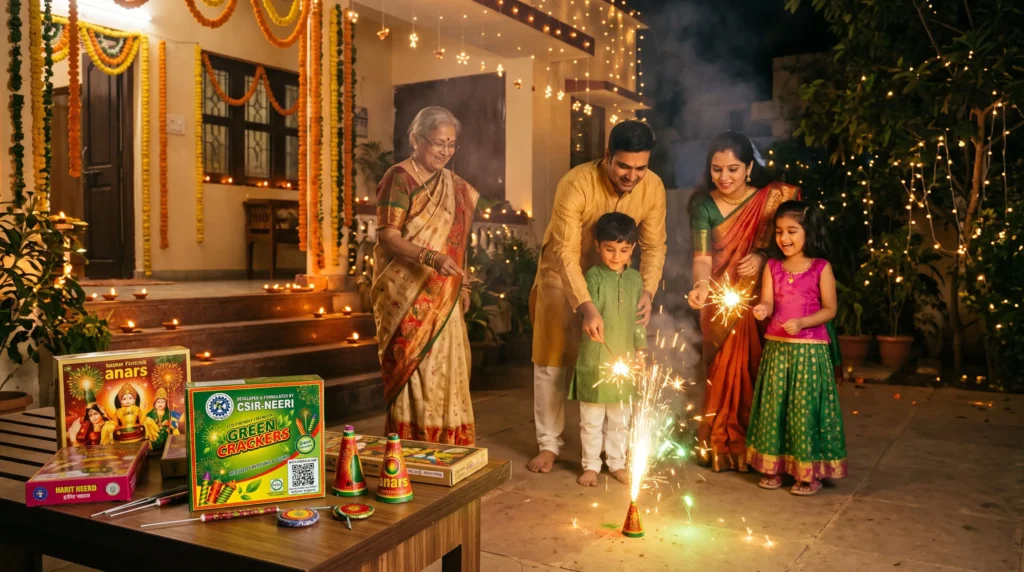
- Choose certified green crackers: CSIR-NEERI’s green crackers are designed to emit at least 30% less particulate matter than conventional ones, and their approved formulations exclude barium, lead, arsenic and mercury.
- Verify before you buy: Each pack should carry the CSIR-NEERI logo and a batch-specific QR code, and the manufacturer should appear on CSIR-NEERI’s registered list. CAQM has found QR codes sold to unregistered makers, so buy from authorized sellers.
- Use fewer, not just cleaner: Green crackers are not pollution-free, and the overall benefit depends on how many are burst.
- Protect vulnerable people: Keep children, older adults and people with asthma or heart conditions indoors and away from smoke and use N95 masks if you go out
Fire Safety During Diwali: Essential Household Precautions
Following basic fire safety precautions during Diwali can significantly reduce the risk of firecracker accidents, residential fires and burn injuries. Households, housing societies and commercial establishments should prepare for potential fire emergencies before celebrations begin. Simple preventive measures can help protect people, property and surrounding communities.
- Choose open spaces. Light fireworks in an open area, away from homes, shops, parked vehicles, dry material and wires. Never from balconies or inside buildings.
- Buy responsibly. Purchase from licensed sellers and follow the label instructions.
- Store carefully. Keep crackers in a cool, dry place away from diyas, candles and kitchens. Never keep large quantities at home or in a shop.
- Supervise children. Children should light fireworks only with an adult present, and younger children should watch from a distance.
- Dress for safety. Wear fitted cotton clothing, and keep dupattas, sarees and loose sleeves away from flames.
- Keep water ready. Keep a bucket of water or sand nearby, and a fire extinguisher where possible.
- Never relight a dud. Wait, then soak it in water.
- Protect your diyas. Keep lamps and candles away from curtains and decorations, and never leave them burning unattended.
- Know the numbers. Fire brigade: 101. Ambulance: 108.
- Treat burns correctly. Run cool (not ice-cold) water over the burn for several minutes and get medical help. Avoid ointments and home remedies.
- Check your building. Apartment residents should check fire exits, alarms and extinguishers before the festival.
A Brighter Way to Celebrate Together: Community Fireworks Shows
One effective idea is to move from many small displays to a few shared, professionally run ones.
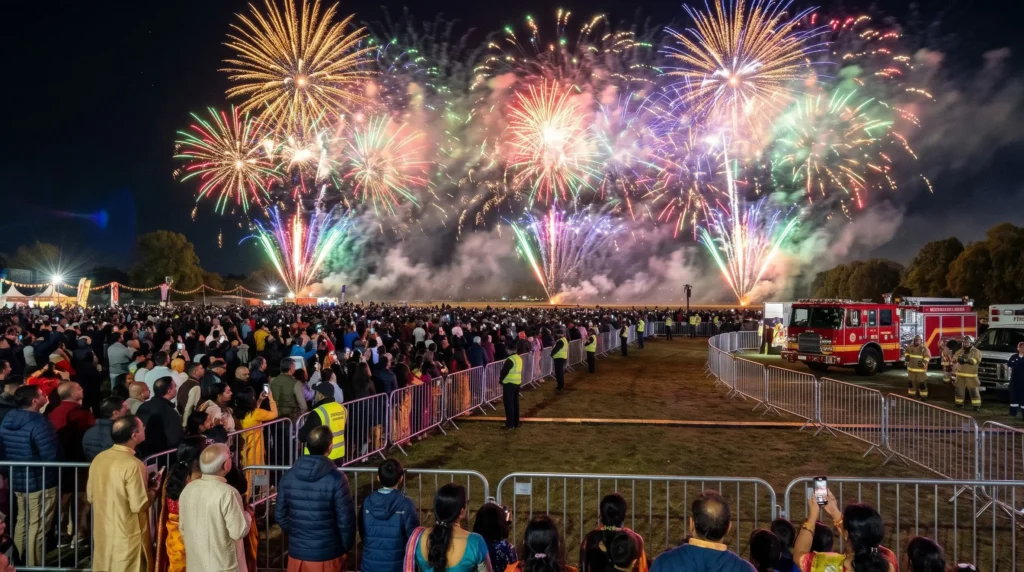
Imagine each city or large town hosting a Diwali fireworks evening in a big open ground. Licensed pyrotechnicians would run the show, with barricaded viewing areas, safe distances, and fire tenders and ambulances on standby. Families could come together to watch, and children would see a far bigger display than they could light at home.
- Trained handling: professionals manage ignition, spacing and wind conditions.
- Emergency readiness: medical and fire teams are present on site.
- Lower pressure on emergency services, which currently face a surge of calls within a few hours.
- A shared experience: neighbours, schools, housing societies and local clubs can celebrate together.
Housing societies and RWAs can start small, with one supervised display on society grounds, a marked safe zone and a volunteer fire-safety team. Local authorities and community groups can build on this with sponsored public displays under the right permissions.
Preventing Fire Accidents from Aerial Firecrackers and Rockets
Aerial firecrackers and rockets can increase the risk of fire accidents because their direction cannot be controlled once they are ignited. They may land on rooftops, balconies, windows or stored goods, potentially starting fires away from the original launch location. These risks are particularly concerning in densely populated residential and commercial areas.
Fire officials in Mumbai suspected rockets and other aerial firecrackers triggered three major fires on Diwali, in Dongri, Marol and Vidyavihar. Afterwards the city’s civic body banned rockets and similar aerial fireworks until 25 November, and Thane’s district administration issued a similar order. The ban does not cover all firecrackers, and it applies to both public and private spaces.
Restricting this one category, while leaving ground-based and certified fireworks in place, is a practical way to cut fire risk without taking away the celebration. Other cities and societies could also adopt these measures:
- Restrict aerial crackers and rockets in dense areas such as high-rises, slums, markets and narrow streets, where a stray rocket can reach homes and shops easily.
- Issue advance notices to housing societies with clear safe-celebration guidelines before Diwali.
- Set up local advisory boards with RWAs, fire officers, schools and community leaders to spread awareness.
- Monitor sellers to check that restricted crackers are not being sold and that stores are licensed and stocked safely.
- Set permitted hours and days for bursting fireworks, so emergency services can plan staffing and neighbours know what to expect.
- Define bursting zones. The Bombay High Court has said firecrackers should not be lit on footpaths or in public places in Maharashtra, and similar clear rules help elsewhere.
- Keep no-burst zones around hospitals, petrol pumps, godowns and crowded markets.
- Provide a complaint or helpline number for residents to report violations or unsafe displays.
- Apply penalties consistently and communicate them in advance, so rules are clear and fair to everyone.
Sources: Mumbai fire surge and restrictions, Free Press Journal · BMC order, India TV News · Official statement and Thane order, Deccan Chronicle · Scope of ban and Bombay High Court directions, Scroll
Diwali Fire Safety Awareness: The Role of Governments and Municipalities
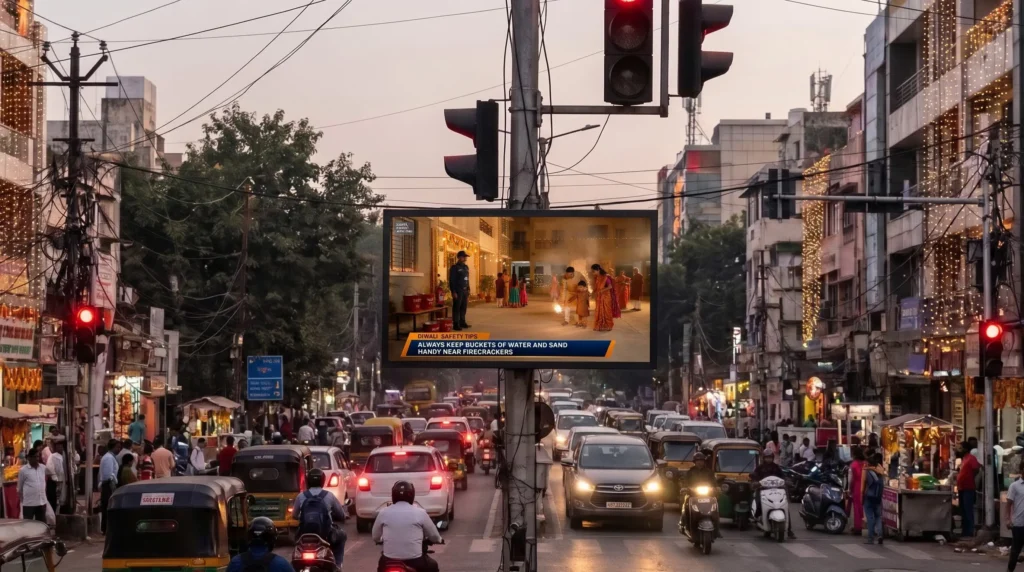
Public awareness plays an important role in preventing Diwali fire incidents. Municipal corporations, district administrations, fire departments and state disaster management authorities can help communities understand firecracker safety, emergency response and basic fire prevention practices. Coordinated awareness campaigns before Diwali can encourage responsible celebrations and reduce avoidable accidents.
- Pre-festival safety messaging in local languages through radio, TV, social media, newspapers and hoardings.
- School programmes that teach children safe bursting habits and basic first aid for burns.
- Awareness for sellers and market associations on safe storage, licensing and display of firecrackers.
- Public notices in housing societies and neighbourhoods about permitted hours, bursting zones and restricted products.
- Fire safety demonstrations at community grounds, markets and ward offices showing how to use an extinguisher and respond to a fire.
- Emergency information (fire 101, ambulance 108) shared widely, with simple burn first-aid instructions.
Consistent, easy-to-understand content helps these drives reach more people with the same message.
At Immersiv Techsphere, we can support such campaigns by producing animated safety content for government and municipal bodies, covering safe celebration practices, fire response and first aid for burns, in local languages and in formats suited to social media, screens at public events and school use.
Closing Thought
Diwali has always been about light, family and hope, and it is a tradition we pass on to our children. The way we celebrate today shapes the memories they carry forward, and the festival they will one day hand to their own families. Choosing safer ways to celebrate protects the people who make the festival special. When every family returns home safe and every child can look back on a Diwali filled with joy, the festival’s light is carried forward for generations to come.
Preventing Diwali fire incidents in India requires collective responsibility, public awareness and consistent fire safety practices. From using firecrackers responsibly to keeping emergency equipment ready, every precaution can help reduce fire accidents, burn injuries and property damage. Safer celebrations begin with informed decisions by individuals, families and communities. By prioritising fire prevention, we can preserve the spirit of Diwali while protecting lives and livelihoods.
Have a Project in Mind?
Need help with 3D animation, industrial visualization, HSE training animation, or product visualization? Tell us about your project and our team will get back to you.