

Table of Contents
Introduction
Manufacturing industries today are moving rapidly toward customizable and configurable products. From industrial equipment and sheet metal assemblies to modular systems and process equipment, customers increasingly expect tailored solutions with shorter lead times.
However, traditional product configuration and quotation workflows are often slow, repetitive, and heavily dependent on engineering teams. Manual calculations, spreadsheet-based configurations, pricing inconsistencies, and repeated validation processes create delays and increase the risk of errors.
This is where CPQ (Configure, Price, Quote) systems are transforming manufacturing workflows. By combining rule-based product configuration, automated pricing, engineering logic, and quotation generation, CPQ systems help manufacturers streamline both sales and engineering processes while improving accuracy and scalability.
What is CPQ System in Manufacturing?
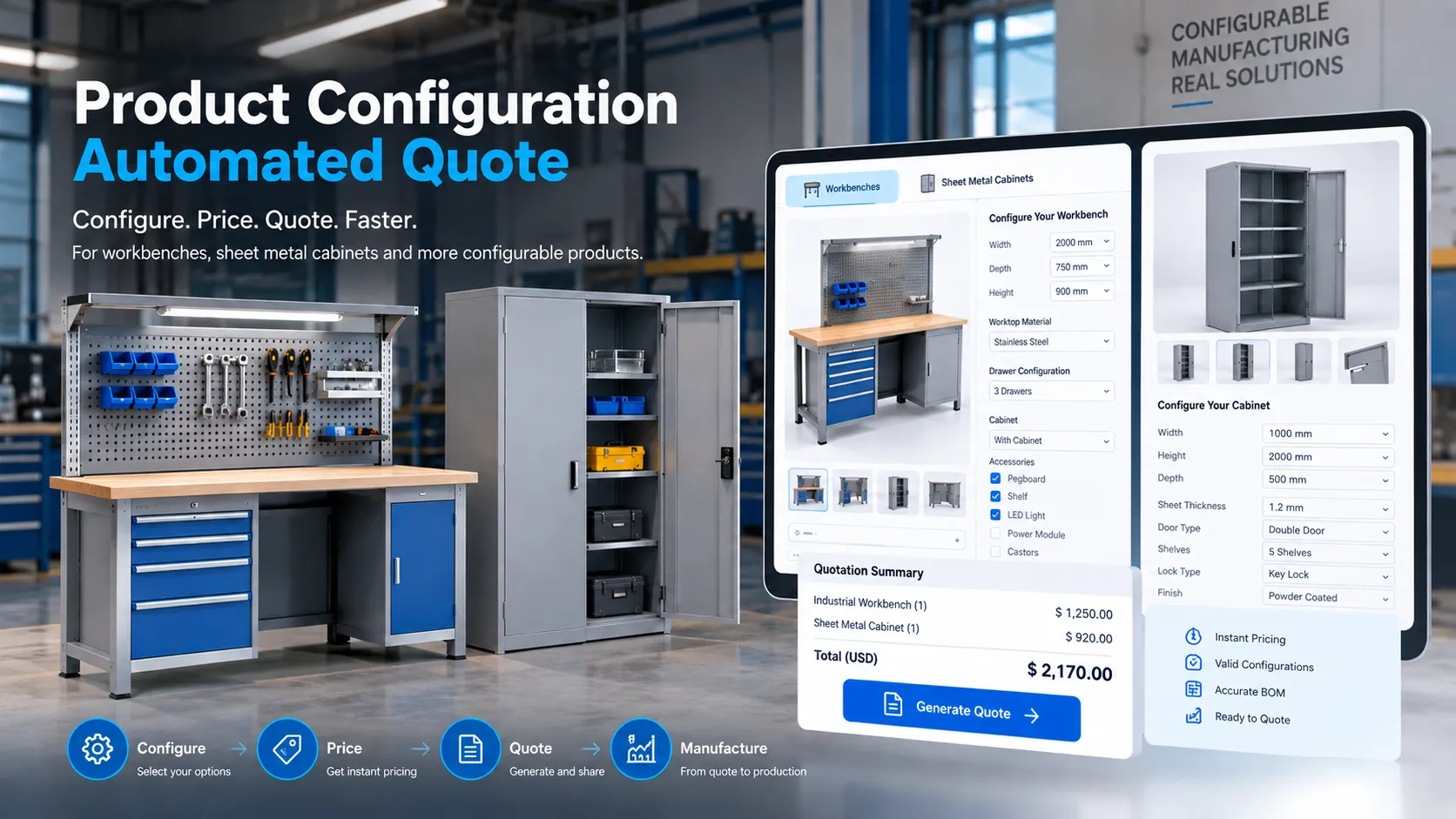
CPQ stands for Configure, Price, Quote – a system designed to automate product customization and quotation workflows for configurable products.
In manufacturing industries, CPQ systems allow businesses to create rule-based product configuration workflows where dimensions, materials, capacities, optional features, and engineering constraints are predefined within the system.
Instead of manually validating every product variation, the system automatically:
- Configures products based on user selections
- Validates engineering rules and dependencies
- Calculates pricing dynamically
- Generates BOMs and technical data
- Creates professional quotations instantly
Modern CPQ systems are commonly used in industries dealing with complex or highly configurable products where engineering involvement is traditionally repetitive and time-consuming.
Why Manufacturing Companies Struggle with Manual Product Configuration
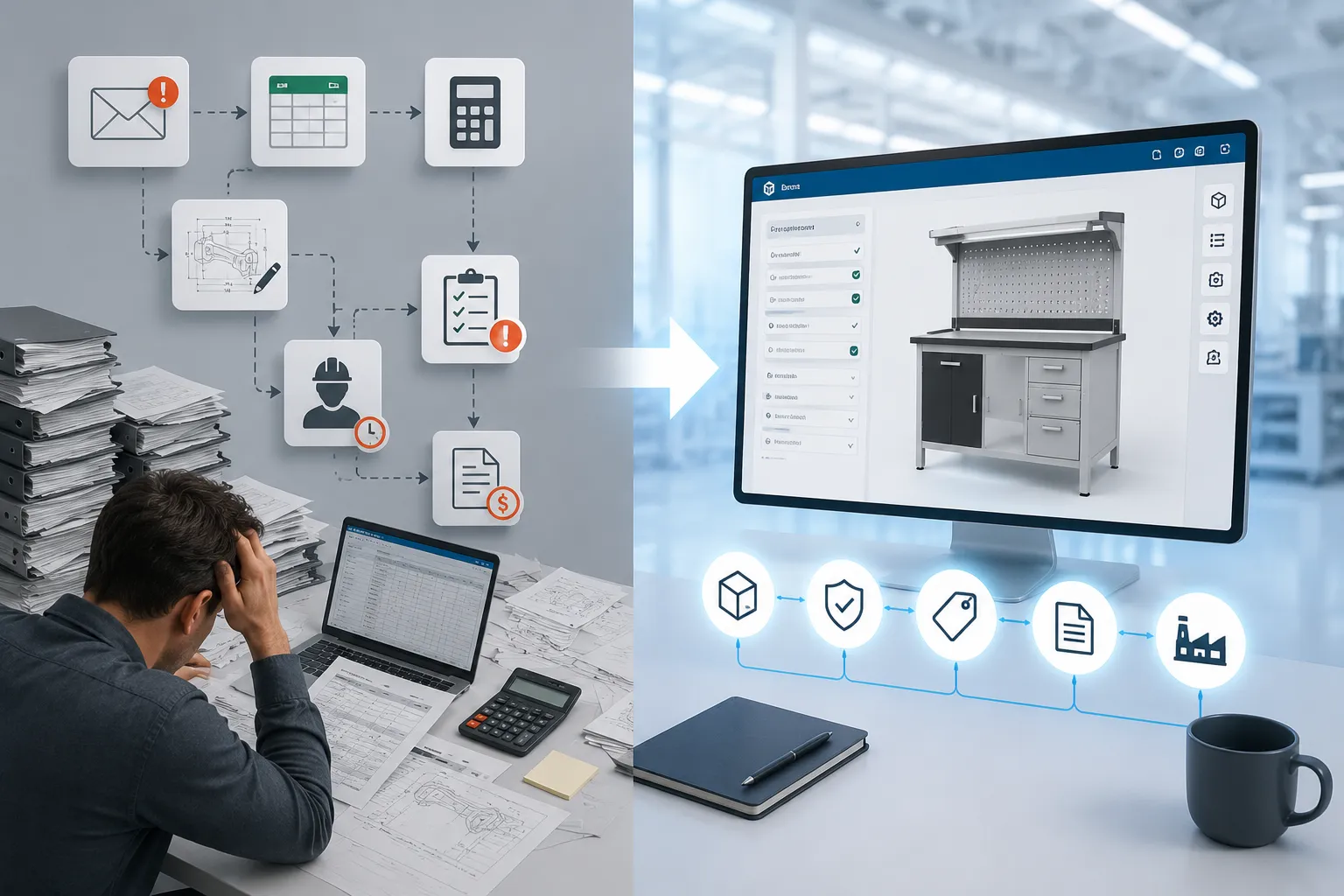
Many manufacturing companies still rely on manual workflows for handling customized products. While these methods may work initially, they become increasingly difficult to manage as product variations and customer requirements grow.
Common challenges include:
- Repetitive engineering calculations
- Manual quotation preparation
- Dependency on engineering approval for every configuration
- Incorrect product combinations
- Pricing inconsistencies
- Delayed customer response times
- Errors in BOM generation
- Difficulty managing multiple product variants
For industries such as mechanical engineering, sheet metal manufacturing, Furniture & hardware manufacturing and industrial equipment design, these repetitive processes consume valuable engineering time that could otherwise be focused on innovation and production optimization.
Without automation, scaling configurable product offerings becomes operationally difficult and prone to inconsistencies.
How Traditional Quotation & Configuration Workflows Slow Down Manufacturing:
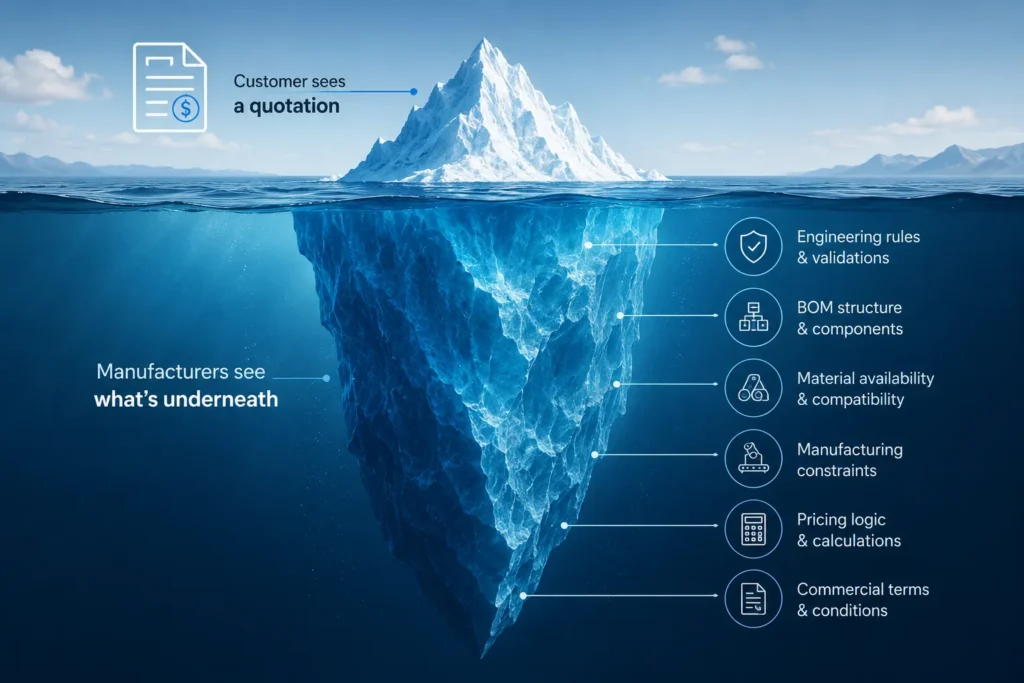
Traditional quotation and product configuration workflows often involve multiple departments, manual validations, repeated calculations, and engineering reviews before a quotation can be finalized.
This creates:
- Longer response times for customers
- Increased dependency on senior engineers
- Delays in production planning
- Higher probability of human errors
- Difficulties in handling complex product variations
- Inconsistent pricing structures
In fast-moving manufacturing environments, delayed quotations and inaccurate configurations can directly impact customer experience and project timelines.
Automated CPQ systems help streamline this process by reducing repetitive tasks and improving coordination between sales, engineering, and manufacturing teams.
Where CPQ Systems Are Used in Manufacturing Industries
CPQ systems are highly effective in manufacturing environments where configurable products, engineering logic, and repetitive documentation workflows are involved.
Common use cases include:
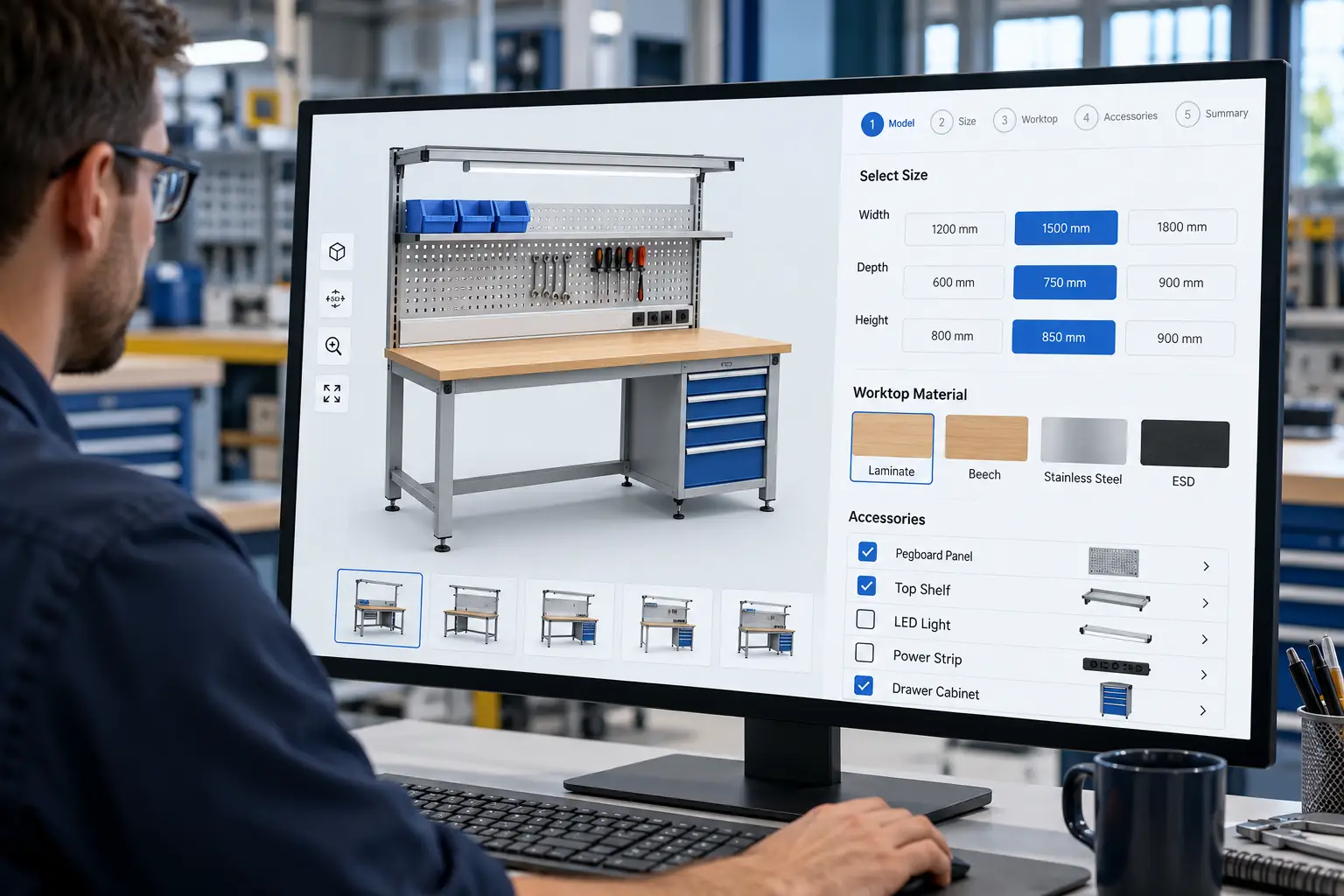
Product Configurators
Interactive systems that allow users or sales teams to configure products based on predefined engineering rules.
Rule-Based Engineering Automation
Automating validation of dimensions, material selections, capacities, and compatibility conditions.
Automated Quotation Systems
Generating quotations instantly with dynamic pricing based on product configuration inputs.
BOM & Documentation Generation
Automatically creating bills of materials and supporting technical documentation.
Web-Based Configurators
Online platforms that simplify product customization workflows for customers and sales teams.
Parametric Product Configuration
Managing configurable products with variable dimensions, components, and engineering dependencies.
Manufacturing Workflow Automation
Reducing repetitive engineering and documentation efforts across sales and production workflows.
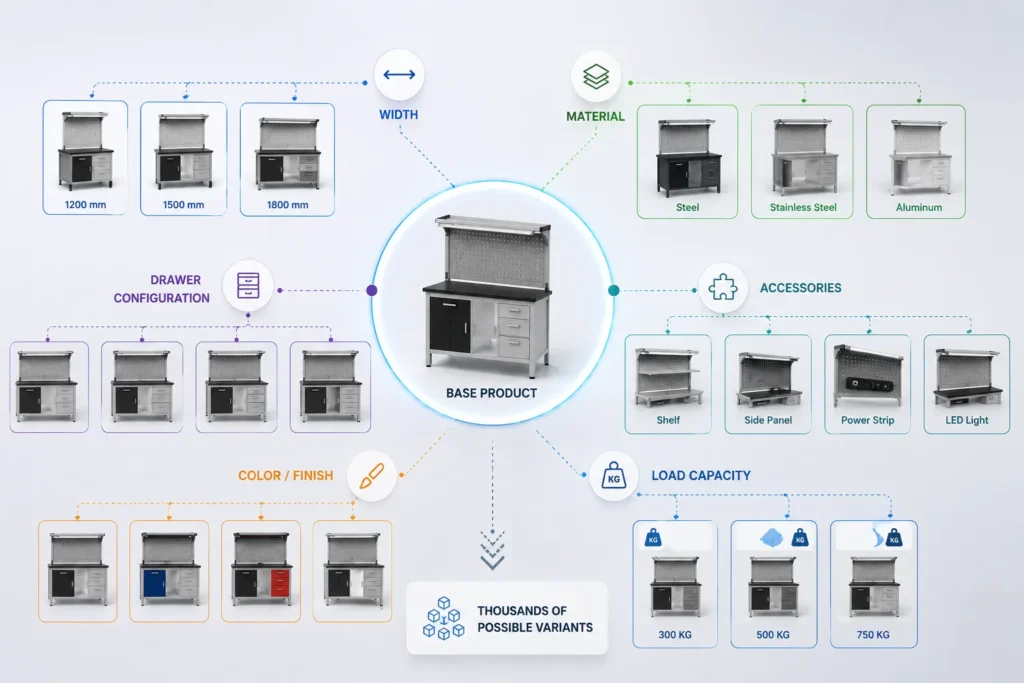
How Rule-Based Product Configurators Work
A modern CPQ workflow typically follows a structured automation process designed to improve speed, accuracy, and consistency.
Step 1 – Product Selection
The user selects the product category or base product model.
Step 2 – Configuration Inputs
Dimensions, material specifications, capacities, optional features, and performance requirements are selected.
Step 3 – Rule Validation
The system validates engineering constraints, compatibility rules, and manufacturing limitations automatically.
Step 4 – Automated Pricing
Pricing is calculated dynamically based on selected configurations, manufacturing complexity, quantity, and material usage.
Step 5 – BOM & Technical Data Generation
The system generates BOMs, configuration summaries, and supporting technical information.
Step 6 – Quotation Generation
A professional quotation is generated instantly with accurate specifications and pricing.
Step 7 – Integration with Engineering & Manufacturing
Approved configurations can be integrated with CAD systems, ERP systems, or manufacturing workflows for further processing.
How CPQ Systems Improve Engineering & Sales Efficiency
CPQ systems provide significant operational and engineering advantages for manufacturing companies handling configurable products.
Key benefits include:
- Faster quotation generation
- Reduced repetitive engineering efforts
- Improved configuration accuracy
- Standardized engineering workflows
- Reduced dependency on manual calculations
- Faster customer response time
- Better coordination between sales and engineering teams
- Lower risk of manufacturing errors
- Improved scalability for customized products
- Streamlined documentation and approval workflows
By automating repetitive processes, manufacturers can focus more on productivity, innovation, and operational efficiency.
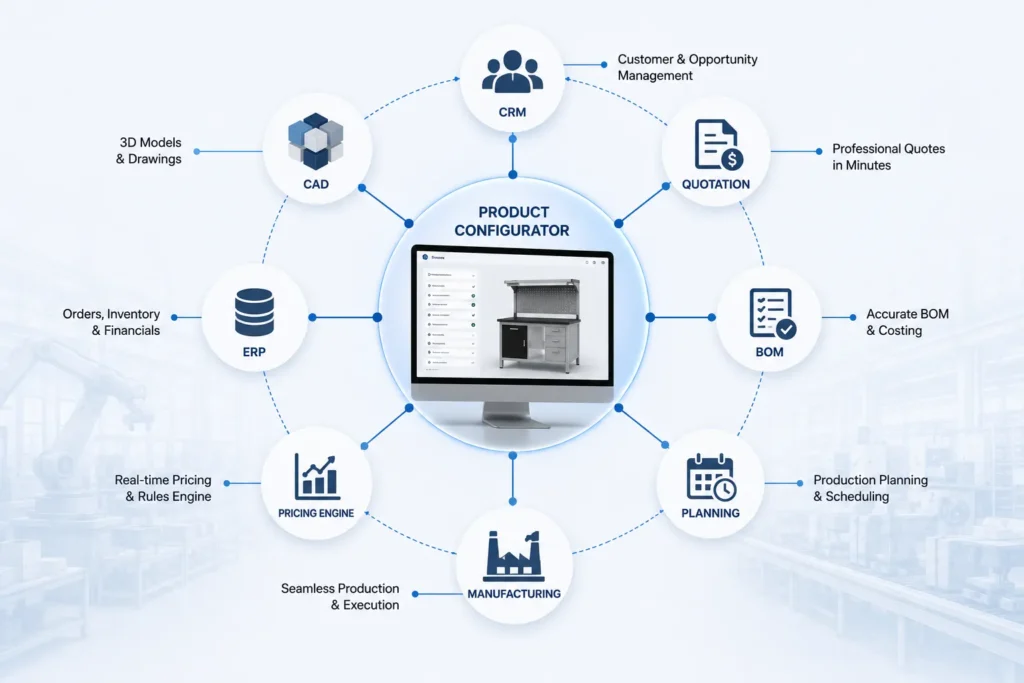
Industries Benefiting from CPQ & Product Configuration Automation
CPQ systems are widely adopted across industries that deal with configurable products and engineering-driven manufacturing workflows.
Industries benefiting from CPQ systems include:
- Mechanical Engineering
- Sheet Metal Manufacturing
- Industrial Equipment Manufacturing
- Modular Furniture Systems
- Process Equipment Industry
- Water Treatment Systems
- HVAC Equipment
- Structural Fabrication
- Fitness Equipment Manufacturing
- Industrial Product Manufacturing
These industries often require flexible product customization while maintaining manufacturing accuracy and workflow standardization.
Technologies Behind Modern CPQ Systems
Modern CPQ systems combine multiple technologies to automate engineering and manufacturing workflows effectively.
Key technologies include:
- Rule-based configurators
- CAD automation
- SolidWorks API integration
- Parametric modeling
- Web-based configuration systems
- ERP integration
- Automated documentation systems
- Real-time pricing engines
- Cloud-based workflow platforms
- 3D visualization tools
The integration of these technologies helps manufacturers reduce repetitive efforts while improving workflow consistency, accuracy, and scalability.
How CAD Automation & CPQ Work Together
CAD automation and CPQ systems together create a highly efficient engineering workflow for configurable products.
When integrated properly, CAD automation systems can automatically:
- Generate parametric CAD models
- Create manufacturing drawings
- Update dimensions and configurations
- Generate BOMs
- Standardize documentation
- Reduce repetitive modeling tasks
This integration significantly reduces manual engineering efforts while improving accuracy and consistency across design and manufacturing workflows.
For manufacturing industries dealing with multiple product variants, CAD automation combined with CPQ creates a scalable and standardized configuration process.
Engineering Automation Solutions by Immersiv Techsphere
Immersiv Techsphere supports manufacturing industries with engineering-focused automation solutions for configurable products and process optimization.
Our expertise includes:
- Rule-based product configurators
- CAD automation using SolidWorks API
- Automated drawing and documentation generation
- Parametric product configuration systems
- Web-based configurator development
- Engineering workflow automation
- BOM automation
- Industrial visualization and rendering
- Manufacturing process optimization
- Configurator support for engineering-driven products
Our approach focuses on reducing repetitive engineering efforts while improving speed, standardization, and manufacturing efficiency for configurable product workflows.
FAQs
A CPQ system automates product configuration, pricing calculations, and quotation generation for customizable manufacturing products.
CPQ systems automate repetitive calculations, product validation, pricing, and documentation workflows using predefined engineering rules.
Yes. Modern CPQ systems can integrate with CAD platforms such as SolidWorks for automated design and engineering workflows.
Industries such as mechanical engineering, sheet metal manufacturing, industrial equipment, modular furniture, and process equipment manufacturing benefit significantly from CPQ systems.
A rule-based configurator automatically validates product configurations using predefined engineering and manufacturing rules.
Yes. CPQ systems can generate BOMs and technical documentation automatically based on configuration inputs.
Why CPQ Systems Are Becoming Essential for Modern Manufacturing
As manufacturing industries continue moving toward customized and configurable products, CPQ systems are becoming increasingly important for improving operational efficiency and reducing repetitive engineering efforts.
By automating product configuration, pricing, quotation generation, and engineering workflows, manufacturers can improve response times, reduce errors, and scale product customization more effectively.
Modern CPQ systems not only streamline sales and engineering coordination but also create a more standardized, scalable, and efficient manufacturing workflow for configurable products.
Looking to automate your product configuration and engineering workflows?
Immersiv Techsphere helps manufacturing industries develop rule-based configurators, CAD automation systems, and engineering workflow solutions tailored to configurable products and manufacturing operations.
Get in touch with our team to discuss your CPQ and manufacturing automation requirements.
Have a Project in Mind?
Need help with 3D animation, industrial visualization, HSE training animation, or product visualization? Tell us about your project and our team will get back to you.