

Table of Contents
Introduction
Working at height is a routine part of many industrial activities. Whether it involves maintenance on elevated platforms, construction work, roof inspections, or equipment installation, employees often need to perform tasks several feet above the ground.
But have you ever considered how quickly a routine task at height can turn into a serious workplace incident?
A missing guardrail, an unsecured ladder, an incorrect harness connection, or a slippery working surface can create a serious fall hazard. Sometimes, workers are aware of these risks but fail to recognise them while concentrating on the task.
This is where effective Working at Height Safety Training becomes important.
Instead of relying entirely on written instructions or classroom presentations, organisations can use visual training methods, including 3D EHS animations, to demonstrate fall hazards, explain safe working practices, and help employees understand how to prevent accidents before they happen.
Let’s explore how visual safety training can make working at height safer and more practical for industrial workplaces.
Why Is Working at Height Considered a High-Risk Activity?
Working at height involves any work where a person could fall and suffer personal injury. It is commonly associated with construction sites, manufacturing plants, warehouses, industrial facilities, and maintenance operations.
The risk is not limited to working on rooftops or tall structures. Even working from a ladder, mobile elevated work platform (MEWP), scaffold, or raised maintenance platform can expose employees to fall hazards.
What makes these activities particularly risky is that accidents can happen during seemingly simple tasks.
For example:
- An employee climbs a ladder without checking whether it is stable.
- A maintenance worker operates near an unprotected platform edge.
- A worker uses a safety harness but connects it to an unsuitable anchorage point.
- Tools or materials are left near an elevated working area and create additional hazards.
- A scaffold is used without proper inspection or adequate edge protection.
These situations demonstrate why working at height safety training should focus on actual workplace conditions rather than simply explaining safety rules.
Common Fall Hazards Employees Should Recognise
Before discussing prevention measures, employees need to understand what can cause a fall. Identifying hazards is one of the most important parts of effective height safety training.
1. Unprotected Edges and Openings
Working platforms, rooftops, and elevated structures can become dangerous when edges are not properly protected.
Missing guardrails, uncovered floor openings, and unsecured access points can expose workers to unexpected falls.
Employees should understand the importance of edge protection, suitable barriers, and proper workplace inspection before starting any task.
2. Unsafe Ladder Usage
Ladders are commonly used for inspection, maintenance, and other short-duration activities. However, incorrect positioning and improper usage can increase the risk of falling.
Common mistakes include:
- Placing ladders on uneven or slippery surfaces.
- Using damaged ladders.
- Overreaching while working.
- Carrying heavy materials while climbing.
- Failing to maintain three points of contact when climbing.
Training should demonstrate how to inspect, position, secure, and use ladders safely. It should also explain when a ladder is unsuitable and a safer work platform is required.
3. Improper Scaffold Setup and Use
Scaffolding provides temporary access to elevated working areas, but an incorrectly assembled or inadequately inspected scaffold can create serious fall hazards.
Employees should recognise the importance of stable foundations, proper platforms, guardrails, toe boards, safe access, and inspection by competent personnel.
A scaffold should never be used if it is incomplete, damaged, or identified as unsafe.
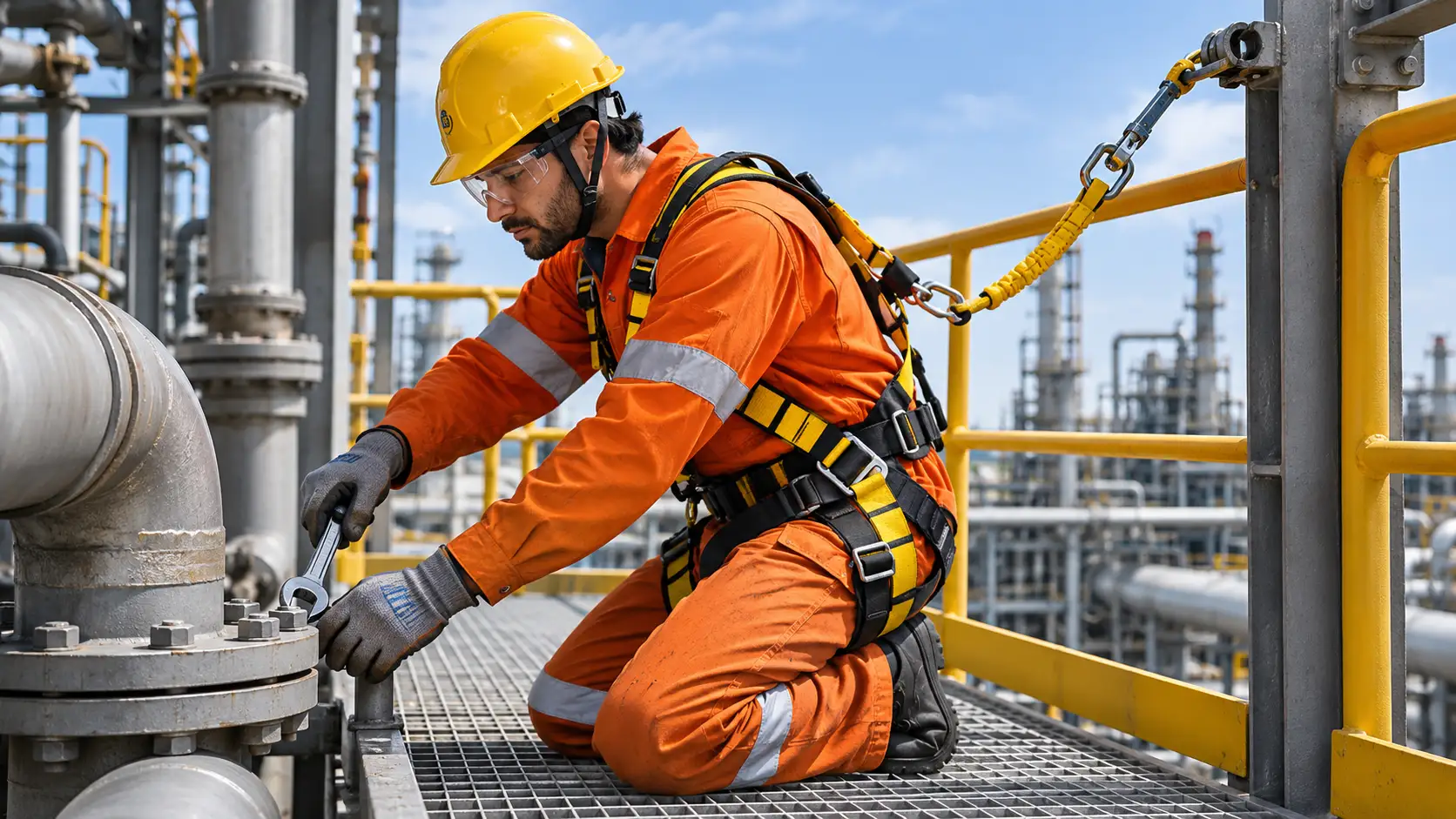
4. Incorrect Use of Personal Fall Protection Equipment
Personal fall protection equipment is an important part of working at height safety. However, simply wearing a harness does not guarantee protection.
Incorrect harness fitting, damaged lanyards, unsuitable anchorage points, and improper connections can compromise the entire fall protection system.
Employees must understand how to inspect their equipment, wear a full-body harness correctly, connect to approved anchorage points, and follow the site-specific fall protection procedure.
Essential Prevention Measures for Working at Height
Recognising fall hazards is only the first step. Employees must also understand what actions they should take before and during elevated work.
An effective working at height safety programme should cover the following prevention measures.
1. Conduct a Risk Assessment Before Starting Work
Every working-at-height activity should begin with a risk assessment.
Before work starts, supervisors and employees should identify:
- The height and nature of the work.
- Potential fall hazards and unprotected edges.
- Weather conditions, including strong winds and rain.
- The condition of ladders, scaffolds, and working platforms.
- Suitable access and fall protection arrangements.
- Emergency access and rescue requirements.
The objective is to identify hazards before employees are exposed to them.
2. Prioritise Collective Fall Protection
Where possible, organisations should eliminate the need to work at height. If this is not reasonably practicable, they should prevent falls through suitable working platforms, guardrails, barriers, and other collective protection measures.
Personal fall protection equipment should be selected based on the task and the assessed risks.
For example, a properly guarded working platform generally provides protection to everyone using it, whereas a safety harness requires individual inspection, correct fitting, suitable anchorage, and appropriate training.
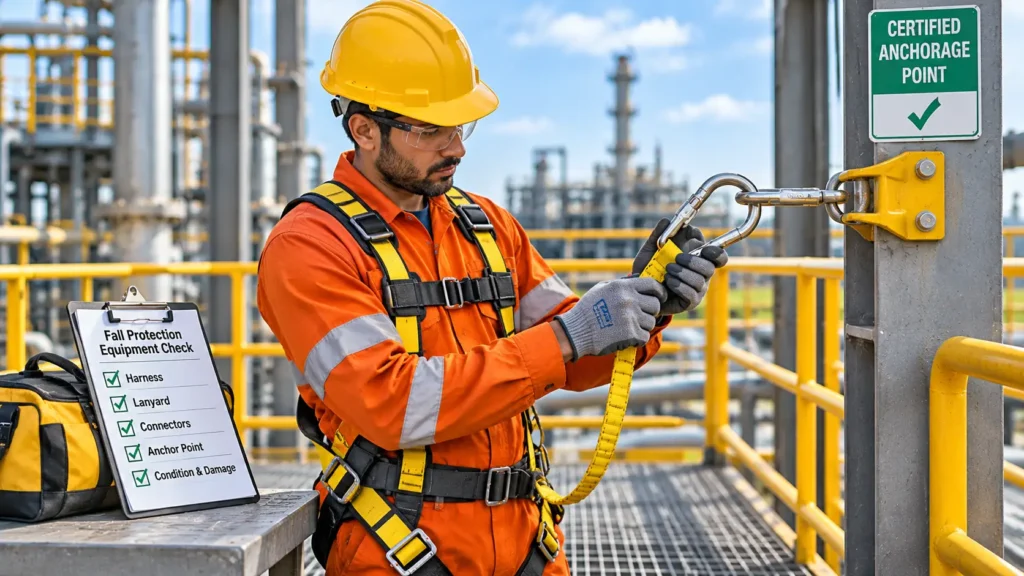
3. Inspect Safety Equipment Before Use
Safety equipment should be inspected before every use, in accordance with the manufacturer’s instructions and site procedures.
Employees should check:
- Harness webbing for cuts, tears, and damage.
- Buckles and adjustment mechanisms.
- Lanyards and connectors.
- Lifelines and anchorage arrangements.
- Ladders and scaffolding components.
- Safety helmets and other required PPE.
Damaged or defective equipment should be removed from service and reported immediately.
4. Maintain Three Points of Contact While Climbing
When climbing a ladder, employees should maintain three points of contact wherever practicable. This means keeping two hands and one foot, or two feet and one hand, in contact with the ladder.
Workers should avoid carrying tools in their hands while climbing. Suitable tool belts, lifting arrangements, or other safe methods should be used instead.
They should also avoid overreaching or making sudden movements that could affect their balance.
5. Establish a Fall Rescue Plan
Fall prevention is essential, but organisations must also prepare for emergencies.
A worker suspended in a fall arrest harness may experience serious medical consequences if rescue is delayed. Therefore, having a suitable rescue plan is just as important as providing fall protection equipment.
A rescue plan should identify:
- Emergency communication procedures.
- Available rescue equipment.
- Trained rescue personnel.
- Safe access to the suspended worker.
- Procedures for providing immediate assistance.
Employees should know what to do if a colleague falls and becomes suspended in a harness. Simply calling emergency services without a timely site-specific rescue response may not be sufficient.
How 3D EHS Animation Makes Working at Height Safety Training More Effective
Explaining fall hazards through written procedures is important, but not every employee can easily visualise how an unsafe action may lead to an accident.
Consider a worker standing on an elevated platform without a guardrail. A safety presentation might explain the risk, but a 3D animation can demonstrate the entire situation.
It can show how the worker approaches the platform edge, loses balance, and falls due to inadequate protection. The same scene can then be presented again with the correct preventive measures.
This makes 3D EHS animation a practical approach for demonstrating workplace hazards and safe operating procedures.
Here are some ways visual training can improve employee understanding.
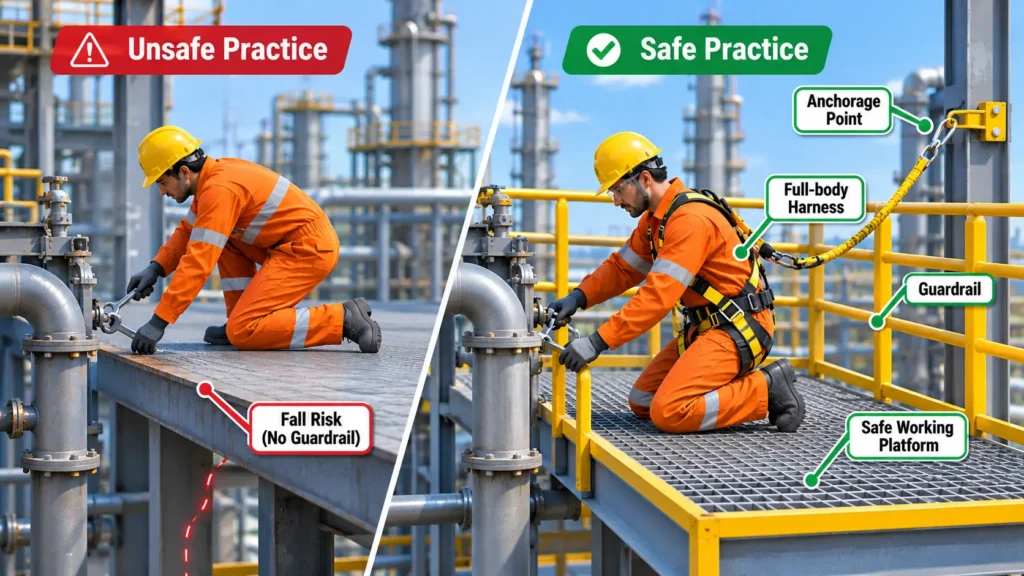
1. Demonstrating Unsafe and Safe Work Practices
A 3D animation can present two versions of the same activity.
In the first scenario, a worker uses an unsecured ladder or works near an unprotected edge. In the second, the worker follows the correct safety procedure.
This side-by-side comparison helps employees recognise the difference between unsafe and safe behaviour.
Watch: Working at Height Safety Training in Action
Understanding fall hazards becomes easier when employees can see how safety procedures are applied in real workplace situations.
Watch this video to understand working at height safety practices, recognise potential fall risks, and learn the importance of appropriate fall protection measures.
Watch the video: https://youtu.be/A10FcBMKqNQ?si=RWeq4vqRJM5XaDtG
2. Visualising Fall Accident Scenarios
Some workplace incidents are difficult to demonstrate through live training without exposing participants to unnecessary risks.
3D animation allows organisations to recreate scenarios such as:
- Falling from an elevated platform.
- Slipping while accessing a rooftop.
- Losing balance on a ladder.
- Falling due to improper harness connections.
- Objects falling from elevated work areas.
These scenarios help employees understand the possible consequences of unsafe practices without recreating actual dangerous conditions.
3. Explaining the Correct Use of Fall Protection Equipment
A common challenge in working at height safety training is explaining how different components of a fall protection system work together.
Through 3D visuals, trainers can demonstrate:
- Correct full-body harness fitting.
- Lanyard attachment and connector locking.
- Suitable anchorage arrangements.
- Fall clearance considerations.
- Safe movement within designated working areas.
Close-up animation sequences can make technical details easier to understand, particularly for employees who are new to industrial safety procedures.
4. Supporting Multilingual and Repeated Training
Industrial workplaces often include employees with different language backgrounds and levels of technical understanding.
Visual storytelling reduces dependence on lengthy written explanations. Animations can also include voiceovers, subtitles, labels, and instructions in different languages.
The same training module can be reused during employee induction, toolbox talks, refresher sessions, and contractor safety training.
What Should a Working at Height Safety Training Video Include?
A useful training video should follow a logical sequence. Instead of presenting disconnected safety instructions, it should take employees through a realistic workplace activity.
The following structure can be used when developing a working at height safety training module.
| Training sequence | What to demonstrate |
|---|---|
| Introduction | Common industrial activities involving work at height |
| Hazard identification | Unprotected edges, unsafe ladders, scaffolding, and fall hazards |
| Risk assessment | Pre-work inspection and hazard identification |
| Safe access | Correct ladder, scaffold, and platform usage |
| Fall protection | Harness inspection, fitting, and anchorage |
| Unsafe practices | Common mistakes and their consequences |
| Emergency response | Reporting incidents and fall rescue procedures |
| Final assessment | Questions to evaluate employee understanding |
The video should reflect the actual equipment, working conditions, and safety procedures relevant to the organisation. Generic visuals may help explain basic concepts, but task-specific training is more useful when employees need to understand particular workplace risks.
Making Safety Training Relevant to Different Industrial Environments
Working at height does not look the same in every industry. The hazards and preventive measures can vary depending on the workplace and the activity being performed.
For example:
- Construction: Working on rooftops, scaffolding, structural steel, and elevated platforms.
- Manufacturing: Performing maintenance on industrial machinery, overhead structures, and production equipment.
- Oil and Gas: Accessing elevated pipe racks, process structures, and offshore installations.
- Warehousing: Using elevated storage access systems and mobile elevated work platforms.
- Power and Utilities: Carrying out inspection and maintenance on elevated installations.
This is why safety training should be developed around the actual tasks employees perform.
A customised 3D HSE animation can recreate the organisation’s equipment, work environment, operating procedures, and potential hazards. This makes the training more relevant to employees than a generic safety presentation.
Turning Working at Height Safety Procedures into Visual Learning
Safety procedures are useful only when employees can understand and apply them in their daily work.
For organisations that regularly conduct maintenance, construction, installation, and inspection activities, visual training can help bridge the gap between written safety instructions and actual workplace behaviour.
At Immersiv Techsphere, we develop 3D industrial and EHS animations that help organisations communicate technical processes, workplace hazards, and safety procedures through realistic visual demonstrations.
Our EHS animation services can support:
- Working at height safety training.
- Fall prevention and fall protection awareness.
- Ladder and scaffold safety.
- Personal protective equipment (PPE) training.
- Emergency response and rescue procedures.
- Industrial safety induction and refresher training.
By combining technical understanding with 3D visualisation, we help transform complex safety procedures into structured and easy-to-follow training content.
Conclusion
Working at height requires more than providing employees with ladders, scaffolding, and safety harnesses. It requires proper planning, hazard identification, suitable fall protection, equipment inspection, and emergency preparedness.
Effective Working at Height Safety Training should help employees recognise unsafe conditions, understand the consequences of incorrect practices, and apply the right preventive measures before starting a task.
3D EHS animation adds another dimension to this process by making workplace hazards and safety procedures easier to visualise and understand.
Because when employees can clearly see how an accident can happen, they are better equipped to recognise the risks and make safer decisions at work.
Need to communicate working at height safety procedures more effectively? Explore Immersiv Techsphere’s EHS Animation Services to develop visual safety training content tailored to your industrial environment.
Have a Project in Mind?
Need help with 3D animation, industrial visualization, HSE training animation, or product visualization? Tell us about your project and our team will get back to you.