

Table of Contents
Introduction
Industrial workplaces involve machinery, heavy equipment, electrical systems, hazardous materials, lifting operations, and complex production processes. Employees must understand the risks associated with their work and know how to follow the correct safety procedures.
However, communicating these instructions effectively is not always easy. Written manuals, presentations, and toolbox talks are useful, but they may not clearly demonstrate how a hazard develops or how workers should respond in a real situation.
This is where safety training videos become valuable.
By combining real workplace footage, 2D graphics, and 3D safety animation, organizations can demonstrate workplace hazards, safe operating procedures, personal protective equipment (PPE), and emergency response actions in a visual and structured format.
For industrial organizations, well-planned safety training videos can support employee induction, ongoing safety awareness, contractor training, and site-specific EHS programs.
What Are Safety Training Videos?
Safety training videos are visual learning materials designed to explain workplace hazards, safety procedures, preventive measures, and emergency response protocols.
They help employees understand what can go wrong, why certain precautions are necessary, and how to perform tasks safely.
Depending on the training objective, these videos can include:
- Real-life workplace footage showing actual industrial activities.
- 2D animated graphics explaining safety rules and warning signs.
- 3D safety animations demonstrating complex industrial hazards.
- Incident recreation videos showing how accidents happen.
- Step-by-step demonstrations of safe operating procedures.
- Emergency response simulations illustrating the correct actions during critical situations.
Organizations looking for customized industrial training content can explore our HSE animation services for visual communication of workplace hazards, operating procedures, and emergency scenarios.
Unlike general awareness videos, industrial safety training videos can be customized around specific machinery, plant layouts, operational processes, and workplace risks.
Why Are Safety Training Videos Important in Industrial Workplaces?
Industrial safety training must go beyond explaining rules. Employees need to recognize hazards and understand how their actions can affect workplace safety.
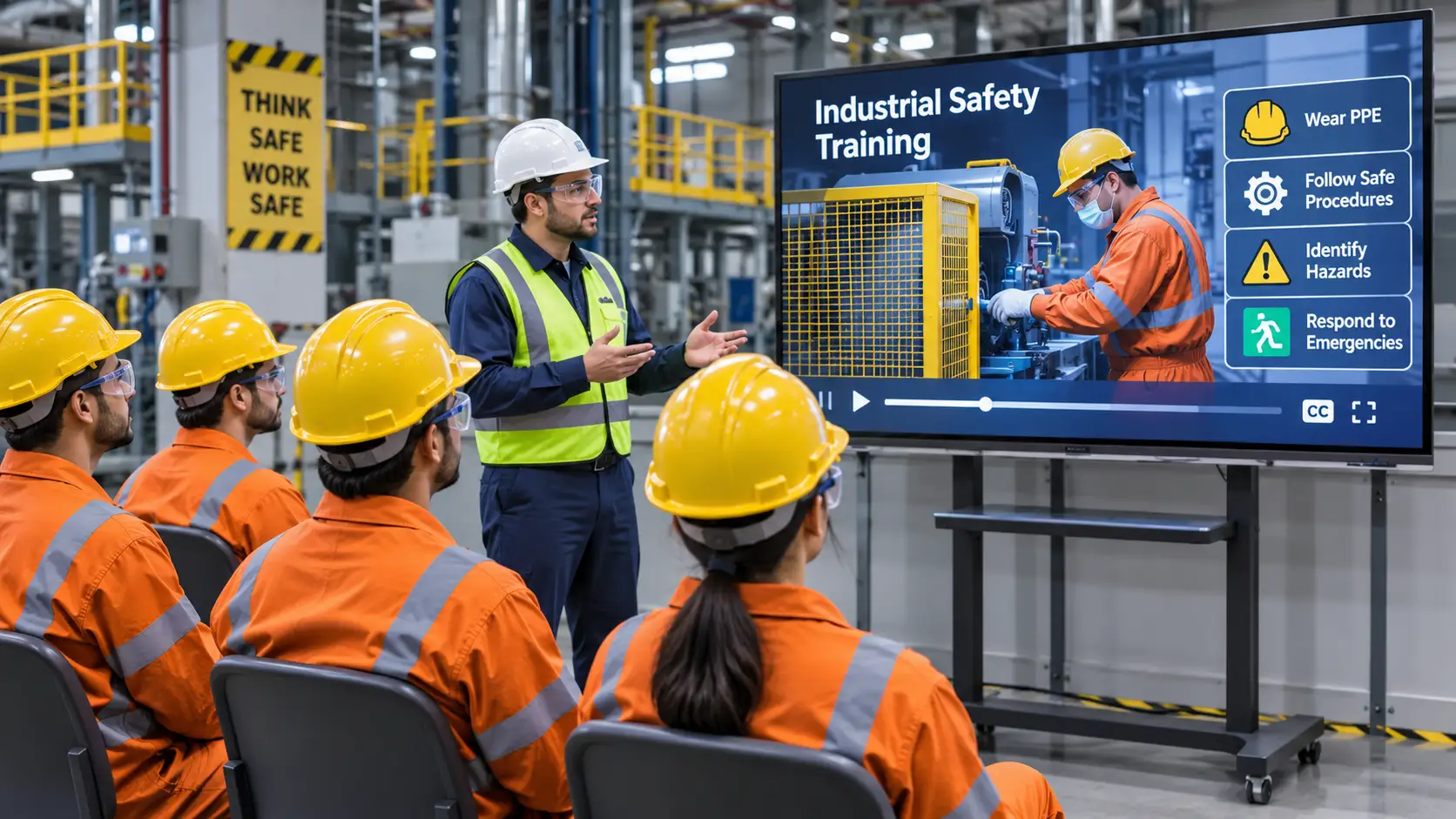
Safety training videos help organizations communicate these requirements through clear and consistent visual demonstrations.
Make Complex Safety Procedures Easier to Understand
Some industrial procedures involve multiple steps, equipment components, and safety precautions.
For example, lockout/tagout (LOTO) procedures require workers to understand energy isolation, equipment shutdown, verification, and controlled restoration.
A visual training video can demonstrate each step in sequence, making the procedure easier to follow.
Demonstrate Hazards That Are Difficult to Explain
Certain workplace hazards are difficult to demonstrate safely during actual training.
Examples include:
- Crane lifting failures and uncontrolled suspended loads.
- Electrical arc flash incidents.
- Chemical leaks and hazardous exposure.
- Confined space atmospheric hazards.
- Machinery entanglement incidents.
- Fire and explosion scenarios.
3D safety animation can recreate these situations in a controlled visual environment without exposing employees to actual danger.
Maintain Consistency Across Training Sessions
When safety instructions are delivered manually, the information and explanations may vary between trainers or departments.
A standardized safety training video helps organizations communicate the same core information to different employee groups, contractors, and visitors.
Improve Safety Awareness and Hazard Recognition
Visual examples help employees identify unsafe conditions, understand the consequences of incorrect actions, and recognize the importance of preventive measures.
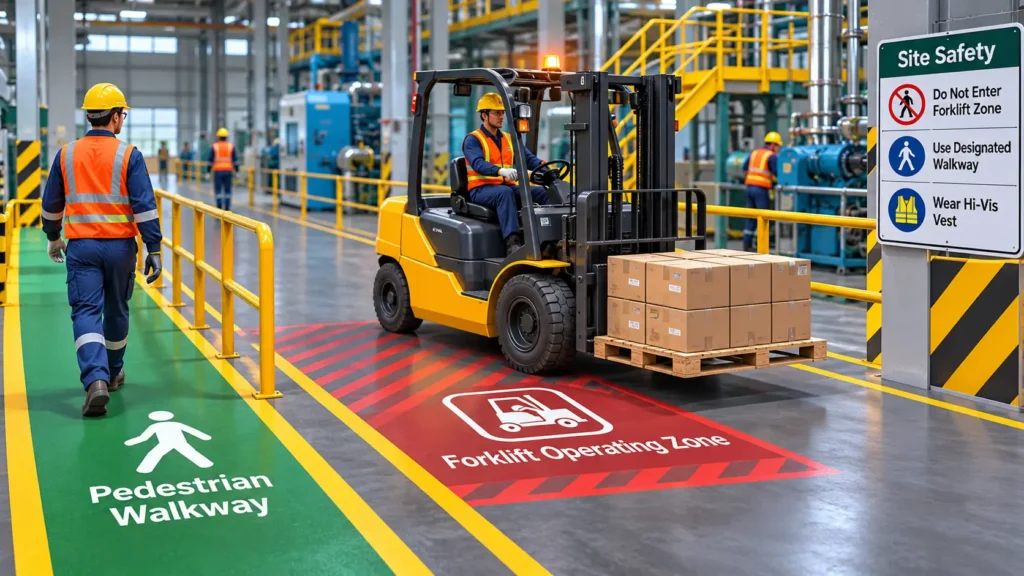
For example, a video showing the difference between a properly segregated pedestrian walkway and an unsafe forklift operating zone can communicate traffic management requirements more clearly.
Support Employee Induction and Refresher Training
Safety training is not limited to newly hired employees.
Organizations can use videos during:
- New employee induction.
- Contractor and visitor orientation.
- Periodic safety awareness programs.
- Equipment-specific training.
- Refresher sessions.
- Emergency preparedness exercises.
These videos can also be reused across departments and locations, provided the content remains relevant to the applicable workplace conditions.
Types of Safety Training Videos Used in Industrial Workplaces
Different industrial activities involve different risks. Therefore, organizations should select training video formats based on their operational requirements and training objectives.
1. Safety Induction Videos
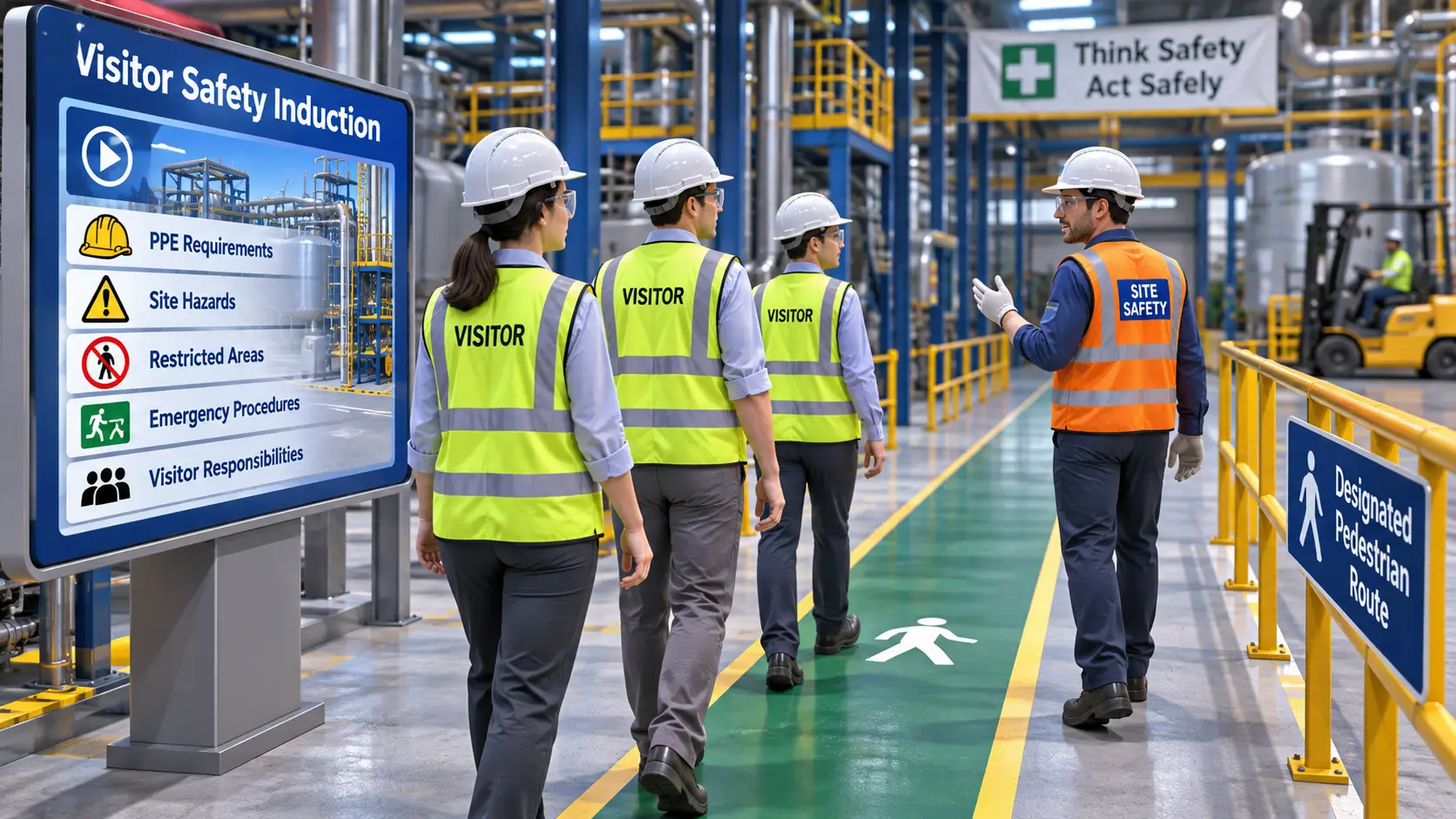
Safety induction videos introduce employees, contractors, and visitors to the essential safety requirements of an industrial facility.
Typical topics include:
- General workplace safety rules.
- Mandatory PPE requirements.
- Restricted and authorized areas.
- Emergency exits and assembly points.
- Fire safety procedures.
- Site-specific hazards.
- Reporting unsafe conditions and incidents.
These videos are particularly useful for manufacturing plants, construction sites, warehouses, and process industries.
For a more detailed look at contractor onboarding, site-specific safety requirements, and visual induction methods, read our article on safety induction animation for contractors working in industrial plants.
2. PPE Training Videos
Personal Protective Equipment (PPE) training videos explain the correct selection, use, inspection, and maintenance of protective equipment.
They can demonstrate:
- Safety helmet and protective footwear requirements.
- Correct use of safety goggles and face shields.
- Hand protection and chemical-resistant gloves.
- Respiratory protection.
- Hearing protection.
- Full-body harnesses and fall protection equipment.
Visual demonstrations can also highlight common mistakes, such as incorrect harness attachment or improper use of protective equipment.
3. Machinery and Equipment Safety Videos
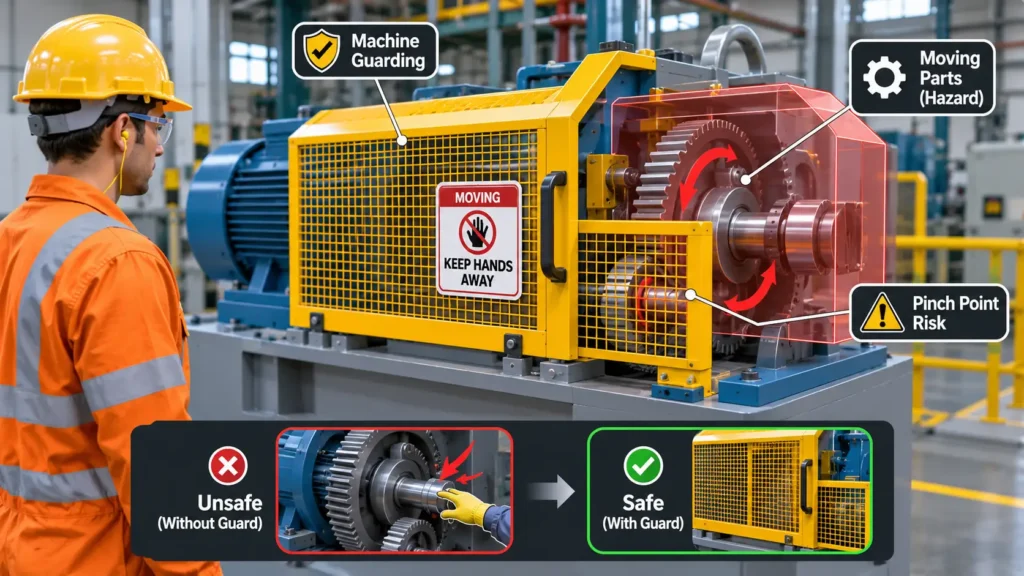
Industrial machinery presents risks such as crushing, cutting, entanglement, and unexpected equipment movement.
Machinery safety videos can explain:
- Machine guarding requirements.
- Safe operating distances.
- Emergency stop mechanisms.
- Equipment inspection procedures.
- Safe material handling.
- Maintenance precautions.
- Lockout/tagout procedures.
3D animation is particularly useful when the internal movement of machinery or hazardous operating zones need to be demonstrated.
4. Fire Safety and Emergency Response Videos
Employees must understand how to respond when an emergency occurs.
Fire safety and emergency response videos can demonstrate:
- Fire alarm activation.
- Identification of emergency exits.
- Correct evacuation procedures.
- Fire extinguisher selection and use.
- Assembly point arrangements.
- Emergency communication.
- Initial response and escalation procedures.
Animated scenarios can demonstrate how a fire develops, how smoke spreads, and why evacuation routes must remain clear.
5. Confined Space Safety Videos
Confined space operations involve serious risks, including oxygen deficiency, toxic atmospheres, engulfment, and restricted access.
Training videos can explain:
- Confined space identification.
- Permit-to-work requirements.
- Atmospheric testing.
- Ventilation arrangements.
- Isolation of hazardous energy.
- Standby attendant responsibilities.
- Communication and rescue procedures.
3D animation can visualize invisible atmospheric hazards and demonstrate the correct entry and rescue sequence.
6. Working at Height and Fall Protection Videos
Working at height requires proper planning, suitable access equipment, and fall prevention measures.
These videos can cover:
- Correct use of safety harnesses.
- Anchorage point selection.
- Scaffolding inspection.
- Ladder safety.
- Guardrail requirements.
- Fall arrest systems.
- Dropped object prevention.
Animated demonstrations can show the consequences of incorrect equipment use without recreating an actual dangerous activity.
7. Material Handling and Lifting Safety Videos
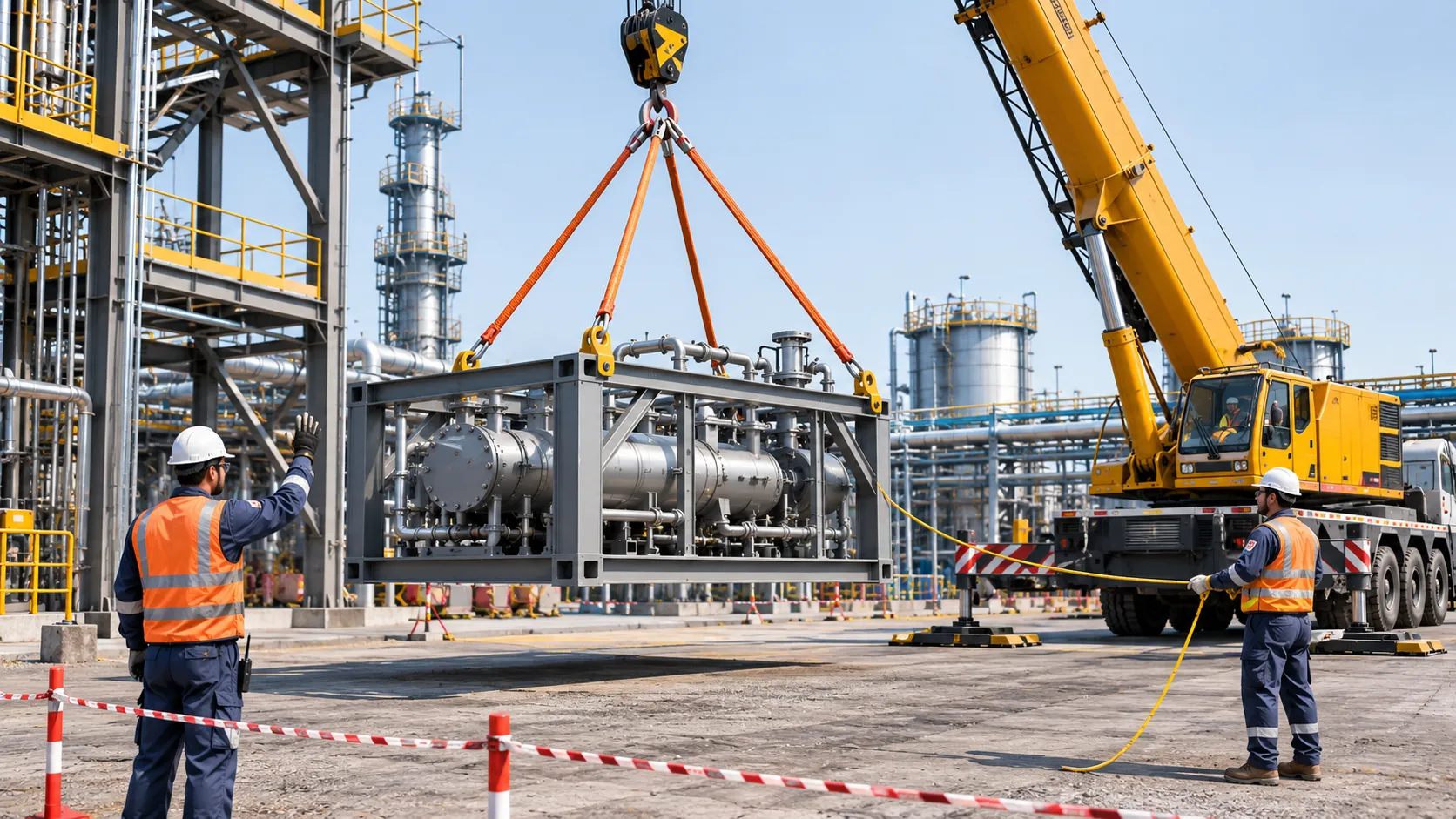
Factories, warehouses, and construction sites frequently involve cranes, forklifts, hoists, and other lifting equipment.
Safety training videos can demonstrate:
- Safe crane lifting operations.
- Rigging and sling inspection.
- Load capacity and center of gravity.
- Safe forklift movement.
- Pedestrian segregation.
- Suspended load exclusion zones.
- Communication between operators and signal persons.
These videos help explain the responsibilities of equipment operators, riggers, signal persons, and nearby workers.
How 3D Safety Animation Makes Industrial Training More Effective
Traditional training footage is useful for demonstrating actual workplace practices. However, certain hazards and technical procedures are difficult to capture using conventional cameras.
This is where 3D safety animation offers additional value.
Using 3D models, camera movements, technical illustrations, and animated sequences, complex industrial situations can be recreated in a controlled environment.
For example, consider a confined space entry operation.
A 3D animated training video can demonstrate:
- Identification of the confined space.
- Preparation of the entry permit.
- Isolation of connected equipment and energy sources.
- Atmospheric testing before entry.
- Installation of ventilation equipment.
- Entry under authorized conditions.
- Monitoring and communication during the operation.
- Emergency response and rescue arrangements.
The animation can also visually represent invisible gases, restricted access, and potential hazards that are difficult to communicate through ordinary footage.
3D Animation vs Traditional Safety Training Videos
| Comparison | Traditional Video | 3D Safety Animation |
|---|---|---|
| Real workplace demonstration | Highly suitable | Can recreate workplace environments |
| Invisible hazards | Difficult to show | Can be visualized |
| Internal machinery movement | Limited visibility | Can show internal components |
| Accident recreation | Requires careful production | Can recreate controlled scenarios |
| Complex procedures | Depends on camera access | Can show step-by-step sequences |
| Customized environments | Requires filming access | Can be developed from references and drawings |
Both formats have a role in industrial training. The right choice depends on the subject, learning objectives, and complexity of the operation.
Key Elements of an Effective Industrial Safety Training Video
Creating a safety training video requires more than attractive visuals. The content must communicate technically correct information and provide employees with clear instructions.
The following elements should be considered during production.
Clearly Defined Training Objectives
Every video should have a specific purpose.
For example, a forklift safety video may focus on pedestrian segregation, while a confined space video may focus on permit requirements and atmospheric testing.
Trying to cover too many unrelated topics in one video can reduce clarity.
Realistic Industrial Environments
The equipment, machinery, PPE, and workplace surroundings should represent the actual industrial environment as closely as possible.
Accurate visualization helps employees relate the training scenario to their everyday work.
Step-by-Step Safety Demonstrations
Procedures should be presented in a logical sequence, highlighting important actions and precautions.
This is particularly important for equipment operation, maintenance, isolation, and emergency response training.
Clear Voiceovers and On-Screen Instructions
Professional voiceovers, subtitles, safety symbols, and on-screen labels can reinforce important instructions.
For organizations operating across multiple locations, multilingual versions can help communicate safety information to employees who speak different languages.
Technical and Safety Validation
Safety-related content must be reviewed by competent personnel before publication.
The animation team should work with the organization’s EHS professionals, technical experts, and subject matter specialists to verify procedures, terminology, equipment details, and safety instructions.
How to Develop Safety Training Videos for Industrial Workplaces
A structured production process helps ensure that the final video meets both technical and training requirements.
A typical workflow includes the following stages.
Stage 1: Requirement Gathering
Understand the industry, workplace environment, target audience, training objectives, and safety topics.
Stage 2: Script and Storyboard Development
Convert the safety requirements into a structured script and visual storyboard. Each scene should communicate a specific action, hazard, or preventive measure.
Stage 3: 3D Modelling and Environment Development
Create the required machinery, industrial equipment, workers, PPE, and workplace environments using 3D modelling tools.
Stage 4: Animation and Visual Development
Animate equipment movement, worker interactions, hazard scenarios, safe practices, and emergency response sequences.
Stage 5: Voiceover and Post-Production
Integrate narration, subtitles, safety labels, sound effects, and other visual elements.
Stage 6: Technical Review and Final Delivery
Review the animation with the client and relevant safety professionals. Incorporate corrections and deliver the final video in the required format.
This process helps maintain consistency between the approved safety procedures and their visual representation.
How Immersiv Techsphere Supports Industrial Safety Training
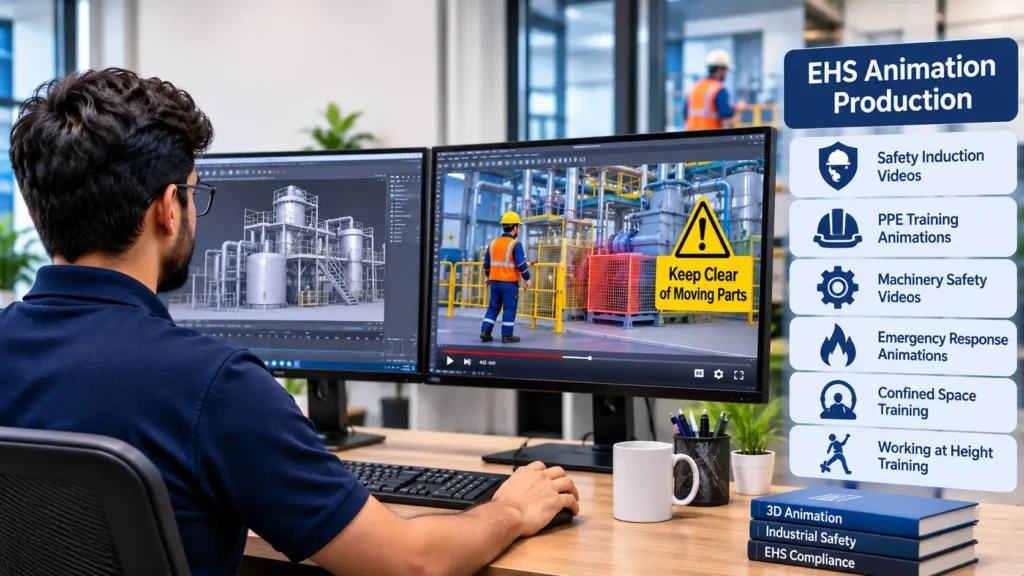
Immersiv Techsphere develops customized 3D EHS and HSE animation videos for industrial organizations that need to communicate workplace hazards, safety procedures, and emergency response requirements.
Our approach combines mechanical engineering understanding, 3D modelling, technical visualization, and animation to convert complex industrial scenarios into clear visual training content.
Our industrial safety animation capabilities include:
- Safety Induction Videos: Visual demonstrations of site rules, PPE requirements, restricted areas, and emergency arrangements for employees, contractors, and visitors.
- PPE Training Animations: Demonstrations of correct protective equipment selection and usage.
- Machinery and Equipment Safety: Visual explanations of machine hazards, guarding, safe operating practices, and maintenance precautions.
- Emergency Response Animations: Demonstrations of fire incidents, evacuation procedures, emergency communication, and response actions.
- Confined Space Safety: Visualization of entry procedures, atmospheric hazards, isolation, and rescue arrangements.
- Working at Height and Lifting Safety: Animated demonstrations of fall protection, crane operations, rigging, and material handling.
- Incident Recreation: 3D reconstruction of workplace incidents to explain unsafe conditions, contributing factors, and preventive measures.
We develop customized animations based on client-provided safety procedures, technical references, equipment details, and training requirements.
Depending on the project scope, deliverables can include voiceovers, subtitles, on-screen safety instructions, and videos adapted for induction sessions, training presentations, and digital learning platforms.
Our objective is to help industrial organizations communicate safety information through technically relevant and visually understandable training videos.
Conclusion
Industrial safety training is most effective when employees can understand the hazards they may encounter and recognize the correct actions required to prevent incidents.
Safety training videos provide organizations with a practical way to demonstrate workplace risks, explain operating procedures, and communicate emergency response requirements.
From employee induction and PPE awareness to machinery safety, confined space operations, and incident recreation, customized industrial safety videos can support different stages of an organization’s EHS training program.
By combining accurate technical information with realistic 3D visualization, organizations can make complex safety procedures easier to communicate and reinforce consistent safety awareness across their workforce.
Immersiv Techsphere supports this approach through customized 3D EHS and HSE animation services developed around industrial environments, equipment, and workplace training requirements.
Frequently Asked Questions (FAQs)
Safety training videos are used to educate employees about workplace hazards, PPE requirements, machinery safety, emergency procedures, safe operating practices, and accident prevention.
Common topics include safety induction, fire prevention, PPE usage, lockout/tagout, confined space entry, working at height, crane and forklift safety, material handling, and emergency evacuation.
3D animation helps visualize complex machinery, invisible hazards, unsafe working conditions, and emergency scenarios. It allows organizations to demonstrate dangerous situations without exposing workers to actual risks during training.
Yes. Videos can be customized using plant layouts, machinery references, equipment drawings, operating procedures, and site-specific safety requirements to represent the actual workplace environment.
Yes. Voiceovers and subtitles can be developed in different languages to support multilingual workforces and improve accessibility.
Yes. Immersiv Techsphere develops customized 3D EHS and HSE animation videos covering safety induction, PPE training, machinery safety, emergency response, confined space operations, working at height, and industrial incident recreation.
Need customized safety training videos for your industrial workplace?
Contact Immersiv Techsphere to discuss your EHS training objectives and explore how 3D safety animation can support your workplace safety communication.
Have a Project in Mind?
Need help with 3D animation, industrial visualization, HSE training animation, or product visualization? Tell us about your project and our team will get back to you.