

Table of Contents
Introduction
Industrial plants regularly depend on contractors for maintenance, shutdown activities, equipment installation, fabrication, inspections, civil work, electrical work, and other specialized tasks. Before entering the facility or beginning work, every contractor needs to understand the site-specific safety requirements, hazards, emergency procedures, and expected behavior.
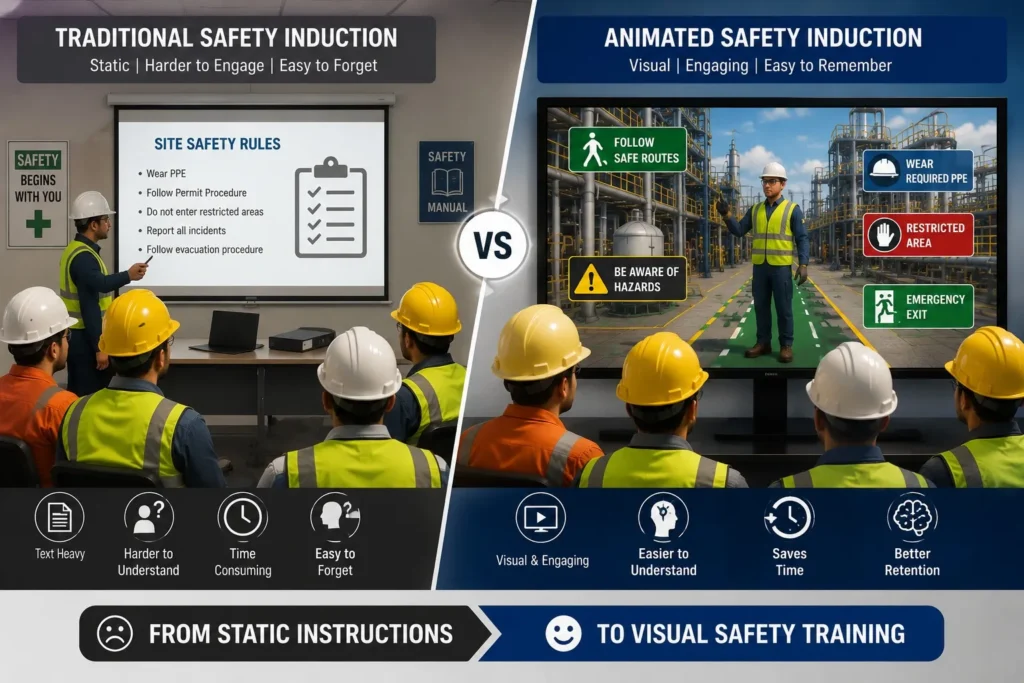
Traditional safety induction methods often rely on presentations, documents, classroom sessions, or site briefings. While these methods remain important, they can make it difficult to explain complex plant environments, hazardous situations, restricted areas, and emergency scenarios in a clear and consistent way.
Safety Induction Animation provides a more visual and structured approach to contractor safety training. By using 3D visuals, realistic industrial environments, animated scenarios, and clear step-by-step explanations, companies can communicate critical safety information before contractors begin work.
This article explains how Induction Animation can improve contractor onboarding in industrial plants and how combining AI tools with traditional animation expertise can help speed up the video creation process.
As part of broader EHS Animation Services, Safety Induction Animation can help organizations communicate site-specific safety procedures, workplace hazards, and emergency requirements through clear and engaging visual content.
Why Contractors Need Effective Safety Induction
Contractors may enter an industrial facility without the same familiarity with the plant as permanent employees. They may work in unfamiliar process areas, around operating equipment, or alongside multiple teams and activities.
Before work begins, contractors may need to understand:
- Site entry and access procedures
- Mandatory PPE requirements
- Plant-specific hazards
- Restricted and hazardous areas
- Permit-to-work procedures
- Lockout/tagout requirements
- Working at height procedures
- Confined space entry requirements
- Vehicle and pedestrian movement rules
- Emergency alarms and evacuation procedures
- Assembly point locations
- Incident and near-miss reporting procedures
- Site-specific safety rules
The challenge is not simply providing this information. Contractors need to understand how the rules apply within the actual industrial environment.
This is where Safety Induction Animation can provide significant value.
What Is Safety Induction Animation?
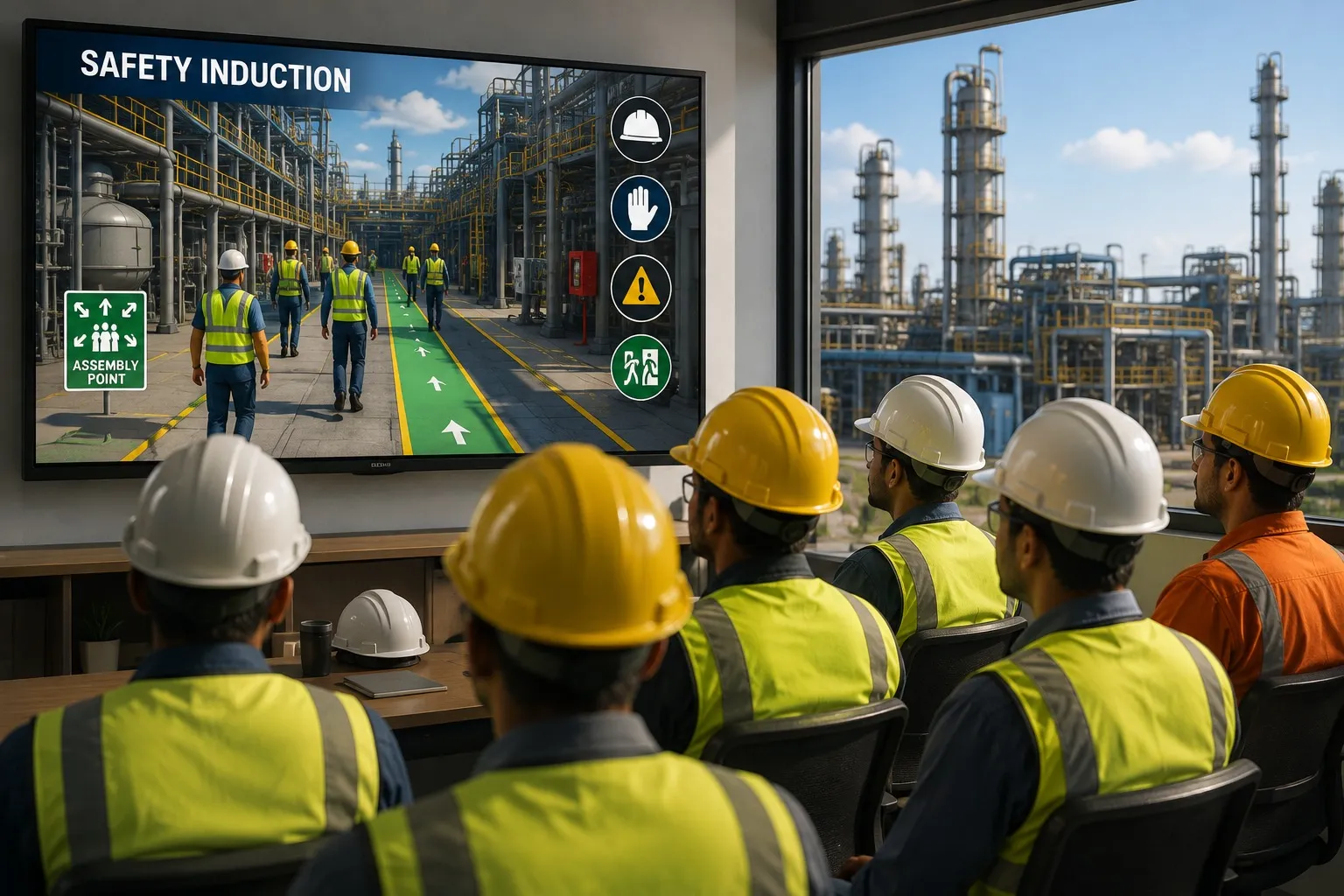
Safety Induction Animation is an animated training video designed to introduce employees, contractors, visitors, or new personnel to the safety requirements of a workplace or industrial facility.
Instead of relying only on written instructions or presentation slides, the animation can visually recreate the plant environment and demonstrate correct and incorrect actions.
For example, an Induction Animation can show:
- A contractor arriving at the facility.
- Completing entry and access procedures.
- Wearing the required PPE.
- Moving through designated pedestrian routes.
- Identifying restricted areas.
- Following permit-to-work requirements.
- Responding correctly to an emergency alarm.
- Evacuating through the designated route.
- Reporting to the correct assembly point.
By showing these situations visually, contractors can better understand the sequence of actions expected from them.
How 3D Animation Improves Contractor Safety Induction
1. It Creates a Visual Representation of the Plant
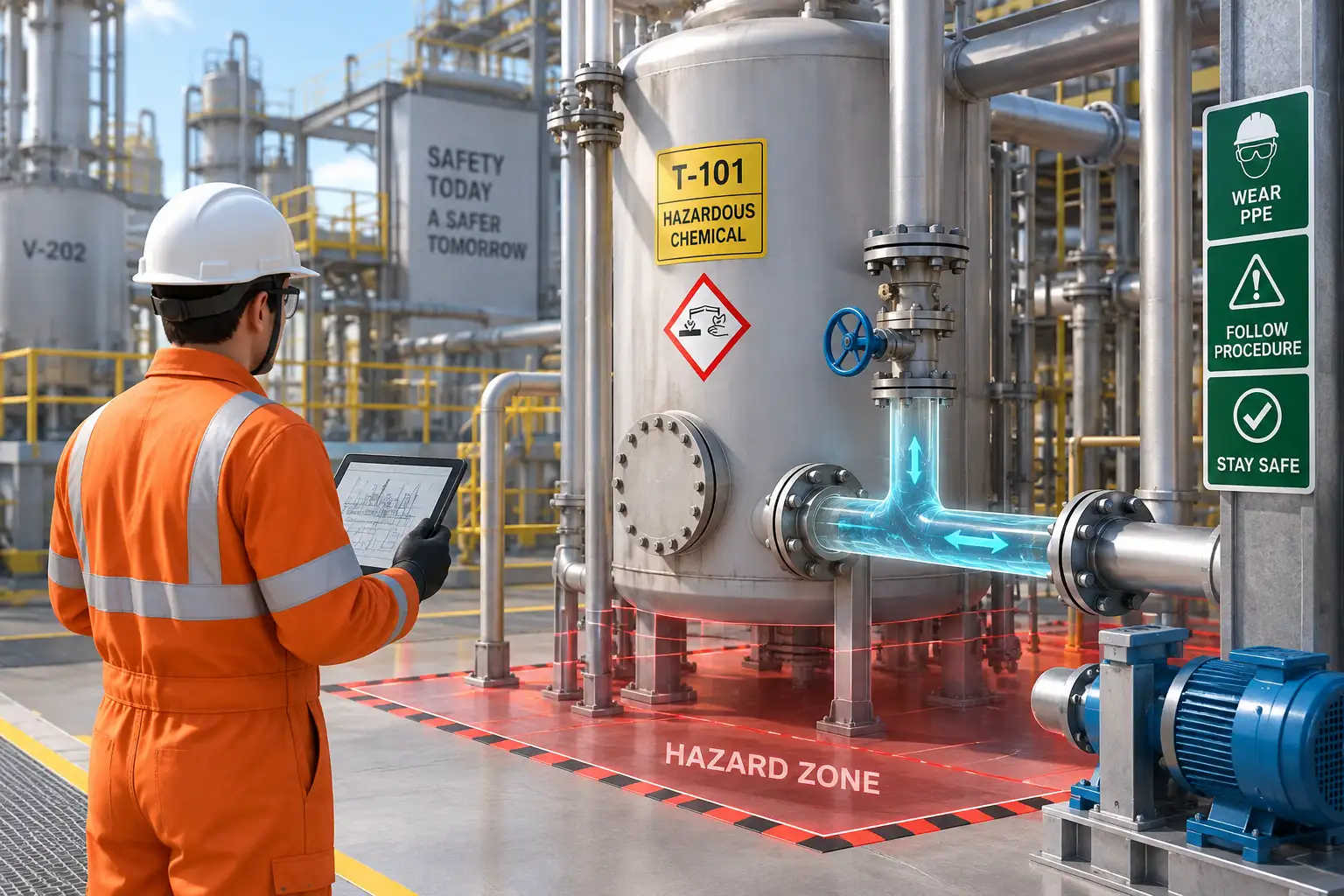
Industrial plants can be complex environments. A contractor may need to understand multiple buildings, equipment areas, access routes, hazardous zones, and emergency exits before beginning work.
A 3D Safety Induction Animation can recreate relevant parts of the facility and provide a visual walkthrough.
Instead of simply stating:
“Do not enter restricted areas without authorization.”
The animation can show the restricted zone, access barriers, warning signs, and the correct authorization process.
This makes the instruction easier to understand and remember.
2. It Demonstrates Correct and Incorrect Behavior
Safety rules become more effective when personnel can see the consequences of different actions.
An Induction Animation can demonstrate scenarios such as:
- A contractor entering an area without appropriate PPE.
- Incorrect use of access routes.
- Working without the required permit.
- Ignoring warning signs.
- Unsafe movement around operating equipment.
- The correct response to a process alarm.
- Proper evacuation during an emergency.
The video can compare unsafe behavior with the correct procedure without exposing real workers to unnecessary risk.
3. It Standardizes Safety Communication
Safety induction may be delivered by different supervisors, departments, or training personnel. This can sometimes result in variations in how information is presented.
A professionally developed Safety Induction Animation provides a consistent training resource.
Every contractor can receive the same explanation of:
- Safety rules
- Plant procedures
- Emergency actions
- PPE requirements
- Site access requirements
This is particularly useful for organizations that regularly onboard large numbers of contractors, subcontractors, maintenance teams, or shutdown personnel.
Key Topics to Include in an Industrial Plant Induction Animation
The exact content should depend on the facility and its operations. However, a comprehensive contractor induction video can include the following sections.
1. Site Introduction
The animation can begin with a high-level overview of the facility, including:
- Main plant areas
- Entry points
- Administrative buildings
- Process areas
- Workshops
- Warehouses
- Emergency facilities
A simplified visual introduction helps contractors understand the overall site before entering specific work areas.
2. Personal Protective Equipment (PPE)
The video can clearly explain where and when different PPE is required.
This may include:
- Safety helmets
- Safety shoes
- Safety glasses
- Hearing protection
- Gloves
- Respiratory protection
- High-visibility clothing
- Fall protection equipment
3D animation can also demonstrate the correct use of PPE in different working environments.
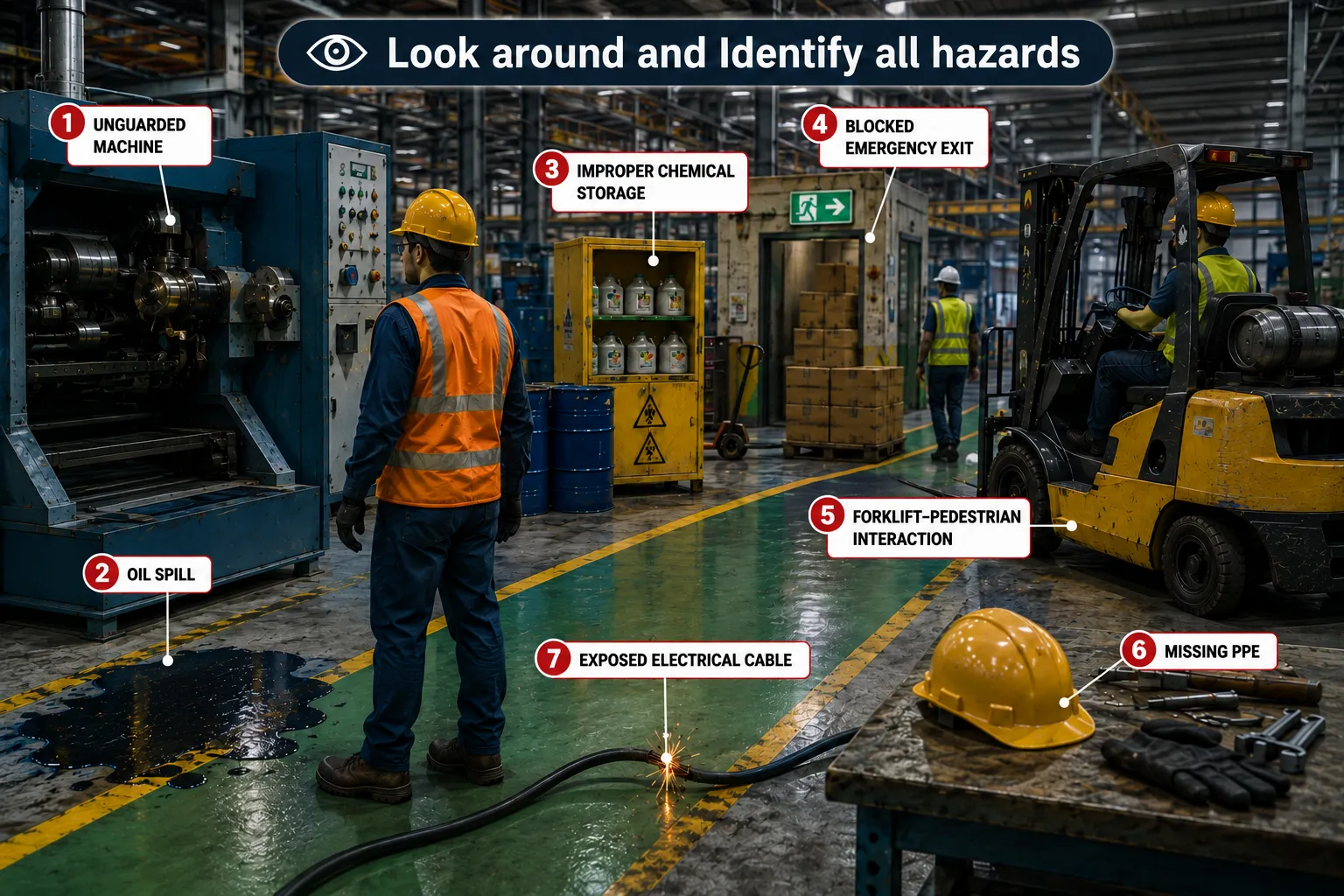
3. Hazard Identification
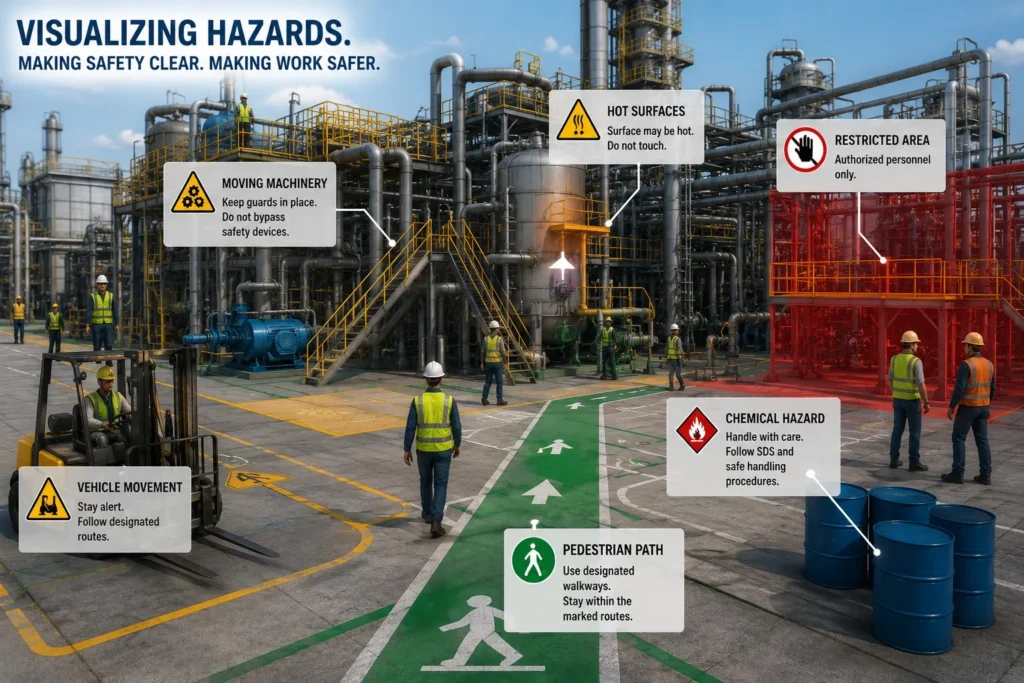
Contractors may encounter hazards that are specific to the plant.
An animated induction can visually demonstrate:
- Moving machinery
- Hot surfaces
- High-pressure equipment
- Chemical hazards
- Electrical hazards
- Slippery surfaces
- Overhead loads
- Vehicle movement
- Confined spaces
- Work at height areas
Visualizing these hazards within the plant environment helps contractors understand where risks may occur and supports more effective Hazard Identification Training before work begins.
For many industrial activities, contractors must follow formal authorization procedures before starting work.
The Safety Induction Animation can introduce the purpose of:
- Hot work permits
- Work-at-height permits
- Confined space permits
- Electrical isolation procedures
- Lockout/tagout
- Equipment isolation
- Gas testing
The objective is not necessarily to replace detailed technical training. Instead, the Induction Animation can provide contractors with a clear introduction to the process and explain when additional authorization is required.
5. Emergency Response and Evacuation
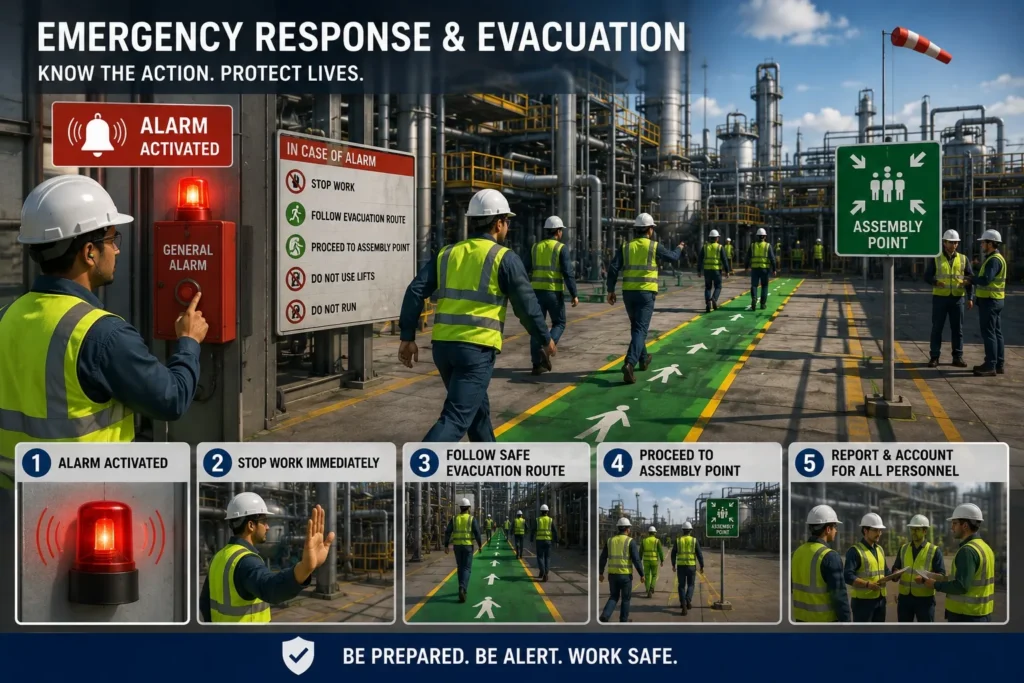
Emergency information is one of the most important elements of contractor induction.
The animation can demonstrate:
- What different alarms mean
- When work must stop
- How to leave the work area safely
- Designated evacuation routes
- Assembly points
- Emergency reporting procedures
- The role of emergency response teams
Animated scenarios can also show why contractors should avoid returning for personal belongings or attempting unauthorized rescue activities.
Using AI Tools with Traditional Animation Skills
AI tools are changing the way animation teams approach research, planning, asset development, and video production. However, for technical industrial training, AI should work alongside traditional animation skills rather than replace them completely.
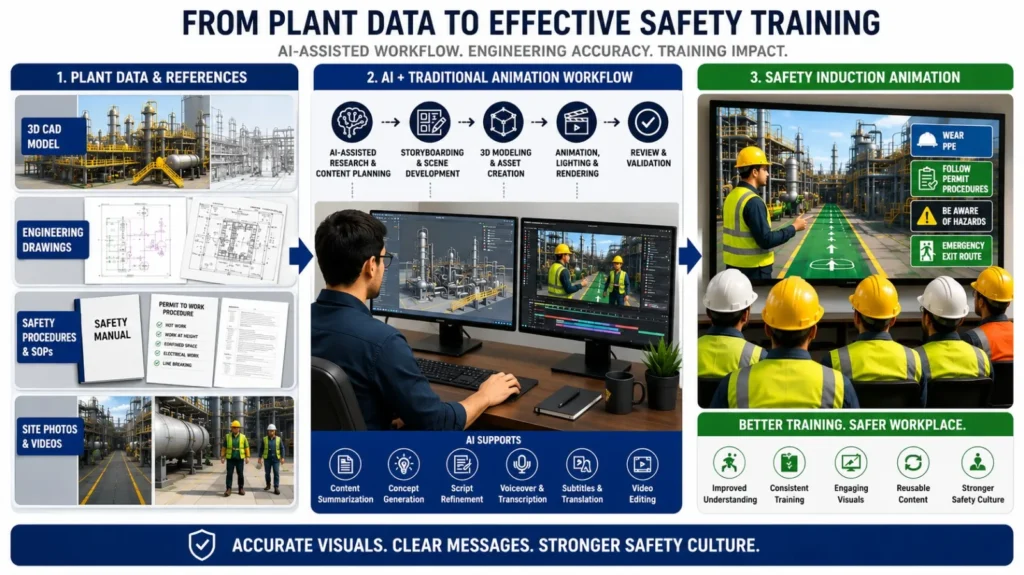
An effective production workflow can combine AI-assisted tools with the expertise of 3D artists, technical animators, mechanical designers, and video editors.
1. AI Can Help Speed Up Pre-Production
The development of an Induction Animation often begins with a large amount of information.
This may include:
- Safety manuals
- Site procedures
- SOPs
- Plant layouts
- Equipment information
- Existing training documents
- Incident reports
- Client-provided images and videos
AI tools can assist with organizing information, identifying major training topics, creating initial content structures, and preparing draft scene concepts.
This can reduce time spent on repetitive pre-production activities.
However, the final training structure still requires review by safety professionals and subject matter experts.
2. AI-Assisted Storyboarding and Scene Planning
AI tools can also help animation teams explore initial visual concepts and storyboards.
For example, AI-assisted workflows may help generate early references for:
- Industrial environments
- Camera compositions
- Character positioning
- PPE visualization
- Training scenarios
- Environmental mood and lighting references
These concepts can then be refined by professional artists and animators to match the actual plant environment and technical requirements.
3. Traditional 3D Animation Ensures Technical Accuracy
Industrial facilities contain highly specific equipment, layouts, structures, and safety systems.
Generic AI-generated visuals may not accurately represent:
- Process equipment
- Plant layouts
- Machine operation
- Safety barriers
- PPE requirements
- Emergency equipment
- Industrial workflows
This is where traditional 3D modeling and animation expertise remain essential.
Professional animators and mechanical designers can create accurate models based on:
- CAD files
- Engineering drawings
- Plant layouts
- Reference photographs
- Technical specifications
The final animation can therefore maintain both visual quality and technical relevance.
4. AI Can Support Production Efficiency
AI-assisted tools may also help speed up selected production activities, such as:
- Initial concept generation
- Background development
- Voiceover preparation
- Script refinement
- Subtitle generation
- Translation support
- Video editing assistance
- Asset organization
Using AI strategically can reduce repetitive work and allow the animation team to spend more time on areas that require technical judgment, creative direction, and detailed animation.
The result is a workflow where AI improves efficiency while traditional animation skills maintain accuracy, consistency, and production quality.
A Practical Workflow for Creating Safety Induction Animation
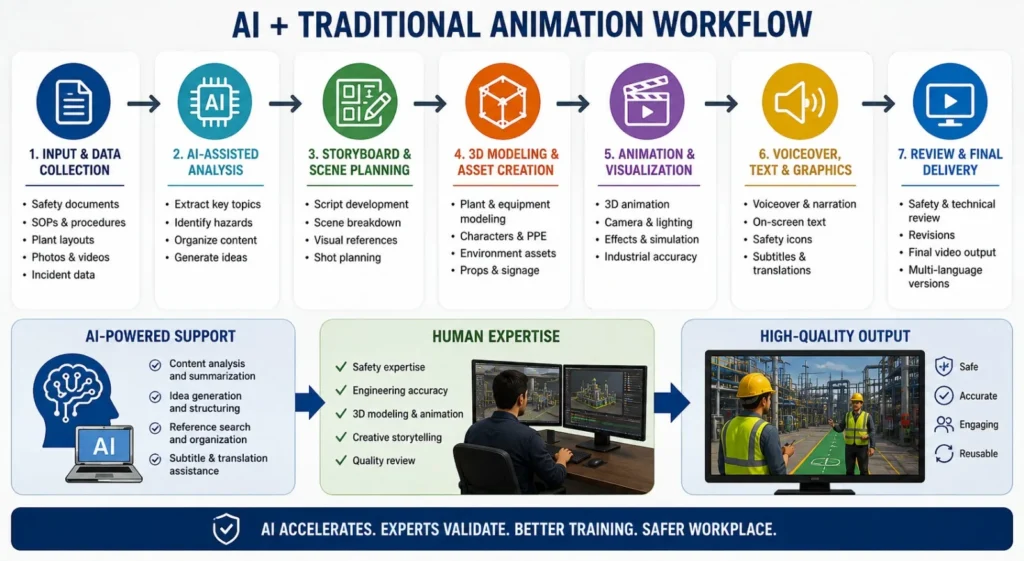
A structured workflow is important when developing an Induction Animation for an industrial facility.
Step 1: Review Existing Safety and Training Materials
The process can begin with reviewing available documents, including:
- Safety induction presentations
- Standard operating procedures
- Contractor safety requirements
- Emergency response plans
- Plant layouts
- PPE policies
- Site photographs and videos
AI-assisted tools can help organize and summarize large amounts of initial reference material, while subject matter experts validate the final content.
Step 2: Define the Training Objectives
The team identifies what contractors must understand after watching the animation.
For example:
- Where they are allowed to enter
- What PPE is required
- Which hazards they may encounter
- When permits are required
- What to do during an emergency
This prevents the video from becoming a general corporate presentation and keeps the Induction Animation focused on practical safety actions.
Step 3: Develop the Script and Storyboard
The safety requirements are converted into a structured sequence of scenes.
Each scene should answer a specific question:
- What does the contractor need to know?
- What action should they take?
- What visual environment will demonstrate the instruction?
- What could happen if the procedure is ignored?
AI tools can support early scripting and concept development, while animation and safety teams refine the final sequence.
Step 4: Create the 3D Environment and Assets
Relevant parts of the industrial plant are modeled or recreated using available engineering and visual references.
Depending on the project, this may include:
- Buildings
- Process equipment
- Pipelines
- Structural platforms
- Safety systems
- Vehicles
- Personnel
- PPE
- Emergency equipment
Existing CAD data can also be useful for improving technical accuracy and reducing the time required to model complex equipment.
Step 5: Animate the Safety Scenarios
The animation team creates realistic sequences showing:
- Normal site entry
- Safe movement
- Hazard identification
- Permit procedures
- PPE use
- Unsafe actions
- Emergency response
- Evacuation
Clear camera angles and scene composition are important because the objective is not only visual appeal. The viewer must immediately understand the safety instruction.
Step 6: Add Voiceover, Text, and Supporting Graphics
The final Induction Animation can include:
- Professional voiceover
- On-screen instructions
- Warning symbols
- Safety labels
- Subtitles
- Multilingual versions
AI-assisted tools can help accelerate subtitle generation, transcription, translation workflows, and other supporting production tasks, followed by human review for accuracy.
Step 7: Review with Safety and Technical Teams
Before final delivery, the animation should be reviewed by relevant stakeholders.
This may include:
- HSE professionals
- Plant managers
- Operations teams
- Maintenance teams
- Engineering teams
- Training departments
The review ensures that the final Safety Induction Animation accurately represents the site’s actual procedures and requirements.
Benefits of Safety Induction Animation for Industrial Contractors
A well-developed Induction Animation can provide several practical benefits.
1. Improved Understanding
Visual demonstrations can make complex instructions easier to understand, particularly when contractors come from different technical backgrounds.
2. Consistent Training
Every contractor receives the same core safety information.
3. Better Visualization of Hazards
3D animation can recreate hazardous environments and scenarios that may be difficult or unsafe to demonstrate in real life.
4. Reusable Training Content
The video can be used repeatedly for:
- New contractor induction
- Employee onboarding
- Refresher training
- Shutdown preparation
- Visitor orientation
- Online training programs
5. Easier Multilingual Adaptation
The same visual animation can be combined with different voiceovers, subtitles, or localized text for multilingual workforces.
6. Efficient Content Production with AI-Assisted Workflows
When used appropriately, AI tools can speed up parts of research, planning, scripting, concept development, voice processing, subtitling, and editing.
Combined with traditional 3D animation and technical visualization skills, this can create a more efficient production workflow without compromising the technical accuracy required for industrial safety training.
Why Technical Animation Expertise Still Matters
Safety videos for industrial plants require more than attractive visuals.
The animation must correctly represent:
- Industrial environments
- Equipment
- Worker movement
- Safety procedures
- PPE
- Hazardous areas
- Emergency actions
For this reason, the strongest production approach combines AI-assisted efficiency with human technical expertise.
AI tools can accelerate selected stages of the production process, but experienced 3D artists, technical animators, engineers, and safety professionals remain responsible for validating the visual and technical accuracy of the final content.
For organizations, this approach can help reduce production time while maintaining the quality and credibility required for professional HSE training.
How Immersiv Techsphere Develops Safety Induction Animation
At Immersiv Techsphere, we develop Safety Induction Animation and technical 3D visual content for industrial training and communication.
You can also explore our EHS animation video samples to see examples of how technical animation and visual content can be used for safety communication, training, and industrial learning.
Our approach combines traditional 3D modeling, animation, engineering understanding, and AI-assisted production workflows where they can improve efficiency.
Depending on the project requirements, the production process can include:
- Review of existing HSE and training materials
- Script and scene development
- 3D plant and equipment visualization
- Contractor safety scenarios
- PPE and hazard demonstrations
- Emergency response animation
- AI-assisted concept and production workflows
- Voiceover and subtitle integration
- Technical and safety review
The objective is to create Induction Animation that helps contractors understand site-specific safety requirements before they begin work in an industrial environment.
FAQs
Safety Induction Animation is an animated training video that visually explains workplace hazards, safety rules, site procedures, PPE requirements, and emergency actions for employees, contractors, or visitors.
Induction Animation helps contractors understand unfamiliar industrial environments, site-specific hazards, required safety procedures, and emergency actions before they begin work.
Yes, AI tools can support tasks such as content organization, concept development, storyboarding, voice processing, subtitling, and editing, while traditional animation and technical expertise help maintain accuracy and quality.
Yes, the animation can be developed using plant layouts, CAD models, photographs, videos, safety procedures, and other site-specific information.
Yes, the same visual animation can be adapted with multilingual voiceovers, subtitles, and on-screen text to support contractors from different language backgrounds.
Conclusion
Contractor safety induction is an important part of managing risk in industrial plants. However, written documents and presentation-based training may not always provide a clear understanding of the actual work environment.
Safety Induction Animation can make safety communication more visual, structured, and consistent by demonstrating plant environments, hazards, correct procedures, and emergency actions through realistic 3D scenarios.
At the same time, AI tools can help speed up selected stages of video production, including research, content organization, concept development, storyboarding, subtitling, and editing.
The most effective approach is not to rely entirely on AI or traditional animation alone. Combining AI-assisted production workflows with professional 3D animation and technical expertise can help organizations create high-quality Induction Animation more efficiently while maintaining the accuracy required for industrial safety training.
Looking to create a customized Safety Induction Animation for your industrial facility?
Get in touch with our team to discuss your requirements and discover how we can transform your safety procedures and plant-specific information into an engaging, technically accurate training video. Fill out our contact form to get started.
Have a Project in Mind?
Need help with 3D animation, industrial visualization, HSE training animation, or product visualization? Tell us about your project and our team will get back to you.