

Table of Contents
Introduction
In manufacturing, assembly errors can quickly lead to production delays, product failures, increased warranty claims, and higher operational costs. Whether you’re assembling industrial machinery, process equipment, laboratory furniture, sheet metal products, or complex mechanical systems, ensuring every technician follows the correct assembly sequence is critical.
For decades, manufacturers have relied on live demonstrations to train operators and assembly technicians. While practical demonstrations remain valuable, they often depend on the instructor’s availability, consistency, and communication skills.
Today, many manufacturers are replacing or supplementing traditional training with Assembly Animation, interactive, repeatable 3D visualizations that clearly explain every assembly step.
So, which method reduces assembly errors faster?
The answer depends on your production environment, but for most organizations, 3D Assembly Animation delivers faster learning, greater consistency, and significantly fewer assembly mistakes.
Why Assembly Errors Continue to Occur?
Even experienced technicians make mistakes when:
- Assembly sequences are difficult to remember.
- Printed manuals contain complex technical drawings.
- Products have hundreds of individual components.
- Similar-looking parts are installed incorrectly.
- Hidden internal assemblies cannot be visualized.
- New operators receive inconsistent training.
- Design revisions are not communicated effectively.
These issues become even more common in high-mix, low-volume manufacturing where products frequently change.
Instead of relying on written instructions alone, manufacturers are increasingly using Industrial Animation to standardize assembly knowledge.
What Is Assembly Animation?
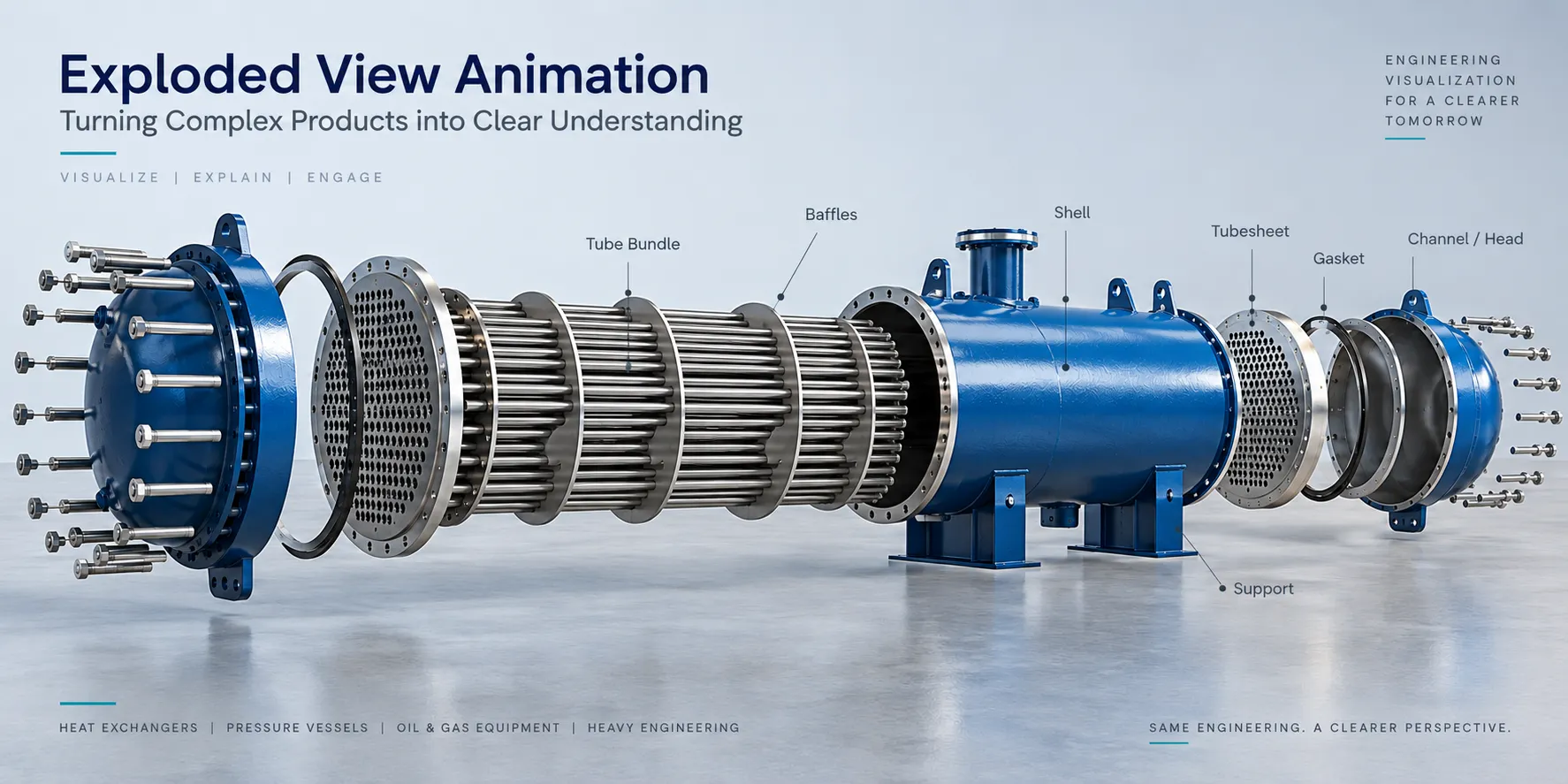
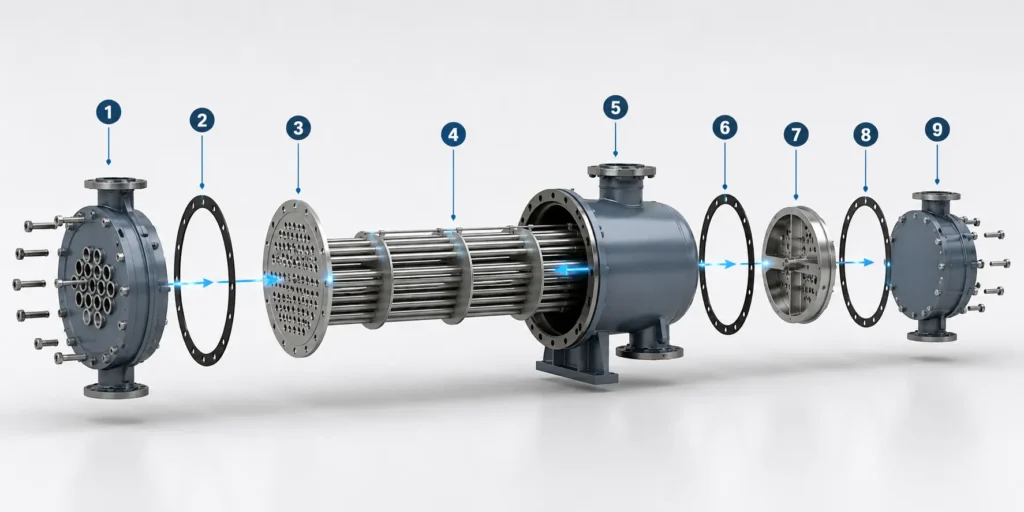
Assembly Animation is a 3D visualization that demonstrates how components fit together in the correct sequence. Unlike static assembly drawings, animations illustrate movement, orientation, fastening methods, safety precautions, and installation order in an easy-to-understand format.
Depending on the application, an assembly animation may include:
- Exploded views
- Sequential assembly steps
- Fastener installation
- Torque instructions
- Tool identification
- Component callouts
- Safety warnings
- Cross-sectional views
- Transparent assemblies
- Motion paths
- Quality checkpoints
The result is a visual guide that is easier to follow than text-heavy manuals.
Assembly Animation or Live Demonstration: Which Is More Effective?
Both live demonstrations and Assembly Animation play an important role in manufacturing training, but they solve different challenges.
A live demonstration gives technicians hands-on exposure to the assembly process and allows them to ask questions in real time. This makes it valuable for introducing new equipment or teaching specialized manual techniques. However, the quality of training often depends on the experience of the instructor, the time available for each session, and the number of employees being trained. As production teams grow or operate across multiple locations, maintaining consistent training becomes increasingly difficult.
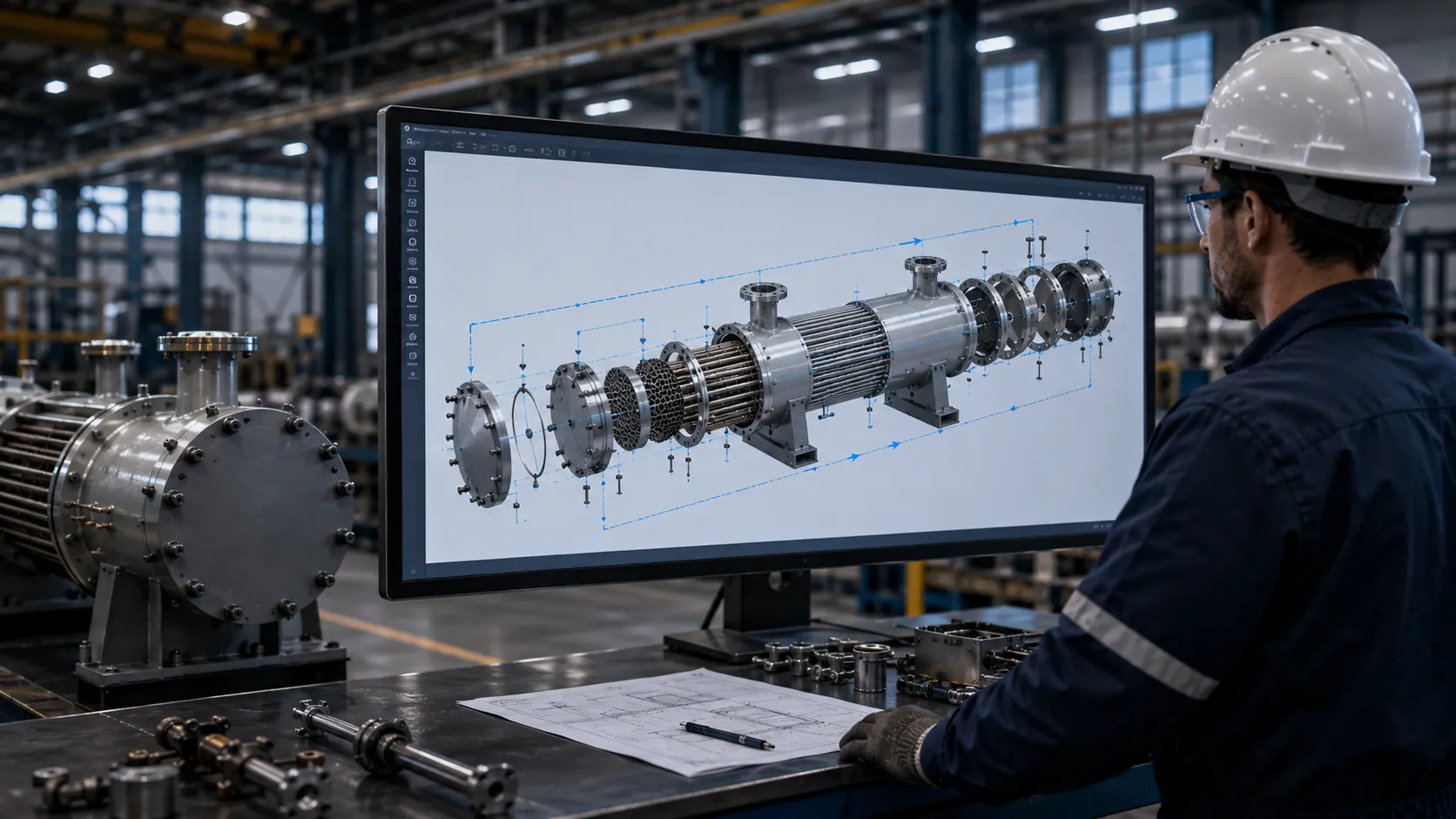
Assembly Animation addresses these limitations by delivering the same clear visual instructions every time. Technicians can watch the complete assembly sequence before starting work, replay complex steps as often as needed, and access the training whenever required. Because animations are created directly from engineering CAD models, they accurately represent component orientation, assembly order, fastening methods, and safety considerations.
Rather than replacing live demonstrations, assembly animations strengthen them. Technicians arrive at practical training with a better understanding of the process, allowing instructors to focus on hands-on skills instead of repeatedly explaining the same assembly sequence. This combination reduces confusion, shortens the learning curve, and helps achieve more consistent assembly quality across the workforce.
Why Assembly Animation Reduces Errors Faster
1. Visual Learning Improves Understanding
Most assembly processes involve spatial relationships that are difficult to explain using words or 2D drawings.
A 3D Assembly Animation allows technicians to observe:
- Component orientation
- Part alignment
- Installation sequence
- Fastening locations
- Internal assemblies
- Moving mechanisms
This reduces interpretation errors before technicians begin work.
2. Every Operator Receives the Same Instructions
Traditional demonstrations vary from trainer to trainer.
- One instructor may explain: Correct torque sequence
- while another may skip it due to time constraints.
Assembly animations eliminate these inconsistencies by delivering identical instructions to every employee.
3. Complex Products Become Easier to Assemble
Industrial equipment often contains:
- Hundreds of components
- Tight clearances
- Internal mechanisms
- Hidden fasteners
- Multiple assembly stages
Animations simplify these complex processes into easy-to-follow visual steps.
This is especially valuable for:
- Process equipment
- Pressure vessels
- Industrial machinery
- Laboratory furniture
- Sheet metal assemblies
- Conveyors
- Material handling equipment
4. New Employees Learn Faster
One of the biggest challenges in manufacturing is onboarding new technicians.
Instead of waiting for experienced operators to conduct demonstrations repeatedly, organizations can use Assembly Training Animations that employees can watch multiple times before entering production.
Benefits include:
- Faster onboarding
- Reduced supervision
- Lower training costs
- Improved confidence
- Better process understanding
5. Mistakes Are Corrected Before Production Begins
Animations allow operators to visualize the complete assembly process before touching physical components.
This proactive learning helps reduce common issues such as:
- Incorrect part orientation
- Missing hardware
- Wrong fasteners
- Improper installation sequence
- Assembly rework
- Component damage
Preventing mistakes early saves both time and material costs.
When Live Demonstrations Still Add Value
Live demonstrations remain useful for:
- Hands-on tool handling
- Ergonomic techniques
- Specialized manual operations
- Final practical assessments
- Skill certification
However, they are most effective when combined with Assembly Animation, rather than used as the only training method.
Best Practice: Combine Assembly Animation with Hands-On Training
Many leading manufacturers now use a blended training approach:
- Watch the assembly animation.
- Review digital work instructions.
- Observe a live demonstration.
- Perform supervised assembly.
- Complete independent assembly.
This method helps technicians understand the process visually before applying it on the shop floor, improving both confidence and accuracy.
Industries That Benefit Most from Assembly Animation
Assembly Animation is widely used across industries such as:
- Industrial machinery manufacturing
- Process equipment fabrication
- Oil & gas equipment
- Laboratory furniture manufacturing
- Sheet metal fabrication
- Automotive components
- Heavy engineering
- Packaging machinery
- Material handling systems
- Capital equipment manufacturing
Wherever products involve multi-step assembly, visual instructions can significantly reduce errors and improve efficiency.Manufacturers across industries use engineering animation portfolio examples to standardize assembly procedures, improve maintenance training, and support customer documentation.
Additional Benefits Beyond Error Reduction
Organizations investing in Industrial Animation often see improvements beyond assembly accuracy, including:
- Standardized global training
- Better knowledge retention
- Faster design change communication
- Reduced travel for trainers
- Easier multilingual training
- Improved maintenance documentation
- Enhanced customer installation support
- Stronger quality control
- Better safety awareness during assembly
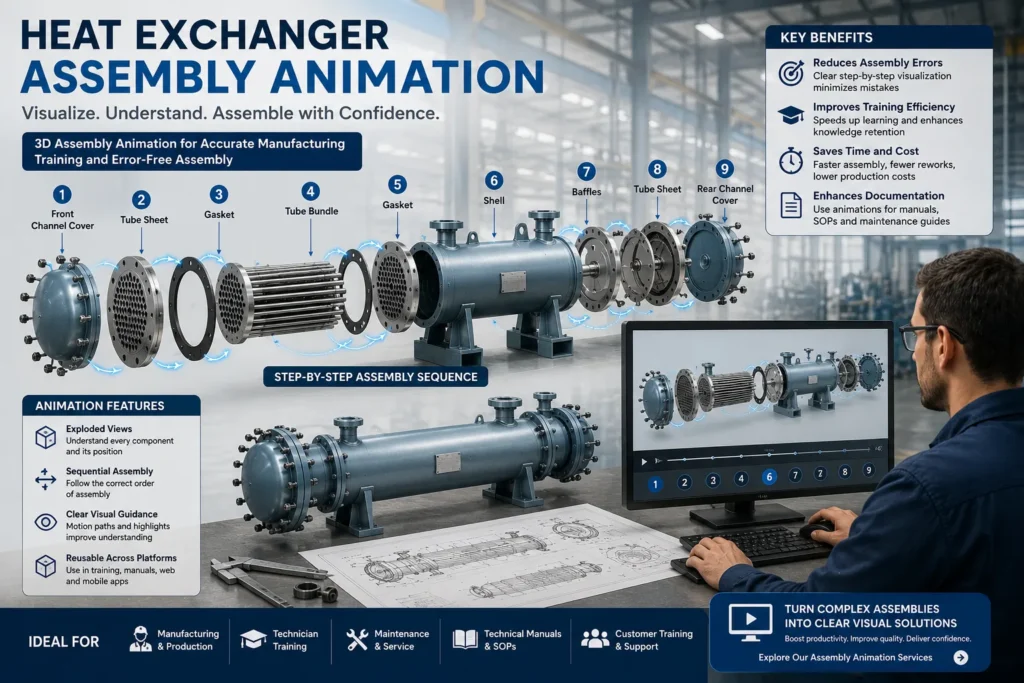
These advantages make assembly animations valuable across manufacturing, service, and aftermarket support.
When Should You Invest in Assembly Animation?
Assembly Animation offers the greatest return when your organization:
- Manufactures complex products
- Frequently introduces new product variants
- Experiences recurring assembly errors
- Trains large or distributed teams
- Supports global customers
- Provides installation guides
- Requires standardized work instructions
- Wants to reduce rework and warranty costs
If multiple technicians perform the same assembly differently, an animation can help establish a single, standardized process.
Frequently Asked Questions
Assembly Animation is a 3D visual representation that demonstrates the correct sequence for assembling products, including component positioning, fastening, motion, and safety instructions.
It provides standardized visual instructions that improve understanding of assembly sequences, part orientation, and installation methods, reducing the likelihood of mistakes.
Not entirely. It works best alongside practical hands-on training, ensuring consistent theoretical understanding before physical assembly begins.
Industries such as industrial machinery, process equipment, laboratory furniture, automotive, sheet metal fabrication, heavy engineering, and material handling commonly use assembly animations for training and documentation.
Yes. Many manufacturers provide assembly animations to customers and field service teams to simplify installation, reduce support requests, and ensure products are assembled correctly the first time.
Conclusion
While live demonstrations remain an important part of practical skills training, they alone cannot guarantee consistency, scalability, or repeatability. Assembly Animation complements hands-on instruction by providing clear, standardized, and reusable visual guidance that technicians can review whenever needed.
For manufacturers aiming to reduce assembly errors, accelerate onboarding, and improve production quality, 3D assembly animations offer a practical and scalable solution. By making complex assembly procedures easier to understand, organizations can minimize rework, support consistent workmanship, and create a more efficient manufacturing process.
Whether you’re training new employees, documenting assembly procedures, or supporting customer installations, investing in Assembly Animation helps transform complex manufacturing knowledge into clear, accessible visual instructions.
Have a Project in Mind?
Need help with 3D animation, industrial visualization, HSE training animation, or product visualization? Tell us about your project and our team will get back to you.