

Table of Contents
Engineering Rework Starts Much Earlier Than Most Manufacturers Think
A quotation is approved. Engineering receives the order. Designers begin modifying an existing CAD model, updating dimensions, selecting components, revising the Bill of Materials (BOM), and checking manufacturing feasibility. A few days later an issue surfaces, an incompatible component was selected, the pricing doesn’t reflect the latest configuration, or the customer requested an option that cannot actually be manufactured.
The engineering team revisits the design, sales issues a revised quotation, procurement updates material requirements, and production schedules shift. What started as a simple customization becomes hours of engineering rework and unnecessary project delays.
For manufacturers offering configurable products, these situations are common. Every manual product configuration introduces opportunities for design inconsistencies, pricing mistakes, and communication gaps between sales, engineering, and manufacturing.
A Product Configurator addresses these challenges by replacing manual interpretation with rule-based configuration. Instead of relying on spreadsheets, emails, and repeated CAD modifications, it validates product options, automates engineering outputs, and generates accurate quotations from a single source of truth.
Rather than simply accelerating the quotation process, a Product Configurator helps manufacturers reduce engineering rework, improve quotation accuracy, and establish a more efficient sales-to-production workflow.
Why Engineering Rework Happens in Custom Manufacturing
Manufacturers today rarely build identical products for every customer. Whether producing industrial equipment, laboratory furniture, sheet metal enclosures, storage systems, conveyors, or modular assemblies, customers expect configurable options while maintaining competitive pricing and delivery schedules.
The challenge is that many engineering teams still rely on manual processes to interpret customer requirements.
Common causes of engineering rework include:
1. Manual Interpretation of Customer Requirements
Sales teams often collect customer specifications through emails, spreadsheets, or handwritten notes. Engineering must then interpret these requirements and determine which product variations are technically feasible.
Even minor misunderstandings can result in incorrect component selection or design revisions later in the project.
2. Reusing Existing CAD Models
Instead of starting from standardized configuration rules, engineers frequently copy previous CAD assemblies and modify them to match new customer requirements.
Although this approach appears faster initially, it often introduces:
- Outdated components
- Incorrect dimensions
- Legacy design features
- Missing documentation
Over time, maintaining multiple variations becomes increasingly difficult.
3. Invalid Product Combinations
Without predefined engineering rules, incompatible options may accidentally be included within quotations.
Examples include:
- Motors that cannot support selected loads
- Frames that exceed structural limits
- Unsupported accessory combinations
- Incorrect material selections
- Components exceeding manufacturing constraints
Engineering discovers these issues only after reviewing the order, leading to unnecessary redesign work.
4. Pricing Based on Manual Calculations
Many quotations are still prepared using spreadsheets.
When product options increase, maintaining accurate pricing becomes increasingly complex.
Incorrect pricing may result in:
- Reduced profit margins
- Incorrect discounts
- Underestimated material costs
- Additional quotation revisions
- Manufacturing Constraints Are Often Missed
Engineering understands manufacturing limitations, but sales teams may not always have complete visibility.
Without configuration rules, quotations may include options that require additional fabrication steps or cannot be produced using existing manufacturing capabilities.
These corrections ultimately become engineering change requests.
The Hidden Cost of Quotation Errors
Quotation mistakes rarely end with an updated price.
Because quotations influence engineering, procurement, manufacturing, and project planning, a single configuration error can impact the entire production process.
Some of the most common consequences include:
1. Increased Engineering Hours
Instead of developing new products or improving existing designs, engineers spend valuable time correcting avoidable configuration errors.
Repeated design modifications reduce overall engineering productivity.
2. Delayed Project Delivery
Every quotation revision affects subsequent activities including:
- CAD modeling
- BOM generation
- Procurement
- Manufacturing planning
- Production scheduling
Even small delays during quotation approval can extend project lead times significantly.
3. Material Procurement Issues
Incorrect configurations often generate inaccurate Bills of Materials.
This may result in:
- Ordering incorrect components
- Material shortages
- Excess inventory
- Procurement delays
These issues increase operational costs throughout the project.
4. Manufacturing Rework
Errors that escape engineering review become significantly more expensive once production begins.
Manufacturing teams may need to:
- Rework fabricated parts
- Replace purchased components
- Modify assemblies
- Delay production schedules
Correcting mistakes during production is considerably more expensive than preventing them during configuration.
5. Reduced Customer Confidence
Customers expect quotations to be accurate the first time.
Repeated revisions create uncertainty regarding:
- Product specifications
- Pricing
- Delivery timelines
- Engineering capability
Consistent quotation accuracy improves customer confidence and shortens the overall sales cycle.
How a Product Configurator Eliminates Engineering Rework
Rather than allowing every project to begin with manual engineering interpretation, a Product Configurator captures engineering knowledge and applies it automatically during product selection.
This transforms engineering from repetitive design work into standardized, rule-driven automation.
1. Standardizes Engineering Rules
Every configurable product follows engineering constraints.
For example:
- Maximum dimensions
- Load capacities
- Material compatibility
- Structural limitations
- Assembly rules
- Manufacturing capabilities
Instead of expecting every salesperson or engineer to remember these constraints, a Product Configurator applies them automatically during product selection.
Every configured product follows predefined engineering standards before reaching production.
2. Prevents Invalid Product Combinations
One of the greatest strengths of a Product Configurator is eliminating impossible configurations before they reach engineering.
For example, if a customer selects:
- A larger cabinet width
- Heavy-duty shelving
- High-capacity accessories
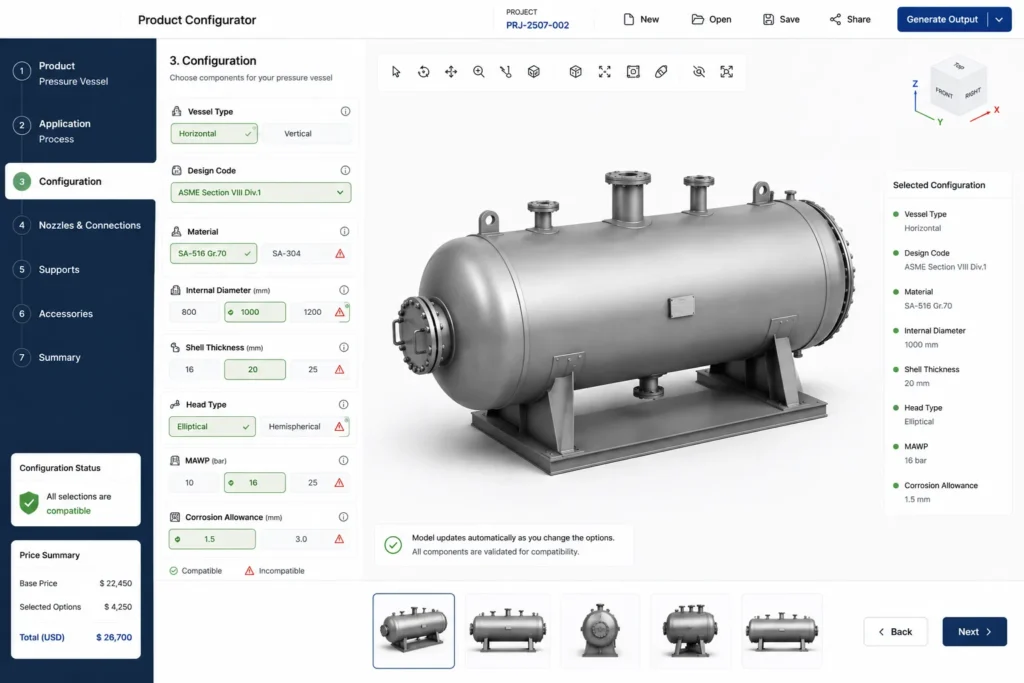
the configurator automatically validates whether the selected frame, hardware, and structural components can safely support the configuration.
If not, incompatible options are prevented immediately.
Instead of discovering design issues days later, validation occurs during configuration.
3. Reduces Repetitive CAD Work
Engineering teams often spend considerable time creating nearly identical product variations.
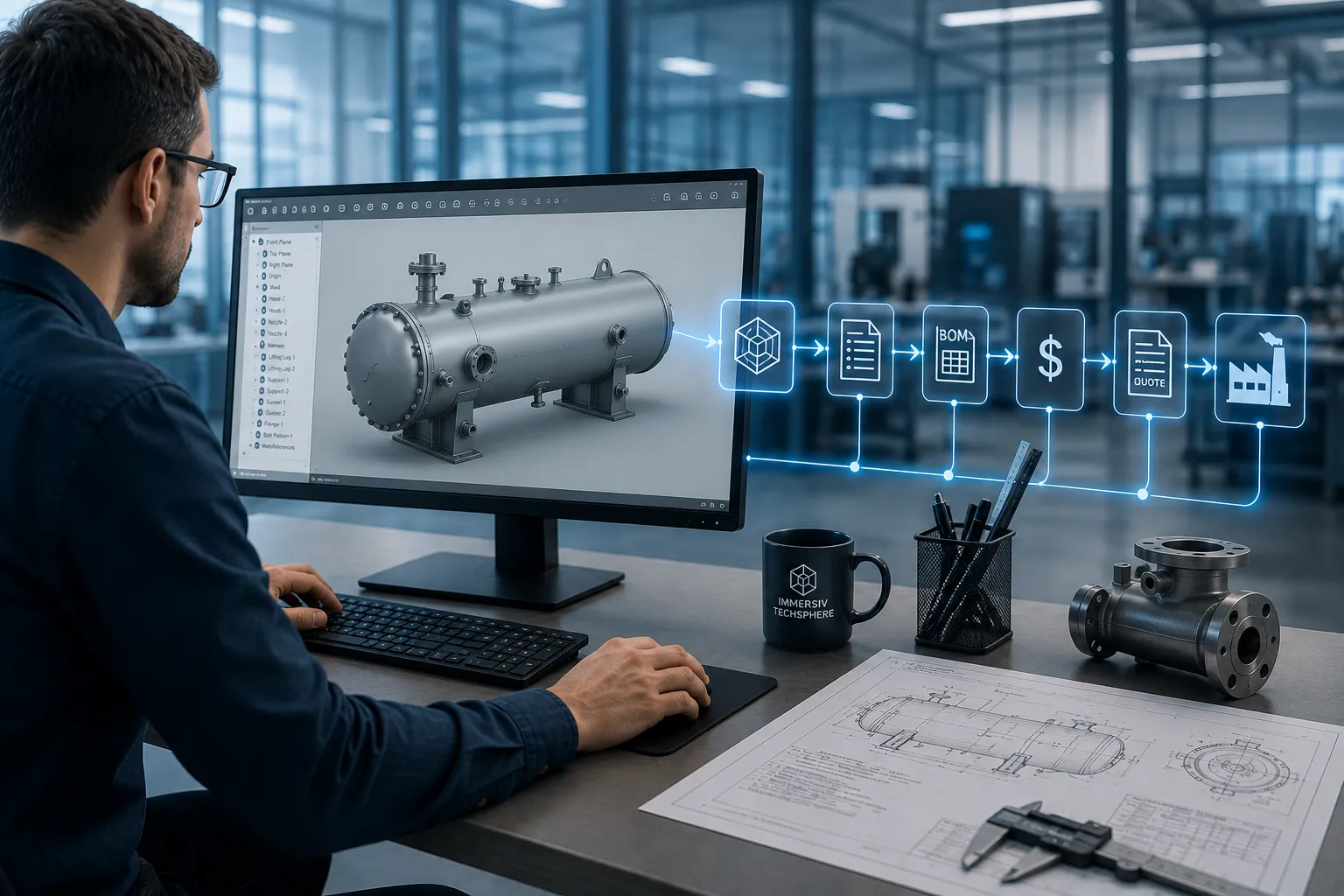
A Product Configurator significantly reduces this repetitive work by automatically generating product-specific outputs based on predefined configuration rules.
Instead of manually modifying every assembly, engineers can automatically generate:
- 3D CAD models
- Assemblies
- Manufacturing drawings
- Configuration-specific BOMs
- Production documentation
This allows engineering teams to focus on product innovation instead of repeatedly modifying existing designs.
4. Creates Consistent Engineering Documentation
Manual documentation introduces inconsistencies between quotations, CAD files, and manufacturing documents.
A Product Configurator ensures that every approved configuration generates standardized engineering outputs based on the selected product options.
This reduces documentation errors while improving consistency across departments.
5. Supports Engineering Knowledge Retention
Many manufacturing companies rely heavily on experienced engineers who understand years of accumulated product knowledge.
A Product Configurator captures this expertise within configurable engineering rules.
Instead of relying on individual experience, organizations create standardized processes that remain consistent as teams grow or change.
How a Product Configurator Improves Quotation Accuracy
Engineering rework often begins with an inaccurate quotation. If the quoted product configuration contains incorrect dimensions, incompatible components, outdated pricing, or incomplete documentation, every downstream process is affected.
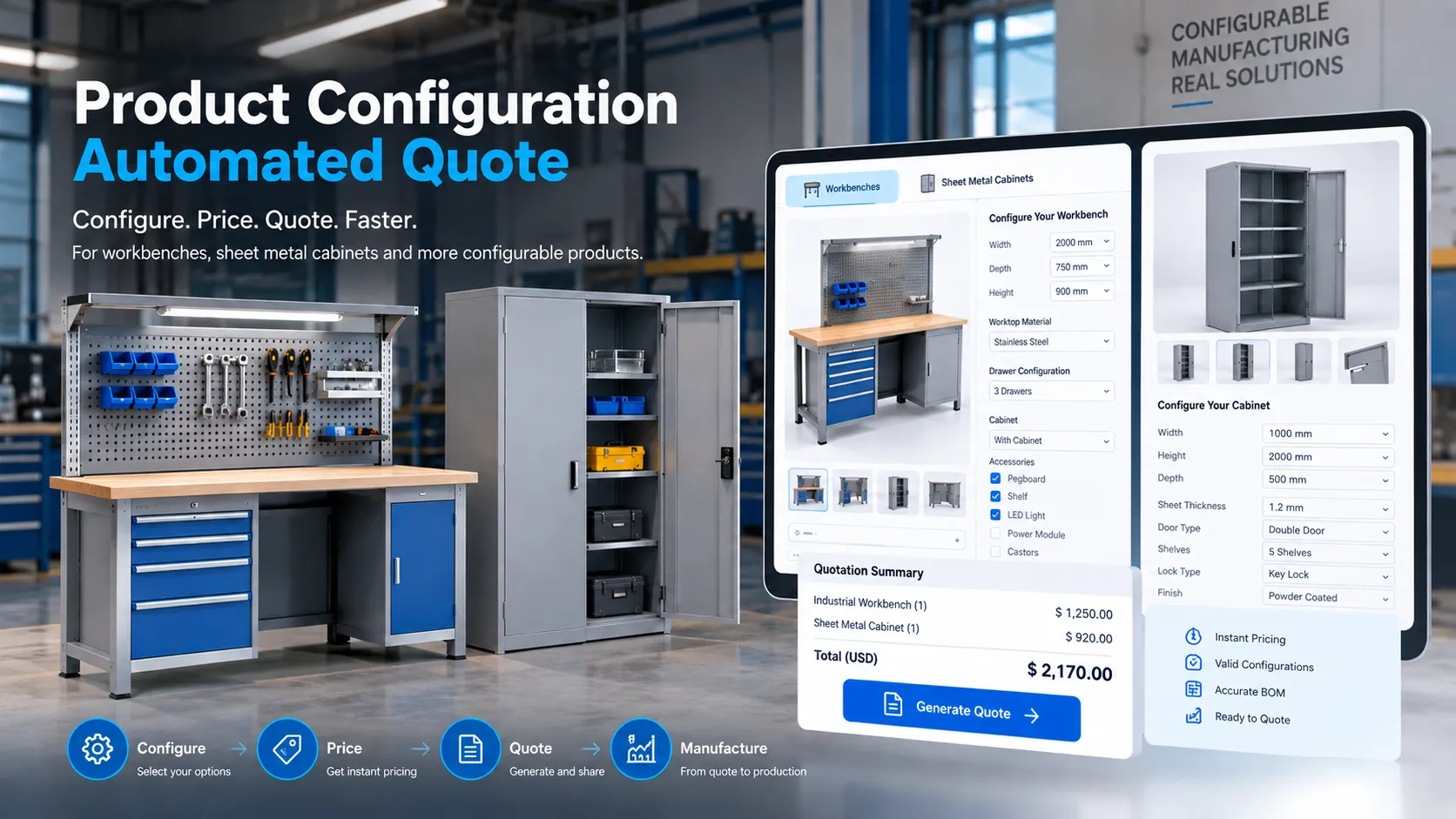
A Product Configurator improves quotation accuracy by ensuring that every configured product follows predefined engineering and pricing rules before the quotation is generated. This creates greater consistency between sales, engineering, procurement, and manufacturing while significantly reducing manual intervention. Manufacturers implementing Configurator & CPQ solutions can automate configuration, pricing, and quotation workflows while ensuring every quote is based on validated engineering data.
1. Generates Accurate Pricing Automatically
Pricing configurable products manually becomes increasingly difficult as product variations grow. Different dimensions, materials, accessories, finishes, and optional features can create hundreds or even thousands of possible combinations.
A Product Configurator automatically calculates pricing based on approved configuration rules, ensuring that every selected option contributes to the final quotation correctly. Instead of relying on spreadsheets or manual calculations, pricing remains consistent across every quotation.
This helps manufacturers:
- Reduce pricing inconsistencies
- Protect profit margins
- Eliminate manual calculation errors
- Respond to RFQs faster
2 .Creates Configuration-Specific Bills of Materials (BOMs)
An accurate quotation requires more than the correct selling price—it also requires an accurate Bill of Materials.
With a Product Configurator, every valid product configuration automatically generates a BOM that reflects the exact components required for manufacturing. This minimizes discrepancies between the quotation, engineering documentation, procurement, and production.
Accurate BOM generation helps reduce:
- Incorrect material procurement
- Inventory discrepancies
- Component shortages
- Last-minute engineering changes
3. Ensures Every Quotation Uses Approved Product Options
Many quotation errors occur because outdated product information continues to circulate across different departments.
A Product Configurator provides a centralized configuration environment where only approved products, dimensions, materials, accessories, and engineering rules are available for selection.
This ensures that sales teams cannot accidentally quote discontinued products or unsupported configurations, resulting in greater consistency throughout the organization.
4. Accelerates RFQ Response Times
Customers increasingly expect fast and accurate quotations.
When engineering teams are required to review every product variation manually, quotation turnaround times increase and valuable engineering resources become tied up in repetitive tasks.
A Product Configurator automates much of this process, enabling sales teams to generate technically validated quotations much faster while engineering focuses on higher-value design and development activities.
Faster response times not only improve operational efficiency but can also increase the likelihood of winning new business.
Engineering Workflow Before vs. After a Product Configurator
The impact of a Product Configurator becomes even clearer when comparing traditional engineering workflows with an automated configuration process.
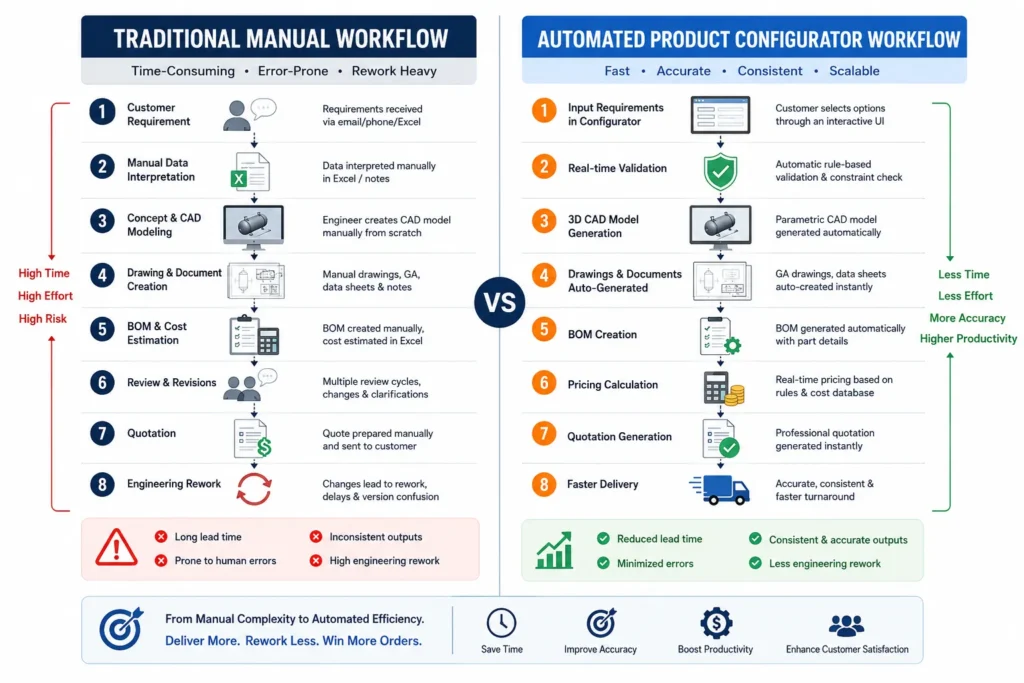
1. Before Using a Product Configurator
A typical workflow often looks like this:
- Sales collects customer requirements manually.
- Engineering reviews emails and spreadsheets.
- Existing CAD models are copied and modified.
- Bills of Materials are created manually.
- Pricing is calculated using spreadsheets.
- Quotations are reviewed multiple times.
- Engineering revisions continue after order confirmation.
- Manufacturing discovers inconsistencies during production.
This process depends heavily on manual coordination between departments, making it prone to errors and delays.
2. After Implementing a Product Configurator
With a Product Configurator, the workflow becomes significantly more streamlined:
- Customer requirements are configured using predefined product rules.
- Only technically valid combinations are allowed.
- Pricing is calculated automatically.
- CAD models and engineering drawings are generated based on approved configurations.
- Bills of Materials are created automatically.
- Quotations are generated using validated engineering data.
- Manufacturing receives accurate production-ready information.
Instead of repeatedly correcting errors, engineering teams spend more time improving products and supporting innovation.
Industries That Benefit Most from a Product Configurator
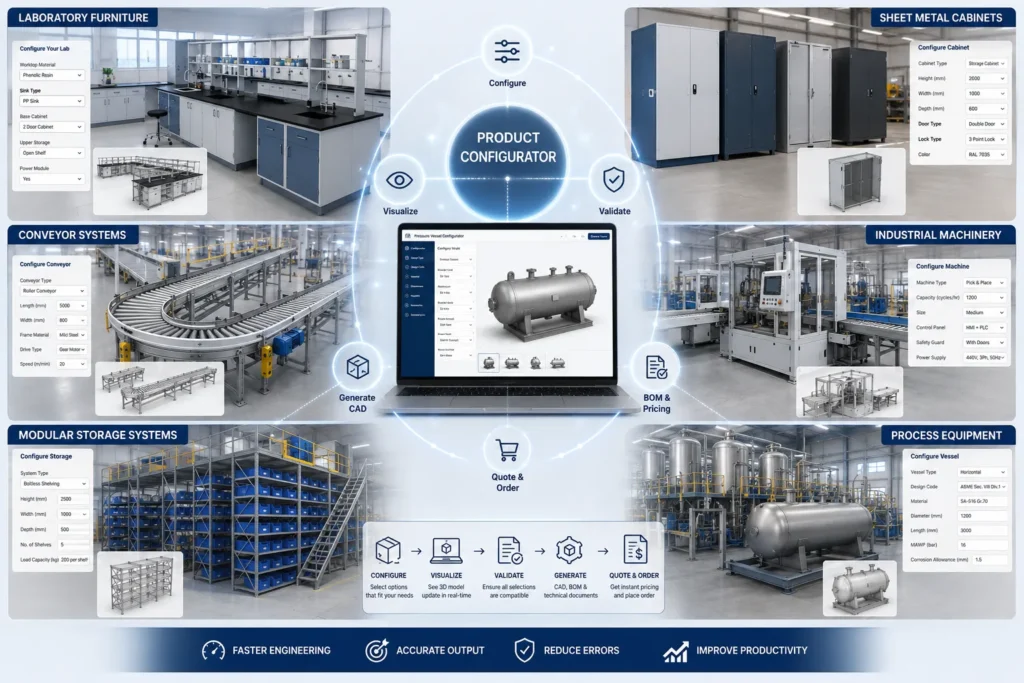
While almost any manufacturer offering configurable products can benefit from a Product Configurator, some industries experience particularly significant improvements due to the complexity and variability of their product offerings.
1. Industrial Equipment Manufacturing
Industrial machinery often includes configurable frames, motors, drives, safety systems, capacities, and optional accessories. Managing these variations manually increases engineering complexity, making Product Configurators especially valuable.
2. Laboratory Furniture
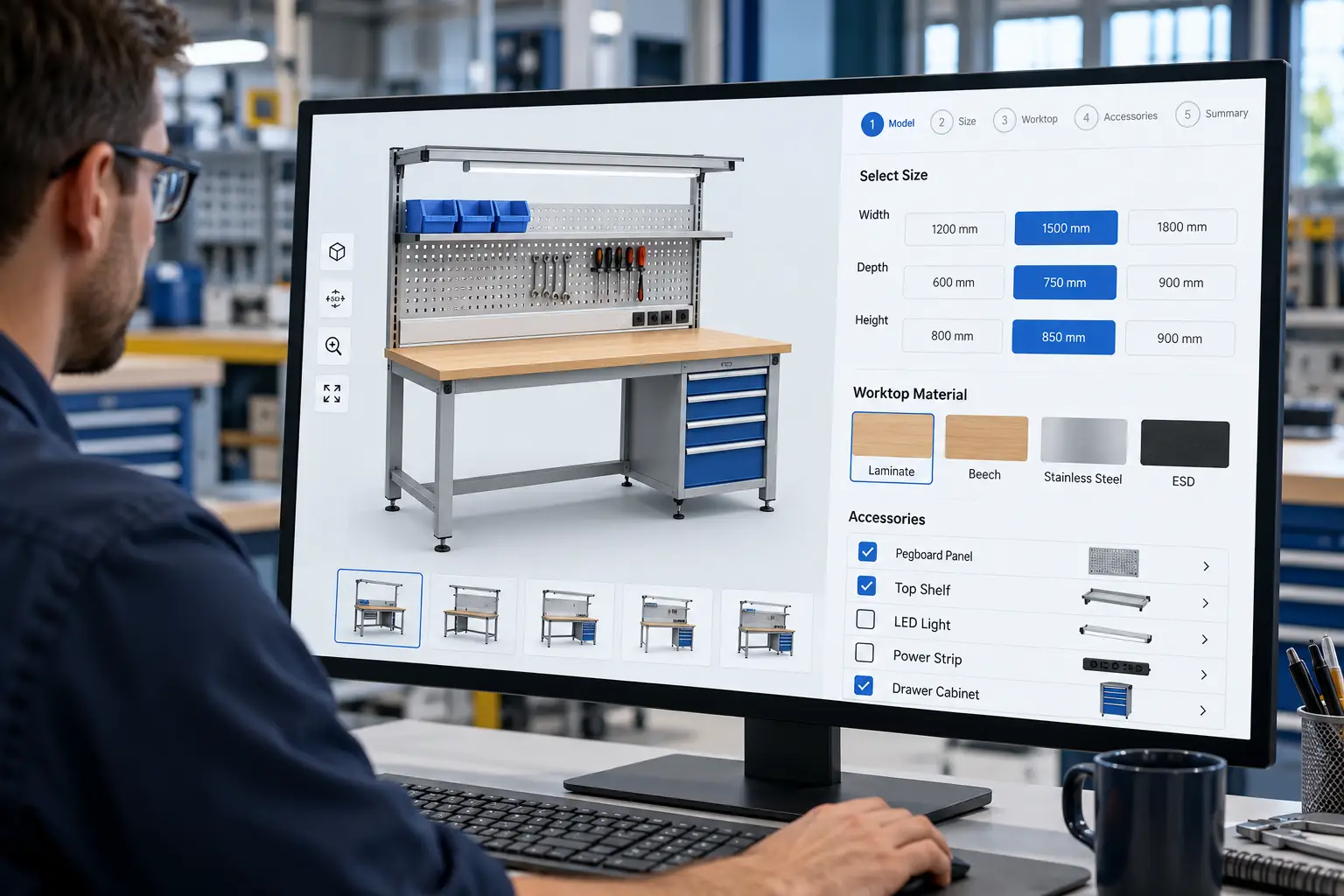
Laboratory furniture projects involve customized layouts, cabinet sizes, worktops, storage options, sinks, utilities, and accessories. A Workbench Configurator allows manufacturers to configure laboratory workstations quickly while automatically generating accurate engineering drawings, Bills of Materials (BOMs), and quotations based on predefined design rules. Combined with a Product Configurator, it helps standardize product variations, reduce engineering effort, and improve quotation accuracy for every project.
3. Sheet Metal Products
Manufacturers producing electrical enclosures, cabinets, workstations, storage systems, and fabrication assemblies frequently manage multiple dimensions, materials, bends, cutouts, and hardware configurations. Automated configuration minimizes repetitive CAD work and improves documentation accuracy.
4. Material Handling and Conveyor Systems
Conveyor lengths, drive systems, supports, sensors, guarding, and accessories often vary from one installation to another. Product Configurators ensure that every configured system complies with engineering constraints before manufacturing begins.
5. Modular Furniture and Storage Systems
Office furniture, warehouse storage, shelving systems, and modular workstations typically offer numerous configurable dimensions and accessories. Product Configurators simplify these variations while improving quotation speed and engineering consistency.
6. Engineer-to-Order (ETO) Manufacturers
Companies producing highly customized products often face the greatest engineering workload. Even when products are not fully standardized, a Product Configurator can automate recurring engineering tasks and reduce repetitive design effort.
Best Practices for Implementing a Product Configurator
Successful implementation goes beyond selecting software. The greatest value comes from accurately capturing engineering knowledge and creating standardized configuration processes.
Consider the following best practices:
1. Standardize Product Families
Identify products that share common components, dimensions, or design logic. Standardization simplifies configuration and reduces long-term maintenance.
2. Define Engineering Rules Clearly
Document compatibility rules, dimensional constraints, material limitations, structural requirements, and manufacturing restrictions before building the configurator.
Well-defined engineering rules form the foundation of a successful Product Configurator.
3. Connect Engineering and Business Systems
Integrating the Product Configurator with CAD software, ERP systems, and Configure Price Quote (CPQ) platforms enables information to flow seamlessly between departments while minimizing duplicate data entry.
4. Automate Documentation Wherever Possible
A Product Configurator delivers the greatest efficiency when it generates not only quotations but also engineering drawings, BOMs, CAD models, PDFs, DXF files, and other production documents automatically.
5. Review and Update Configuration Rules Regularly
As products evolve, engineering rules should be reviewed periodically to reflect new components, pricing, manufacturing capabilities, and design improvements.
Keeping configuration rules current ensures long-term accuracy and reliability.
Why Product Configurators Deliver Long-Term ROI
The benefits of a Product Configurator extend far beyond faster quotations.
Over time, manufacturers often experience measurable improvements across multiple business functions, including engineering, sales, procurement, and manufacturing.
Some of the long-term advantages include:
- Reduced engineering rework
- Improved quotation accuracy
- Faster response to customer inquiries
- Consistent engineering documentation
- Shorter order processing times
- Fewer manufacturing errors
- Better utilization of engineering resources
- Improved collaboration between sales and engineering
- Enhanced customer experience
- Greater scalability as product portfolios expand
Rather than repeatedly solving the same engineering problems, teams can focus on developing new products, improving existing designs, and delivering greater value to customers.
How Immersiv Techsphere Can Help
At Immersiv Techsphere, we help manufacturers implement tailored Product Configurator and Configure Price Quote (CPQ) solutions that simplify complex product configuration while improving engineering efficiency and quotation accuracy.
Our approach begins with understanding your products, engineering rules, and manufacturing workflows. We work closely with your team to define configurable product logic, automate engineering decisions, and create a solution that fits your existing design and business processes.
Our Product Configurator solutions can integrate with CAD automation workflows to generate configuration-specific 3D models, engineering drawings, Bills of Materials (BOMs), and manufacturing documents automatically. Combined with CPQ capabilities, they also help sales teams generate technically validated quotations using accurate pricing and approved product options.
Whether you manufacture industrial equipment, laboratory furniture, sheet metal products, modular systems, or other configurable products, our goal is to reduce repetitive engineering work, improve collaboration between sales and engineering, and create a connected workflow from product configuration to production.
Conclusion
As manufacturers continue to offer more product customization, relying on manual engineering processes becomes increasingly difficult to sustain. Repetitive CAD modifications, quotation revisions, and configuration errors not only consume valuable engineering time but also affect manufacturing efficiency, delivery schedules, and customer satisfaction.
A Product Configurator addresses these challenges by standardizing product rules, validating configurations, automating engineering documentation, and improving quotation accuracy. Instead of repeatedly correcting avoidable errors, engineering teams can focus on innovation while sales teams deliver faster, more reliable quotations.
For organizations looking to streamline their sales-to-engineering workflow, reduce engineering rework, and support scalable growth, implementing a Product Configurator is more than a productivity improvement, it is a strategic investment in building a more efficient, accurate, and digitally connected manufacturing process.
Have a Project in Mind?
Need help with 3D animation, industrial visualization, HSE training animation, or product visualization? Tell us about your project and our team will get back to you.