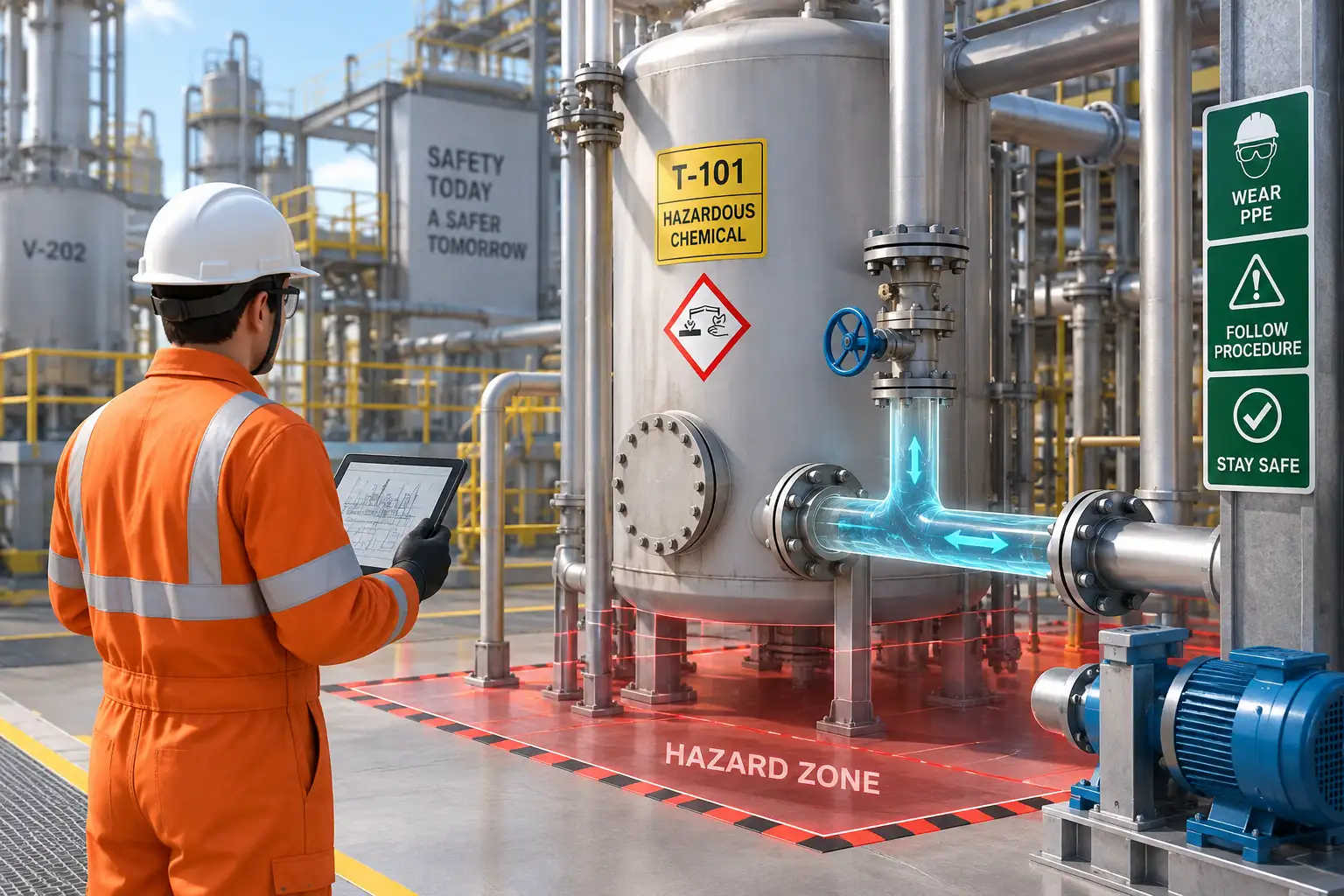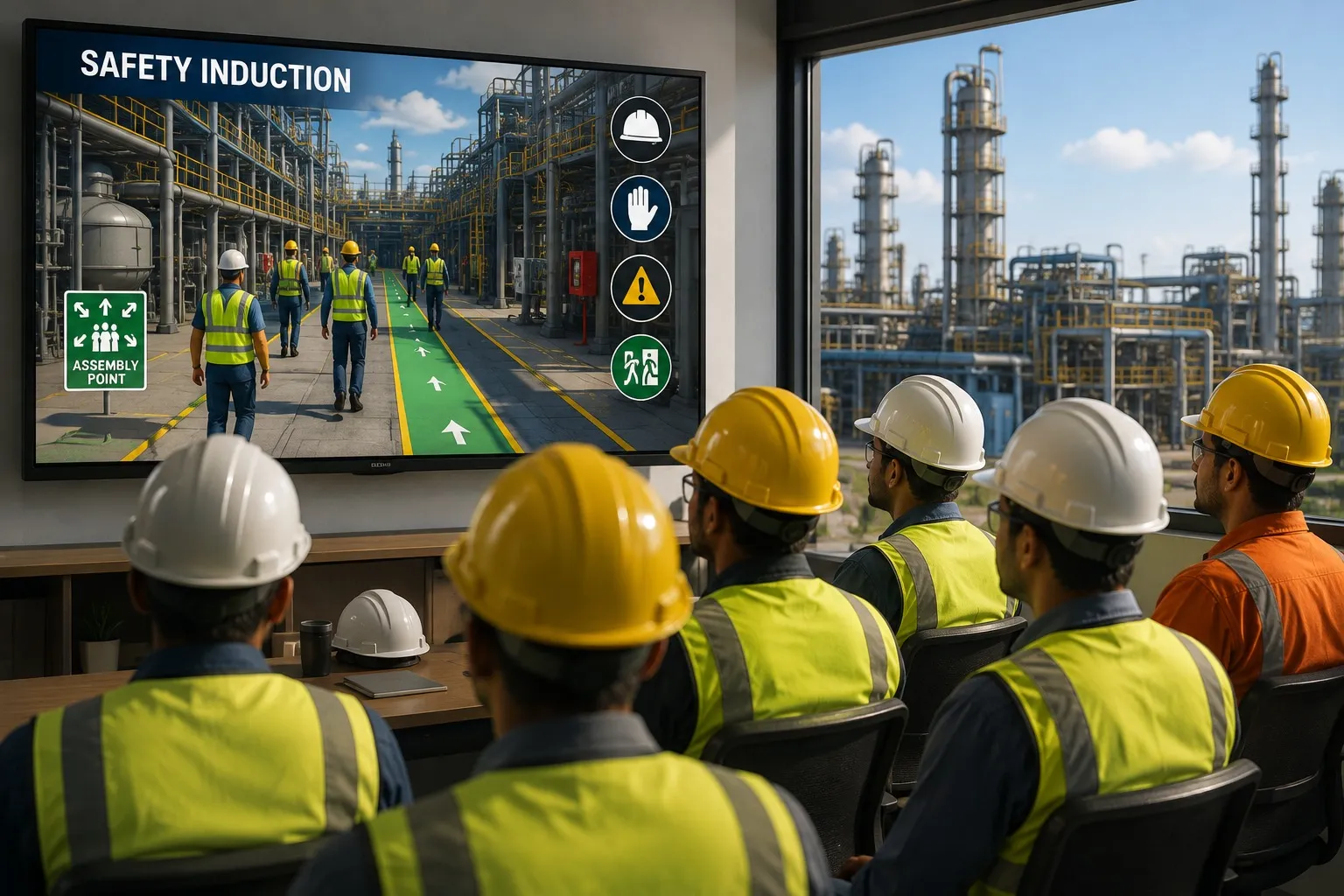

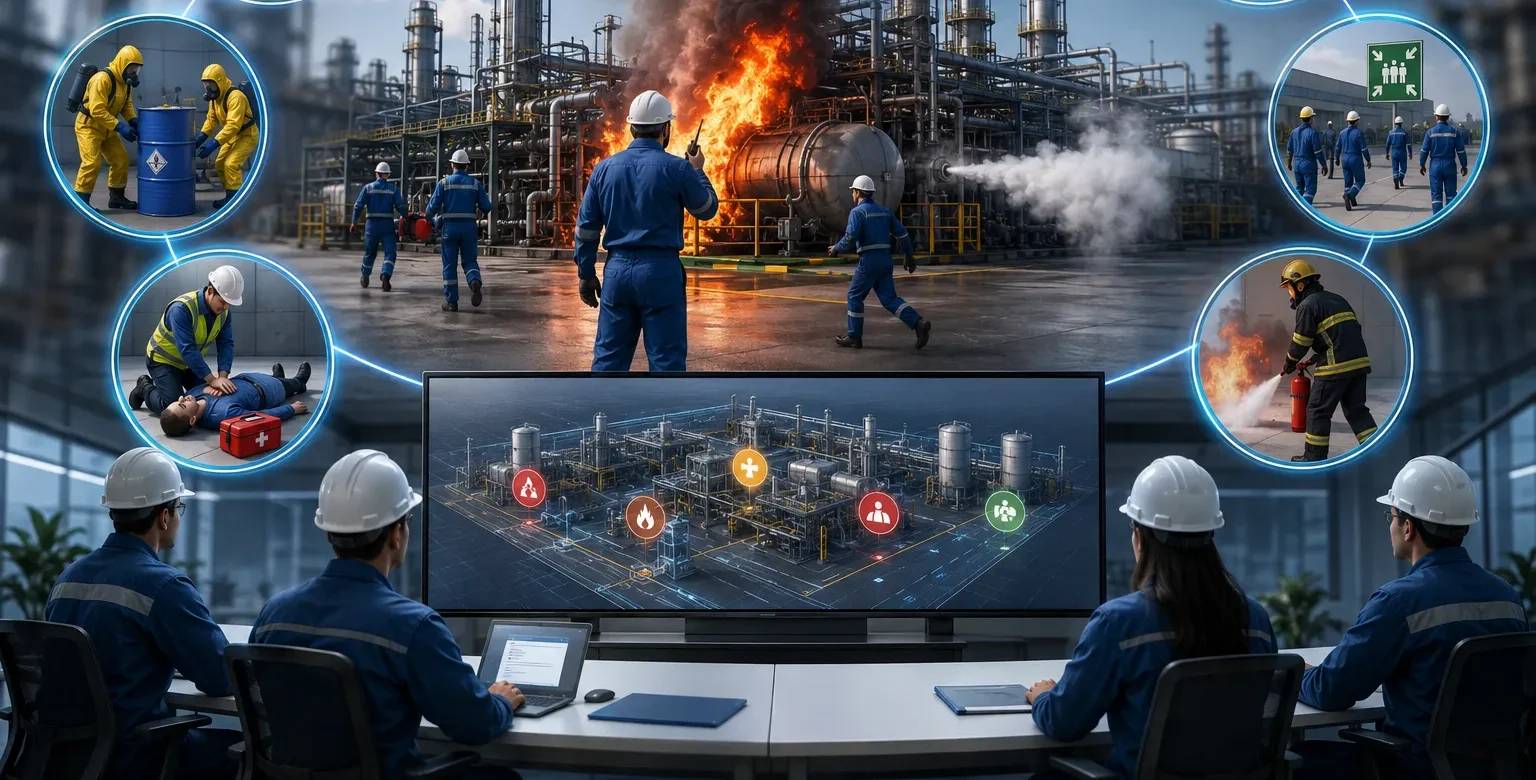

Table of Contents
Introduction
Industrial emergencies are unpredictable. A fire, chemical spill, gas leak, machinery failure, confined space incident, or electrical accident can escalate within minutes if employees are not trained to respond correctly. During such situations, every second counts, and confusion can lead to severe injuries, equipment damage, environmental impact, or even loss of life.
This is why Emergency Response Training is a fundamental part of every organization’s Environment, Health, and Safety (EHS) program. It equips employees with the knowledge and confidence to recognize emergencies, take immediate action, communicate effectively, and follow established emergency procedures.
While traditional classroom sessions, safety manuals, and mock drills remain important, they often struggle to replicate complex industrial emergencies safely and consistently. This has led many organizations to adopt 3D Safety Animation through industrial animation services that bring emergency scenarios to life using realistic engineering-based visual simulations.
By combining engineering accuracy with engaging visual storytelling, EHS Animation and HSE Animation enable employees to understand emergency procedures more effectively than text-based instructions alone. Workers can observe hazardous situations, identify correct actions, and learn standardized response procedures without being exposed to actual danger.
Whether your organization operates in manufacturing, oil & gas, pharmaceuticals, chemical processing, power generation, mining, or heavy engineering, integrating animated safety training into your emergency preparedness program can significantly improve workforce readiness and support a stronger safety culture.
What is Emergency Response Training?
Emergency Response Training is a structured safety training program designed to prepare employees to respond safely, quickly, and effectively during workplace emergencies such as fires, chemical spills, gas leaks, equipment failures, electrical incidents, medical emergencies, natural disasters, and evacuations.
An effective emergency response program typically includes:
- Hazard identification
- Emergency preparedness planning
- Alarm recognition
- Evacuation procedures
- Emergency Action Plan (EAP)
- Fire response
- Chemical spill response
- Incident communication
- Rescue procedures
- First aid awareness
- Incident reporting
- Post-incident recovery
The primary objective is not only to comply with safety regulations but also to ensure that every employee understands their responsibilities before an emergency occurs.
Key Takeaways
- Emergency Response Training prepares employees to react quickly and correctly during workplace emergencies.
- 3D Safety Animation transforms complex emergency procedures into realistic visual learning experiences.
- Animated safety training improves knowledge retention, employee engagement, and procedural consistency.
- EHS Animation allows organizations to simulate hazardous situations that cannot be demonstrated safely in real life.
- HSE Animation helps standardize emergency procedures across multiple locations and multilingual workforces.
- Visual safety training complements practical drills and strengthens emergency preparedness programs.
- Customized animations can accurately represent your facility, equipment, operating procedures, and emergency action plans.
Why Emergency Response Training Is More Important Than Ever
Industrial facilities have become increasingly complex. Modern manufacturing plants, refineries, pharmaceutical facilities, chemical processing units, and power plants operate with sophisticated machinery, hazardous chemicals, pressurized systems, and automated production lines.
A single emergency can quickly affect multiple departments if employees are unsure how to respond.
Effective Emergency Response Training helps organizations:
- Protect employees from injury
- Reduce response time during emergencies
- Minimize property damage
- Prevent environmental contamination
- Support business continuity
- Improve coordination between departments
- Strengthen organizational resilience
- Meet regulatory and compliance requirements
Rather than relying on instinct during an emergency, employees follow predefined procedures developed specifically for their workplace.
Why Traditional Emergency Response Training Has Limitations
Many organizations continue to depend primarily on classroom presentations, printed manuals, PowerPoint slides, and periodic emergency drills.
While these methods remain valuable, they also present several challenges.
1. Limited Visualization
Reading emergency procedures does not always help employees understand how an incident develops in real life.
For example, explaining the sequence of events during a chemical leak is far less effective than showing how the leak spreads, how alarms activate, where personnel should evacuate, and how emergency teams respond.
2. Practical Drills Cannot Cover Every Scenario
Conducting full-scale emergency drills requires:
- Significant planning
- Production downtime
- Multiple departments
- Safety supervision
- Operational costs
Because of these constraints, organizations typically conduct only a limited number of drills each year.
Employees may never experience certain emergency scenarios until an actual incident occurs.
3. High-Risk Situations Cannot Be Demonstrated Safely
Some emergencies simply cannot be recreated during training.
Examples include:
- Toxic gas releases
- Explosions
- Arc flash incidents
- Boiler failures
- Pressure vessel ruptures
- Major chemical spills
Without visual demonstrations, employees must rely entirely on imagination.
4. Inconsistent Training Delivery
Different trainers may explain emergency procedures differently.
Over time, this can result in inconsistent understanding among employees working across multiple plants, shifts, or geographic locations.
Organizations benefit from standardized training materials that deliver identical information every time.
Why 3D Safety Animation Is Transforming Emergency Response Training
Traditional safety training explains emergency procedures whereas 3D safety training animation services transform complex Emergency Response Training into immersive visual experiences that employees can easily understand and remember.
3D Safety Animation shows employees exactly how those procedures work in realistic industrial environments.
Instead of imagining an emergency, trainees watch the incident unfold step by step while learning the correct sequence of actions.
This creates a far more immersive learning experience.
Animations can accurately demonstrate:
- Fire development
- Smoke movement
- Chemical spill spread
- Gas leak dispersion
- Equipment malfunction
- Emergency shutdown procedures
- Personnel evacuation
- Rescue operations
- Incident communication
- Safe assembly points
Because employees can visualize the entire emergency process, they develop a deeper understanding of both hazards and response procedures.
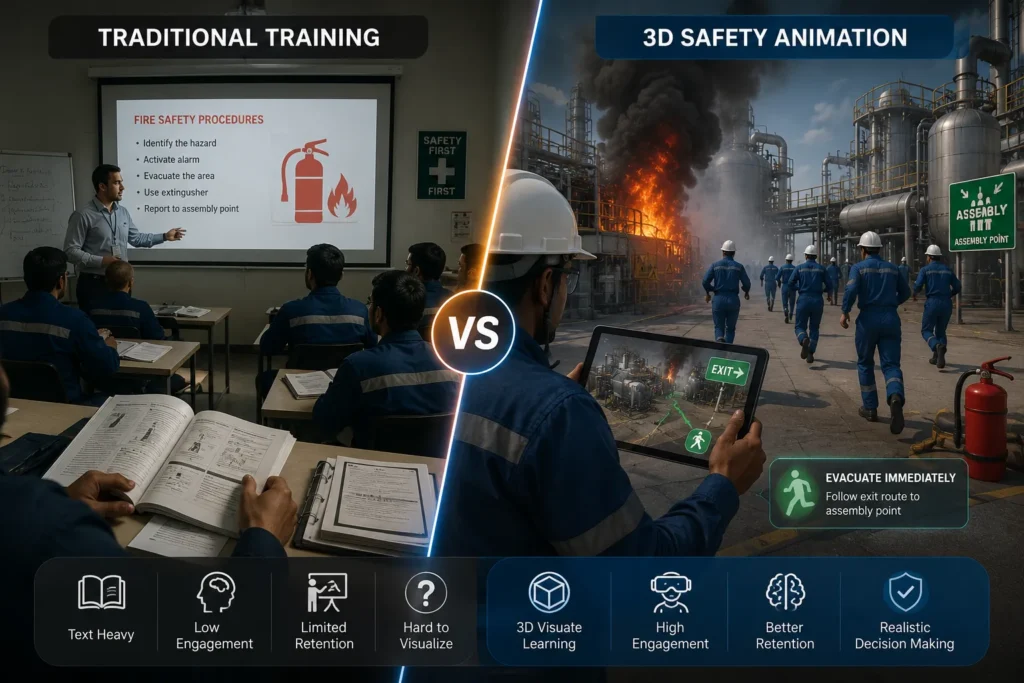
Traditional Training vs. 3D Safety Animation
| Traditional Emergency Training | 3D Safety Animation |
| Text-heavy manuals | Realistic visual demonstrations |
| Classroom lectures | Scenario-based learning |
| Difficult to visualize emergencies | Employees observe actual emergency sequences |
| Limited practical drills | Unlimited virtual scenarios |
| Instructor-dependent | Standardized training delivery |
| Lower engagement | Higher learner engagement |
| Difficult to update | Easy to revise when procedures change |
| Language barriers | Visual communication supported with multilingual narration |
Rather than replacing practical drills, 3D Safety Animation enhances them by ensuring employees understand the procedures before participating in physical exercises.
How 3D Safety Animation Improves Emergency Response Training
1. Creates Realistic Emergency Simulations
Animations recreate actual industrial environments using engineering models, facility layouts, equipment, and operating conditions.
Employees learn how emergencies evolve within their own workplace instead of generic examples.
2. Improves Knowledge Retention
According to educational research, visual learning significantly improves comprehension and long-term memory compared to text-only instruction.
Employees remember emergency procedures more effectively when they observe realistic situations rather than simply reading about them.
This is particularly valuable for infrequent but high-risk emergencies.
3. Reduces Fear During Actual Emergencies
One of the biggest causes of delayed emergency response is uncertainty.
Employees often panic because they have never experienced the situation before.
By repeatedly watching emergency scenarios through EHS Animation, workers become familiar with alarms, evacuation routes, emergency equipment, and response procedures before an actual incident occurs.
This familiarity helps improve decision-making under pressure.
4. Supports Multilingual Workforces
Industrial facilities frequently employ workers from different linguistic backgrounds.
Animated safety training reduces dependence on lengthy written instructions.
Voiceovers and subtitles can be provided in multiple languages while the visuals remain universally understandable.
5. Standardizes Emergency Procedures
Whether training ten employees or ten thousand, animation ensures every learner receives the same accurate instruction.
This consistency becomes especially valuable for organizations operating multiple manufacturing plants or project sites.
What Should an Emergency Response Training Program Include?
A comprehensive emergency preparedness program should address a wide range of potential workplace incidents.
Essential topics include:
- Fire emergency response
- Emergency Action Plan (EAP)
- Evacuation procedures
- Chemical spill response
- Hazard communication
- Gas leak response
- Lockout/Tagout during emergencies
- First aid awareness
- Rescue procedures
- Emergency shutdown processes
- Emergency communication hierarchy
- Incident reporting
- Assembly point management
- Coordination with external emergency services
- Post-incident review and corrective actions
Each of these topics can be significantly enhanced using 3D Safety Animation, allowing employees to visualize the correct sequence of actions in realistic workplace scenarios.
Emergency Response Training Checklist
Organizations should ensure their emergency preparedness program includes:
✔ Emergency Action Plan (EAP)
✔ Clearly defined evacuation routes
✔ Emergency exits and assembly points
✔ Fire extinguisher training
✔ Chemical spill response procedures
✔ Gas leak emergency protocols
✔ Machine isolation procedures
✔ Electrical emergency response
✔ Emergency communication process
✔ First aid awareness
✔ Rescue team responsibilities
✔ Incident reporting workflow
✔ Periodic refresher training
✔ Emergency drill evaluation
✔ Continuous improvement through incident reviews
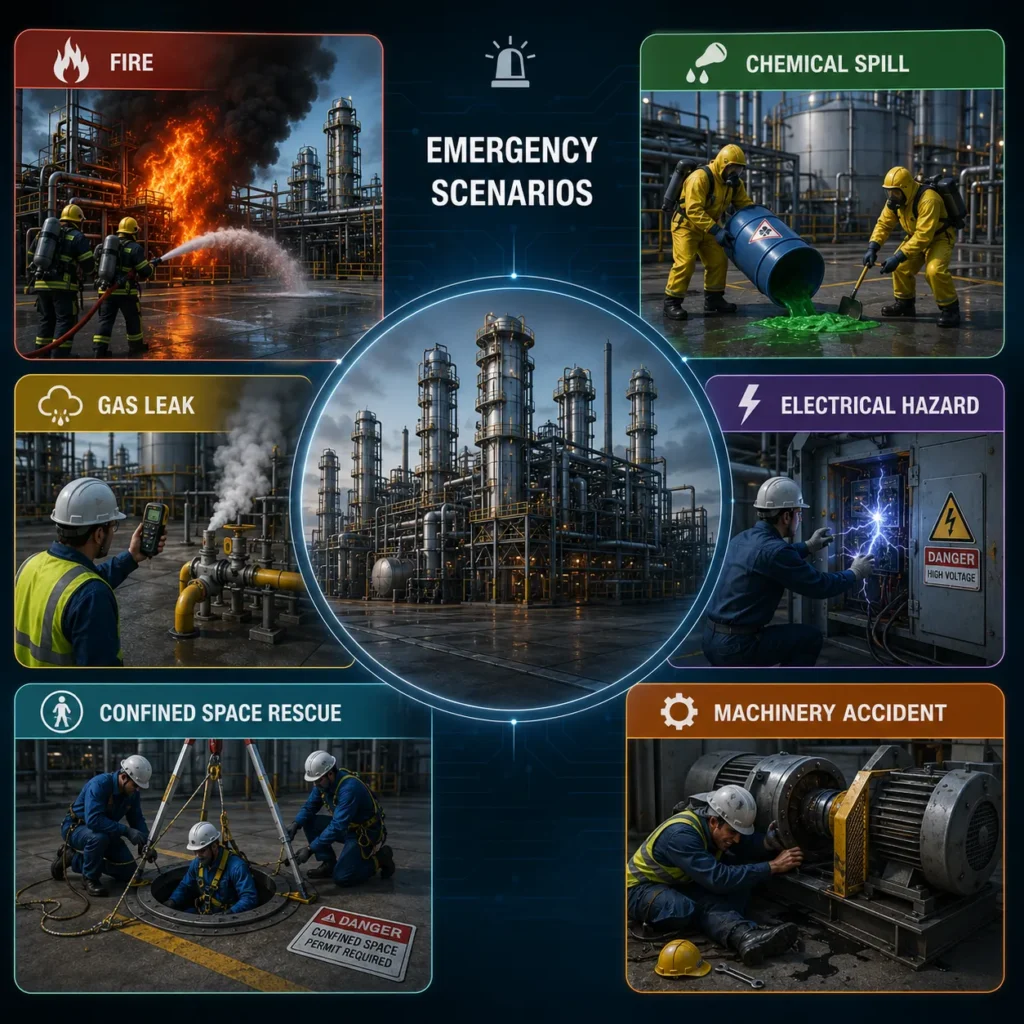
Emergency Scenarios That Can Be Effectively Taught Using 3D Safety Animation
One of the greatest advantages of 3D Safety Animation is its ability to recreate hazardous situations that cannot be safely demonstrated during conventional training sessions. Employees can observe how an incident unfolds, understand the correct sequence of actions, and learn the organization’s Emergency Action Plan (EAP) without being exposed to actual danger.
Below are some of the most common emergency scenarios where animated training delivers significant value.
1. Fire Emergency Response Training
Fire emergencies remain one of the most common industrial hazards across manufacturing facilities, warehouses, chemical plants, power stations, and commercial buildings.
Traditional fire safety presentations often explain evacuation procedures using diagrams or floor plans. However, employees may struggle to visualize how quickly smoke spreads, how evacuation routes become inaccessible, or when to use fire extinguishers.
A 3D Safety Animation can demonstrate the complete emergency sequence, including:
- Identifying the source of the fire
- Recognizing fire alarm systems
- Activating emergency alarms
- Using the appropriate fire extinguisher
- Safe evacuation routes
- Emergency exit procedures
- Assembly point protocols
- Fire warden responsibilities
- Coordination with emergency responders
Employees gain a realistic understanding of how a fire emergency develops, allowing them to react more confidently during an actual incident.
2. Chemical Spill Emergency Response
Chemical manufacturing, pharmaceuticals, laboratories, and process industries frequently handle hazardous substances that require immediate containment during accidental releases.
A chemical spill can expose workers to toxic substances, contaminate equipment, and impact the surrounding environment if not managed properly.
Using EHS Animation, organizations can visually demonstrate:
- Spill identification
- Hazard assessment
- Emergency notification procedures
- PPE selection
- Spill containment methods
- Isolation of affected areas
- Decontamination procedures
- Safe disposal practices
- Incident reporting workflow
Since many chemical incidents cannot be recreated during practical training, animation provides a safe and highly effective learning alternative.
3. Gas Leak Emergency Response
Industrial facilities handling compressed gases, natural gas, ammonia, hydrogen, or other hazardous gases require well-defined emergency response procedures.
Animated training helps employees understand:
- Early warning signs
- Gas detection systems
- Alarm activation
- Emergency shutdown procedures
- Ventilation systems
- Safe evacuation
- Restricted access zones
- Communication protocols
- Emergency isolation of equipment
Visual demonstrations help employees understand how invisible gases spread throughout a facility, which is difficult to communicate using text alone.
4. Confined Space Emergency Response
Confined spaces such as tanks, vessels, pits, silos, and underground chambers present unique hazards including oxygen deficiency, toxic atmospheres, and restricted access.
Confined space emergencies often require specialized rescue procedures.
A customized HSE Animation can demonstrate:
- Permit-to-work requirements
- Atmospheric testing
- Continuous gas monitoring
- PPE requirements
- Rescue equipment
- Entry and exit procedures
- Emergency communication
- Rescue team coordination
- Post-rescue medical response
Because actual rescue drills can be complex and resource-intensive, animated simulations help reinforce these critical procedures.
5. Electrical Emergency Response
Electrical incidents involving high-voltage equipment, switchgear, or energized machinery require immediate and disciplined action.
Training animations can explain:
- Electrical hazard identification
- Arc flash risks
- Equipment isolation
- Emergency shutdown
- Lockout/Tagout procedures
- Safe rescue methods
- Emergency medical response
- Incident reporting
Employees learn not only what to do, but also what actions must never be attempted during electrical emergencies.
6. Machinery and Equipment Emergencies
Unexpected machine failures can result in entanglement, crushing injuries, hydraulic failures, or mechanical hazards.
Animations can demonstrate:
- Emergency stop procedures
- Machine isolation
- Area evacuation
- Lockout/Tagout verification
- Communication with maintenance teams
- Safe restart procedures
Showing these procedures visually helps reduce confusion during equipment-related emergencies.
7. Medical Emergency Response
Medical emergencies can occur in any workplace, regardless of industry.
Animated training may include:
- Emergency communication
- First aid response
- CPR awareness
- Safe transportation of injured personnel
- AED awareness
- Emergency medical coordination
- Incident reporting
While medical professionals provide treatment, employees learn how to respond safely until assistance arrives.
8. Natural Disaster Preparedness
Organizations operating in regions prone to earthquakes, floods, cyclones, or severe storms benefit from visual emergency preparedness training.
Animations can demonstrate:
- Emergency warnings
- Shelter procedures
- Safe evacuation
- Equipment shutdown
- Utility isolation
- Communication hierarchy
- Recovery planning
These scenarios are difficult to replicate during practical drills, making animation a valuable educational tool.
Industry Applications of Emergency Response Training Animation
Emergency preparedness requirements vary across industries, but the objective remains the same to protect people, assets and operations.
1. Manufacturing
Manufacturing facilities commonly use Emergency Response Training for:
- Fire emergencies
- Machine accidents
- Chemical storage incidents
- Electrical hazards
- Production line evacuations
2. Oil & Gas
Oil & Gas facilities benefit from animations covering:
- Hydrocarbon leaks
- Emergency shutdown systems (ESD)
- Fire suppression
- Explosion response
- Permit-to-work emergencies
- Offshore evacuation
3. Chemical Processing
Chemical plants require detailed training on:
- Toxic releases
- Spill containment
- PPE selection
- Hazard communication
- Emergency isolation
- Environmental protection
4. Pharmaceutical Manufacturing
Animations support:
- Cleanroom evacuation
- Chemical handling
- Laboratory incidents
- Fire safety
- Contamination control
- Emergency communication
5. Power Generation
Power plants commonly train personnel on:
- Electrical emergencies
- Turbine failures
- Boiler incidents
- Fire response
- Emergency shutdown procedures
6. Warehousing and Logistics
Emergency scenarios include:
- Forklift accidents
- Fire evacuation
- Battery charging hazards
- Loading dock incidents
- Chemical storage emergencies
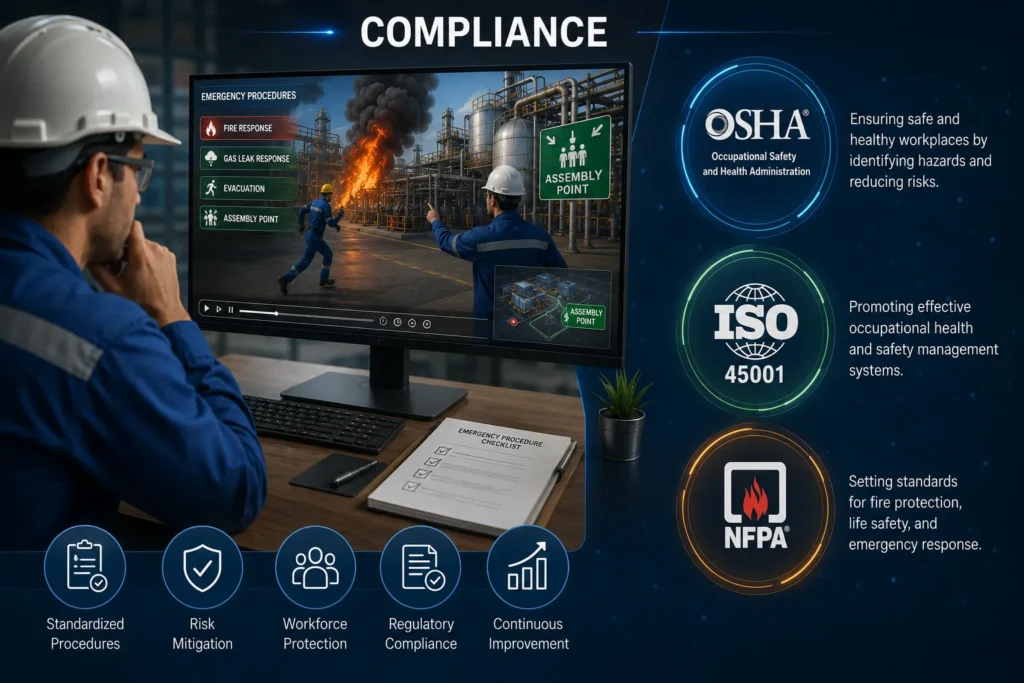
Supporting OSHA, ISO 45001 and NFPA Compliance Through Animation
Although 3D Safety Animation does not replace regulatory compliance requirements or mandatory practical drills, it significantly strengthens workplace safety programs by making procedures easier to understand and consistently communicate.
Organizations can align their animated training content with internationally recognized safety frameworks, including:
1. OSHA Emergency Action Plans
According to the OSHA Emergency Action Plan requirements, every workplace should establish documented procedures for reporting emergencies, evacuation, employee responsibilities, and rescue operations. These plans help organizations respond quickly and consistently during workplace emergencies.
Emergency Action Plans typically include:
- Emergency reporting procedures
- Evacuation routes
- Alarm systems
- Employee responsibilities
- Rescue procedures
Animations help explain each of these requirements visually, making emergency procedures easier for employees to follow.
2. ISO 45001 Occupational Health and Safety Management
The ISO 45001 Occupational Health and Safety Management Systems standard emphasizes a proactive approach to workplace safety through hazard identification, risk assessment, emergency preparedness, employee competence, and continual improvement. Organizations can use animated training to communicate these procedures consistently across their workforce.
Key focus areas include::
- Hazard identification
- Risk assessment
- Worker competence
- Emergency preparedness
- Continual improvement
Animated training supports these objectives by providing standardized, repeatable learning experiences across the organization.
3. NFPA Fire and Life Safety Standards
Organizations can also align fire emergency training with NFPA fire and life safety resources to reinforce best practices for fire prevention, emergency evacuation, and occupant safety. When combined with 3D Safety Animation, these guidelines become easier for employees to understand and remember.
Fire safety animations can reinforce:
- Fire prevention
- Occupant evacuation
- Fire extinguisher awareness
- Emergency response coordination
Organizations can adapt animations to reflect their internal emergency procedures while supporting applicable fire safety practices.
Why Visual Safety Training Works Better
Research consistently shows that people process and retain visual information more effectively than text alone. In industrial environments where emergency procedures involve multiple steps, realistic visualization helps employees understand both the sequence of events and their individual responsibilities.
Compared with manuals or slide presentations, animated training offers several advantages:
- Higher employee engagement
- Better understanding of complex hazards
- Improved recall of emergency procedures
- Consistent training across departments and locations
- Easier communication with multilingual workforces
- Faster onboarding for new employees
When employees can clearly visualize an emergency before experiencing one, they are more likely to respond calmly and follow established procedures.
Using EHS Animation for Compliance Training
Many organizations are expanding beyond traditional induction programs by integrating EHS Animation throughout their safety management system.
Common applications include:
- Employee induction training
- Contractor orientation
- Toolbox talks
- Safe Operating Procedure (SOP) training
- Permit-to-work awareness
- Lockout/Tagout procedures
- Chemical handling
- PPE training
- Working at height
- Confined space awareness
- Incident prevention programs
Unlike printed manuals, animated content can be updated whenever equipment, layouts, or operating procedures change.
HSE Animation for Incident Recreation and Root Cause Analysis
Every incident provides an opportunity to improve workplace safety.
Instead of relying solely on photographs or written reports, organizations increasingly use HSE Animation to recreate incidents in a controlled virtual environment.
Incident recreation animations can illustrate:
- The sequence of events leading to the incident
- Unsafe acts and unsafe conditions
- Equipment failures
- Human factors
- Root causes
- Corrective actions
- Preventive measures
These visual reconstructions help employees understand why an incident occurred and how similar events can be prevented in the future, supporting a proactive safety culture rather than assigning blame.
The Future of Emergency Response Training
Digital transformation is changing how organizations deliver safety education.
Modern emergency preparedness programs are increasingly combining 3D Safety Animation with advanced technologies such as:
- Virtual Reality (VR) for immersive emergency simulations
- Augmented Reality (AR) for on-site training assistance
- Digital Twins to simulate facility-specific emergency scenarios
- AI-powered learning platforms that personalize training content
- Learning Management Systems (LMS) for tracking training progress
- Interactive e-learning modules for remote workforce training
As industrial facilities become more automated and interconnected, these technologies will enable organizations to deliver more engaging, measurable, and scalable safety training programs.
Best Practices for Developing Effective Emergency Response Training Animations
To maximize the effectiveness of Emergency Response Training, organizations should ensure that their animations are tailored to actual workplace conditions rather than relying on generic safety videos.
Consider including:
- Accurate plant layouts
- Company-specific Standard Operating Procedures (SOPs)
- Emergency Action Plans (EAPs)
- Real equipment and machinery
- Correct PPE usage
- Safety signage and escape routes
- Emergency shutdown procedures
- Alarm systems
- Multilingual voiceovers and subtitles
- Accessibility features where appropriate
- Periodic content updates as processes evolve
Customized animations provide employees with training that closely reflects the environments in which they work every day.
Frequently Asked Questions (FAQs)
Emergency Response Training prepares employees to respond safely and effectively during workplace emergencies such as fires, chemical spills, gas leaks, machinery failures, medical incidents, and evacuations.
3D Safety Animation visually demonstrates emergency scenarios, helping employees understand procedures more clearly, retain information longer, and practice correct responses in a safe virtual environment.
Industries such as manufacturing, oil & gas, chemical processing, pharmaceuticals, power generation, mining, warehousing, and heavy engineering commonly use animated emergency response training.
No. EHS Animation complements classroom instruction and emergency drills by helping employees understand procedures before participating in practical exercises.
HSE Animation can recreate fire emergencies, chemical spills, gas leaks, confined space incidents, machinery accidents, electrical hazards, medical emergencies, natural disasters, and incident investigations.
Yes. Animations can be developed using your facility layout, machinery, operating procedures, Emergency Action Plans (EAPs), and company-specific safety protocols.
Organizations should provide emergency response training during employee onboarding, after significant process changes, and at regular intervals as part of refresher training and emergency preparedness programs.
Emergency response training helps organizations communicate emergency procedures consistently and supports compliance with internal safety programs and recognized occupational health and safety management practices.
Conclusion
Effective Emergency Response Training is one of the most important investments an organization can make to protect its workforce, operations, and reputation. While manuals, classroom sessions, and emergency drills remain essential, they cannot always recreate the complexity of real industrial emergencies.
By incorporating 3D Safety Animation, organizations can transform written procedures into realistic visual experiences that improve understanding, engagement, and knowledge retention. Employees gain the confidence to recognize hazards, follow Emergency Action Plans, and respond appropriately during critical situations.
Whether training employees for fire emergencies, chemical spills, gas leaks, confined space rescues, machinery incidents, or emergency evacuations, EHS Animation and HSE Animation provide a consistent and scalable approach to workplace safety education.
As organizations continue embracing digital transformation, integrating animation into emergency preparedness programs will play an increasingly important role in building safer workplaces, improving compliance, and strengthening long-term safety culture.
Have a Project in Mind?
Need help with 3D animation, industrial visualization, HSE training animation, or product visualization? Tell us about your project and our team will get back to you.