

Table of Contents
Introduction
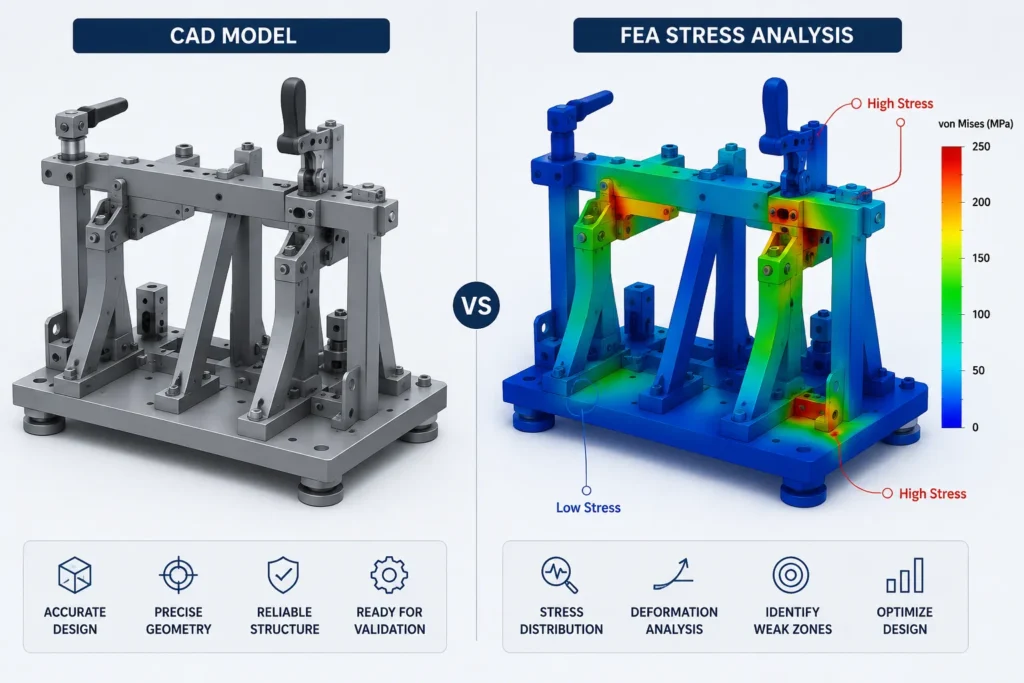
Design failures in mechanical equipment, industrial fixtures and gym equipment often originate during the design stage, long before manufacturing begins. Components that appear structurally sound in a CAD model may experience excessive stress, deformation, buckling or fatigue when subjected to real operating conditions. Discovering these issues after fabrication results in costly rework, production delays, increased material consumption and unexpected downtime.
This is where FEA Simulation Services become an essential part of modern mechanical engineering. By using SolidWorks Simulation, engineers can evaluate how a product behaves under realistic loads, constraints and operating conditions before any material is cut or fabricated.
Instead of relying on assumptions or multiple physical prototypes, engineering teams can validate structural performance digitally, optimize designs and make informed decisions early in the development process. At Immersiv Techsphere, FEA simulation is integrated into structured engineering workflows to support the design validation of mechanical equipment, fabricated structures, industrial fixtures and gym equipment.
What is FEA Simulation?
Finite Element Analysis (FEA) is a numerical engineering method used to predict how a component or assembly behaves when exposed to external forces, pressure, vibration, gravity or thermal loads.
FEA divides a complex CAD model into thousands of smaller finite elements, allowing engineers to calculate stress, strain and displacement throughout the structure.
Using SolidWorks Simulation, engineers can:
- Evaluate stress distribution throughout a component
- Predict deformation and displacement
- Calculate factor of safety
- Identify stress concentration zones
- Validate structural integrity before manufacturing
- Compare multiple design alternatives quickly
- Optimize material usage without compromising strength
For example, an industrial welding fixture designed to support heavy fabricated components can be analysed under actual loading conditions to ensure it maintains dimensional accuracy during welding. Similarly, a gym equipment frame can be validated to withstand repeated user loads while maintaining structural safety.
Why Early Design Validation is Important
Mechanical equipment and industrial fixtures are expected to perform reliably under demanding operating conditions. Every design decision directly affects product performance, manufacturing efficiency and long-term durability.
Without engineering validation, hidden structural issues often remain undetected until the product reaches fabrication or field operation.
Early design validation helps engineers to:
- Verify structural strength before manufacturing
- Improve dimensional stability under load
- Ensure operator and user safety
- Reduce unnecessary material consumption
- Increase product reliability
- Improve manufacturing consistency
- Minimize engineering changes during production
Whether designing machine frames, fabricated structures, welding fixtures or commercial gym equipment, validating structural performance before manufacturing significantly reduces project risks.
Common Design Failures Without FEA Simulation
Many structural problems are difficult to identify by visual inspection alone. FEA Simulation enables engineers to detect these issues during the design phase rather than after production.
1. Structural Deformation
Machine frames, fixtures and fabricated assemblies may bend or deflect under operational loads, affecting accuracy, alignment and product performance.
2. Stress Concentration
Sharp corners, mounting holes, welded joints and sudden geometry changes often create localized stress concentrations that increase the likelihood of cracking or structural failure.
3. Buckling Under Compression
Support members subjected to compressive loads may become unstable even when material strength appears sufficient. Simulation helps engineers identify buckling risks before fabrication.
4. Fatigue Failure
Mechanical equipment and gym equipment frequently experience repetitive loading cycles. Areas subjected to cyclic stress can develop fatigue cracks over time if not properly designed.
5. Excessive Weight
Without simulation, engineers often compensate by adding more material than necessary. While this increases strength, it also raises manufacturing costs, transportation expenses and product weight.
6. Low Factor of Safety
Components that appear acceptable during CAD modelling may not meet required safety margins under actual operating conditions. FEA validates whether the design satisfies engineering safety requirements before production.
These failures are typically identified only after fabrication, increasing cost, rework and production delays.
How SolidWorks FEA Simulation Identifies Design Failures
1. Load and Boundary Condition Analysis
Simulation begins by applying realistic operating conditions to the CAD model.
Engineers define:
- Static loads
- Applied forces
- Fixed supports
- Contact conditions
- Operating constraints
- Assembly interactions
This creates a realistic representation of how the product behaves in service.
2. Stress Analysis
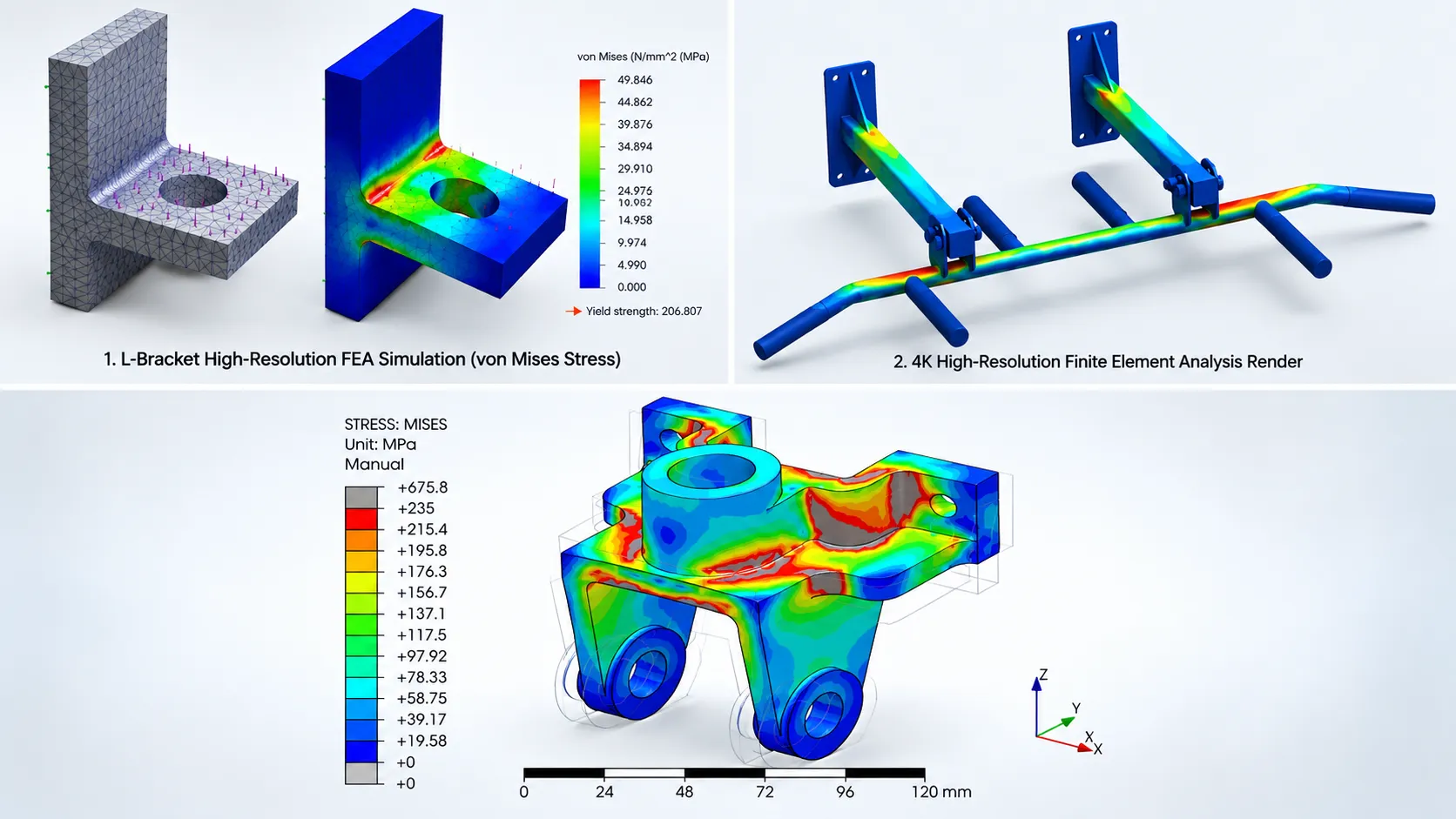
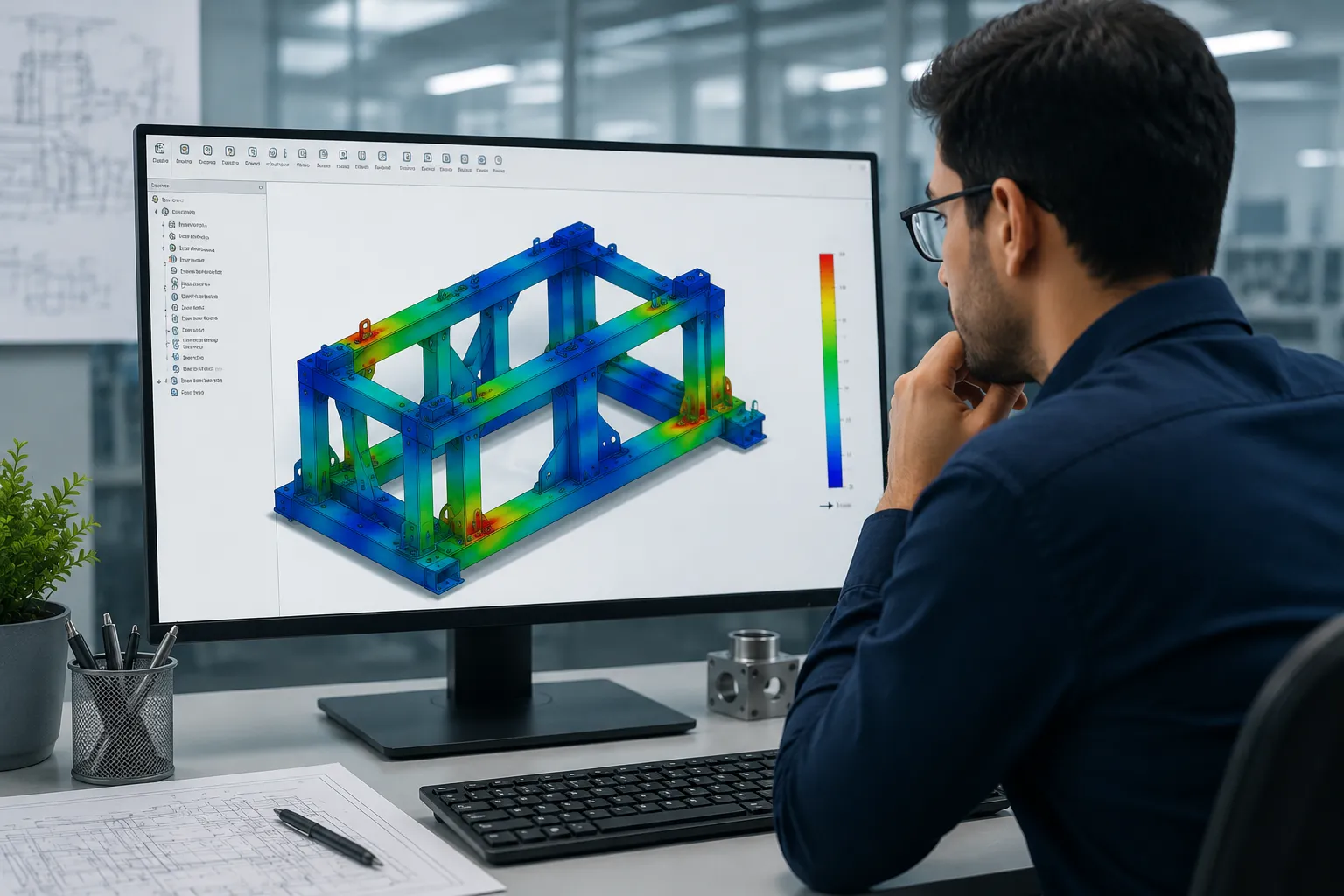
SolidWorks Simulation calculates stress throughout the entire model and visually identifies highly stressed regions.
Stress analysis enables engineers to:
- Locate critical stress zones
- Evaluate stress concentration
- Verify allowable material limits
- Improve weld and joint design
- Increase overall structural reliability
3. Deformation Analysis
Even when stresses remain within acceptable limits, excessive deformation can affect product functionality.
Deformation analysis helps evaluate:
- Linear displacement
- Fixture rigidity
- Equipment stability
- Alignment accuracy
- Frame stiffness
This is particularly important for precision fixtures and heavy mechanical assemblies.
4. Factor of Safety Evaluation
The factor of safety indicates whether a design can safely withstand expected operating loads.
Simulation allows engineers to:
- Compare actual stress with allowable stress
- Validate structural margins
- Identify over-designed regions
- Detect areas requiring reinforcement
A balanced factor of safety improves reliability while reducing unnecessary material usage.
5. Design Optimization One of the biggest advantages of FEA Simulation Services is rapid design optimization.
Engineers can evaluate multiple design alternatives without manufacturing physical prototypes.
Optimization may include:
- Reducing overall weight
- Improving structural stiffness
- Selecting appropriate materials
- Modifying rib patterns
- Reinforcing high-stress regions
- Improving manufacturability
This significantly shortens the product development cycle while improving engineering confidence.
Types of FEA Simulation Used in Mechanical Engineering
Different engineering applications require different simulation approaches depending on product functionality and loading conditions.
- Static Structural Analysis
Evaluates how a component behaves under constant loads. It is widely used for machine frames, fabricated equipment and industrial fixtures.
- Deformation Analysis
Measures displacement and deflection to ensure dimensional stability during operation.
- Stress Analysis
Determines stress distribution throughout the model and identifies critical locations that require design improvements.
- Contact Analysis
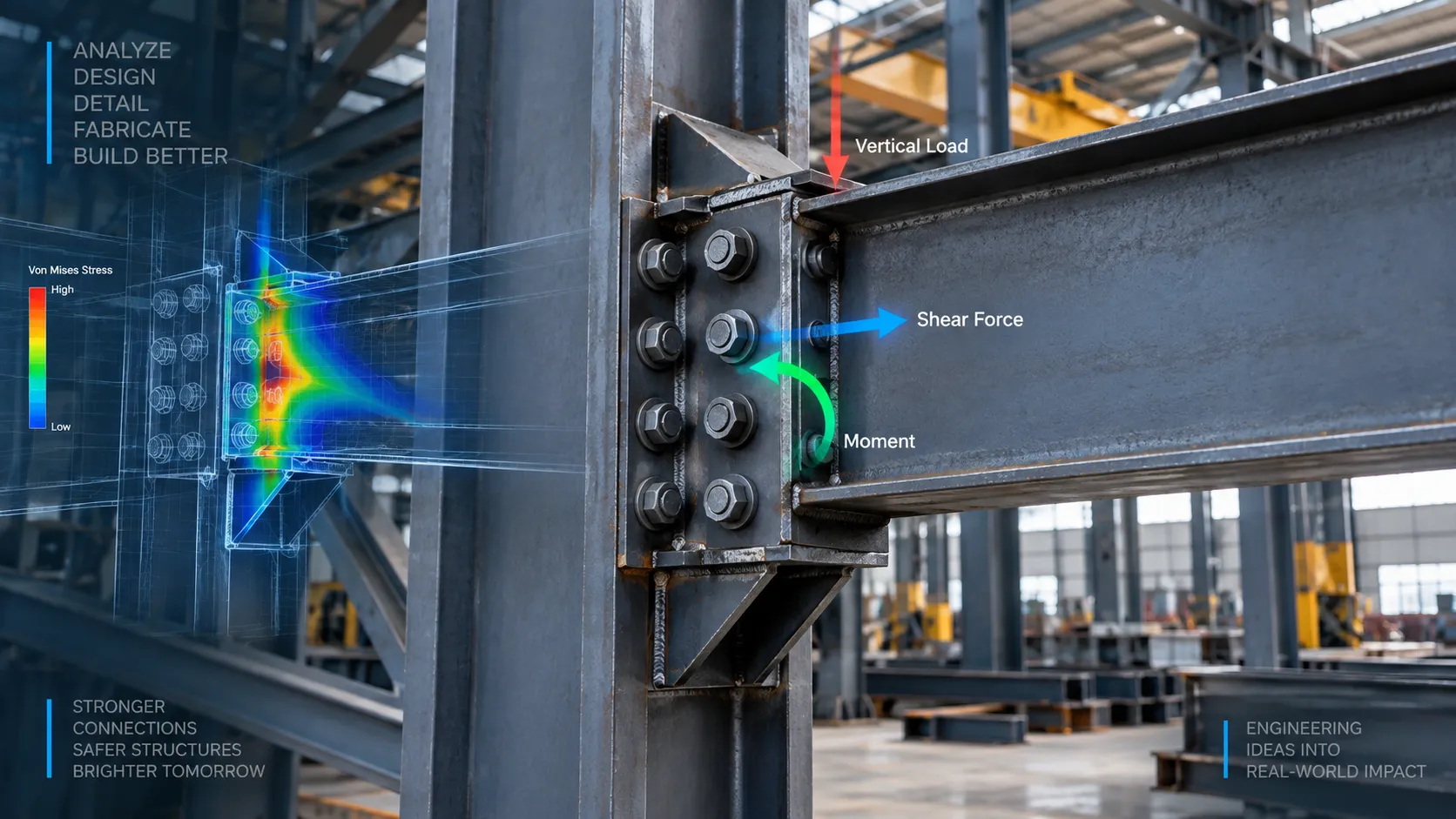
Evaluates interactions between assembled components, including bolts, pins, welded parts and mating surfaces.
- Factor of Safety Assessment
Calculates engineering safety margins to ensure components meet design requirements before manufacturing.
- Linear Elastic Analysis
Suitable for most fabricated steel structures, machine components and industrial equipment where material behaviour remains within the elastic range.
Applications of FEA Simulation Services
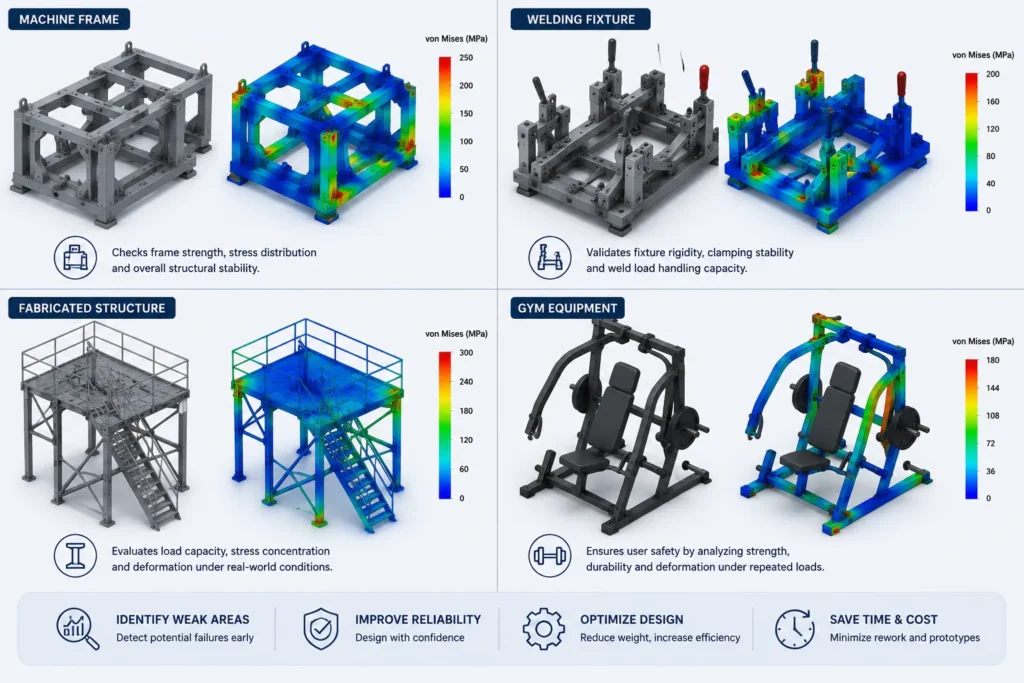
FEA Simulation Services are widely used across manufacturing industries to validate the structural performance of mechanical products before production. By simulating real-world operating conditions, engineers can identify potential design issues, improve product reliability and reduce costly design iterations.
1. Mechanical Equipment
Mechanical equipment often operates under heavy loads, dynamic forces and demanding environments. FEA simulation helps engineers verify that machine frames, fabricated assemblies and structural components can safely withstand operational conditions.
Typical applications include:
- Machine frames and base structures
- Industrial equipment supports
- Fabricated steel assemblies
- Material handling equipment
- Custom machinery
Simulation enables engineers to evaluate stress distribution, structural stiffness and deformation before manufacturing begins.
2. Welding Fixtures
Welding fixtures must securely position components throughout the welding process while maintaining dimensional accuracy.
FEA simulation helps validate:
- Structural rigidity
- Fixture deformation under load
- Weld distortion risks
- Clamping force distribution
- Support frame stability
Early validation improves weld quality and minimizes production errors.
3. Machining Fixtures
Machining fixtures experience significant cutting forces that can affect positioning accuracy if the structure lacks sufficient rigidity.
Simulation helps engineers evaluate:
- Fixture stiffness
- Deflection during machining
- Clamping effectiveness
- Load distribution
- Structural safety
This results in improved machining precision and repeatability.
4. Gym Equipment
Commercial and industrial gym equipment must safely withstand repeated user loads throughout its service life.
FEA Simulation Services help engineers validate:
- Frame strength
- Structural deformation
- Weld joint performance
- Load-bearing capacity
- Factor of safety
- Long-term durability
Virtual testing helps improve product reliability while reducing unnecessary material usage. These validation methods are widely used during Fitness & Gym Equipment Design Services to optimize frame strength, user safety and structural performance before manufacturing.
5. Fabricated Structures
Steel fabricated structures require careful structural validation to ensure long-term performance.Projects involving platforms, machine supports and industrial frameworks often combine structural analysis with Steel Structure Analysis & Detailing Services to improve design accuracy before fabrication.
Typical examples include:
- Support frames
- Platforms
- Equipment skids
- Mounting structures
- Heavy fabricated assemblies
Simulation identifies stress concentration, excessive displacement and structural weaknesses before fabrication.
Benefits of FEA Simulation Services
Engineering simulation provides measurable benefits throughout the product development process.
1. Early Detection of Design Failures
Potential structural issues are identified during the design stage instead of after manufacturing, significantly reducing engineering risk.
2. Reduced Physical Prototyping
Multiple design alternatives can be evaluated digitally, minimizing the need for expensive prototype fabrication.
3. Improved Product Reliability
Validated designs perform more consistently under real operating conditions, leading to higher product quality and longer service life.
4. Optimized Material Usage
Simulation helps engineers remove unnecessary material while maintaining structural strength, reducing manufacturing costs and product weight.
5. Faster Product Development
Design modifications can be tested quickly without rebuilding prototypes, accelerating engineering workflows and reducing development time.
6. Better Engineering Decisions
Simulation replaces assumptions with engineering data, enabling informed decisions based on measurable structural performance.
The Role of FEA Simulation in Modern Engineering Workflows
Modern mechanical product development relies on engineering validation rather than trial-and-error manufacturing.
Integrating FEA Simulation Services into the design process enables engineering teams to:
- Validate structural performance before fabrication
- Improve product safety and reliability
- Reduce manufacturing rework
- Minimize design iterations
- Increase engineering efficiency
- Support data-driven decision-making
Simulation has become a standard engineering practice for manufacturers seeking to improve product quality while controlling development costs.
FEA Simulation Services at Immersiv Techsphere
Immersiv Techsphere integrates SolidWorks Simulation into mechanical design workflows to support engineering validation across a wide range of industrial applications.
The focus is on evaluating structural performance before manufacturing through realistic simulation of operating conditions.
Typical engineering analyses include:
- Static structural analysis
- Stress analysis
- Deformation analysis
- Factor of safety evaluation
- Load and boundary condition validation
- Design optimization
- Structural assessment of mechanical equipment
- Fixture design validation
- Gym equipment structural analysis
By incorporating simulation early in the design process, engineering teams can identify potential design failures, improve product reliability and reduce costly manufacturing changes.
FAQs
FEA Simulation Services use Finite Element Analysis to evaluate how mechanical components respond to loads, constraints and operating conditions before manufacturing.
SolidWorks Simulation is used to perform stress analysis, deformation analysis, structural validation and factor of safety evaluation on mechanical designs.
FEA helps identify potential design failures during product development, allowing engineers to improve designs before fabrication and reduce manufacturing risks.
Yes. By minimizing physical prototypes, reducing engineering changes and preventing manufacturing rework, FEA Simulation Services can significantly reduce overall development costs.
Industries including industrial machinery, heavy equipment, manufacturing, automotive, material handling, fabrication, aerospace and fitness equipment manufacturing commonly use FEA simulation.
Yes. Engineers use FEA Simulation Services to evaluate frame strength, structural stability, deformation and user safety for commercial and industrial gym equipment.
Mechanical equipment, industrial fixtures, fabricated structures, machine frames, welded assemblies, lifting equipment, support structures and gym equipment all benefit from engineering simulation.
FEA significantly reduces the need for physical prototypes by validating designs digitally. However, final product testing may still be required depending on industry standards and regulatory requirements.
Conclusion
Design failures discovered after manufacturing often result in expensive rework, production delays and increased engineering costs. FEA Simulation Services enable engineers to identify these issues much earlier by validating structural performance under realistic operating conditions.
Whether developing mechanical equipment, industrial fixtures, fabricated structures or gym equipment, simulation provides valuable insight into stress distribution, deformation, structural integrity and safety before production begins.
By integrating SolidWorks Simulation into engineering workflows, manufacturers can make informed design decisions, optimize material usage and improve overall product reliability. Early engineering validation reduces uncertainty, shortens development cycles and supports the creation of safer, more efficient mechanical products.
Have a Project in Mind?
Need help with 3D animation, industrial visualization, HSE training animation, or product visualization? Tell us about your project and our team will get back to you.