

Table of Contents
Introduction
Manufacturers today are expected to deliver highly customized products without increasing engineering effort, delaying quotations, or creating production bottlenecks. Whether it’s industrial equipment, laboratory furniture, sheet metal products, storage systems, or configurable machinery, businesses need digital solutions that simplify both product configuration and customer interactions.
Two technologies that play an important role in this process are CPQ (Configure, Price, Quote) and Product Configurators. While they are often mentioned together, they are designed to support different stages of the product lifecycle.
Understanding CPQ vs Product Configurator helps manufacturers identify how each solution contributes to engineering efficiency, sales productivity, and a seamless customer experience.
What is a Product Configurator?
A Product Configurator is a rule-based system that enables users to create customized products by selecting predefined options while ensuring every configuration follows engineering and manufacturing rules.
Instead of manually designing every product variation, engineers, sales teams, dealers or customers can configure products using predefined parameters such as:
- Dimensions
- Material
- Components
- Accessories
- Features
- Finish
- Capacity
Once the configuration is complete, the system validates the selected options and can automatically generate engineering outputs such as CAD models, Bills of Materials (BOMs), drawings, manufacturing documentation, or CNC-ready files.
This allows manufacturers to manage a large number of product variants while maintaining consistency and engineering accuracy.
Benefits of a Product Configurator
A Product Configurator provides value throughout the engineering and manufacturing process by helping organizations:
- Standardize configurable products
- Reduce repetitive engineering activities
- Improve design consistency across product families
- Minimize configuration errors through predefined rules
- Generate engineering documentation automatically
- Accelerate product customization
- Improve collaboration between engineering and manufacturing teams
- Support scalable product customization for growing product portfolios
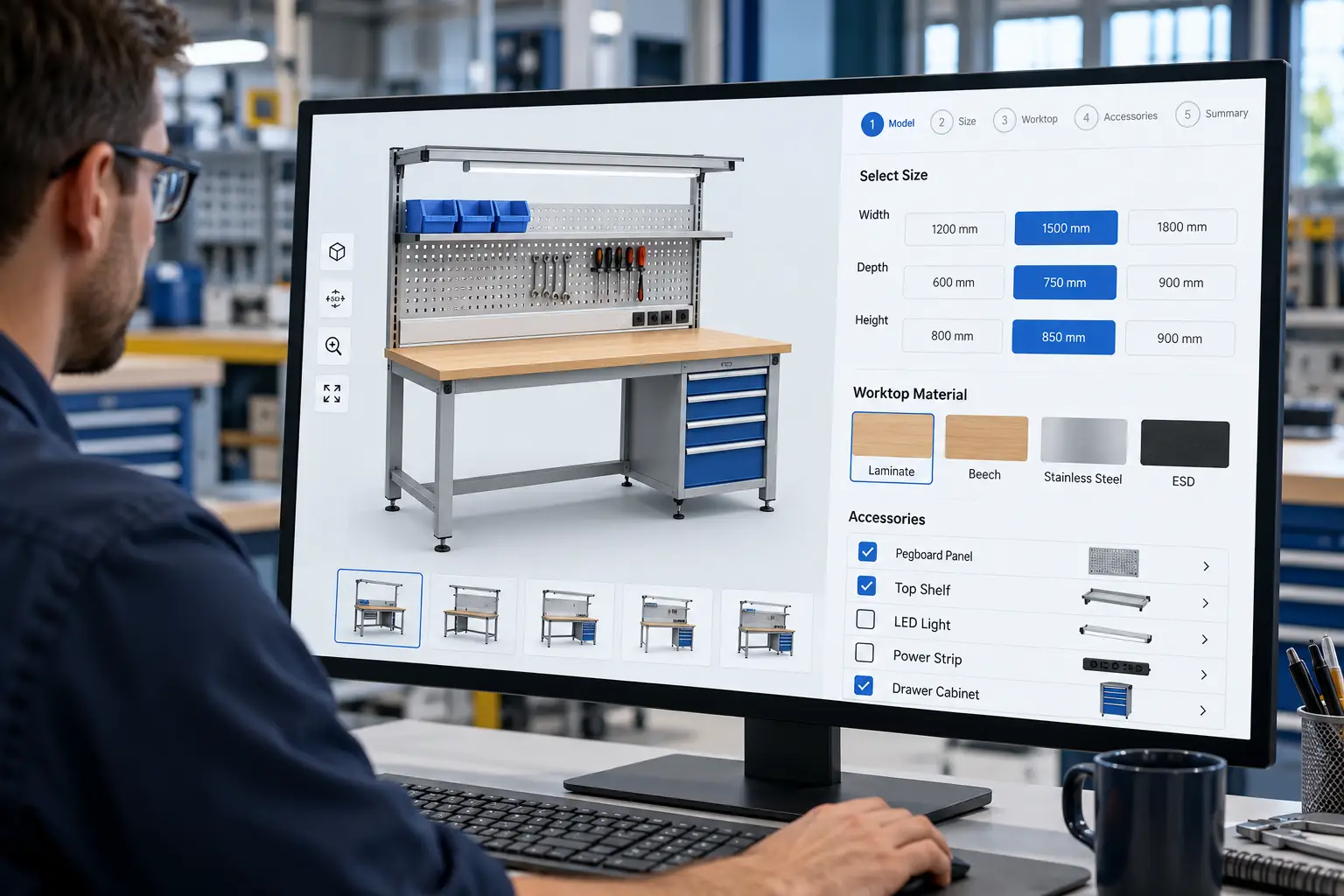
- Manufacturers of configurable products, such as industrial workbenches, can use a Workbench Configurator to automate product configuration and engineering documentation.
For manufacturers offering configurable products, Product Configurators help transform engineering knowledge into repeatable digital workflows.
What is CPQ?
CPQ, short for Configure, Price, Quote, is a business solution that simplifies the process of configuring products, calculating pricing, and generating accurate quotations.
After a product has been configured, CPQ applies pricing rules, discounts, commercial policies, and approval workflows before producing a customer-ready quotation.
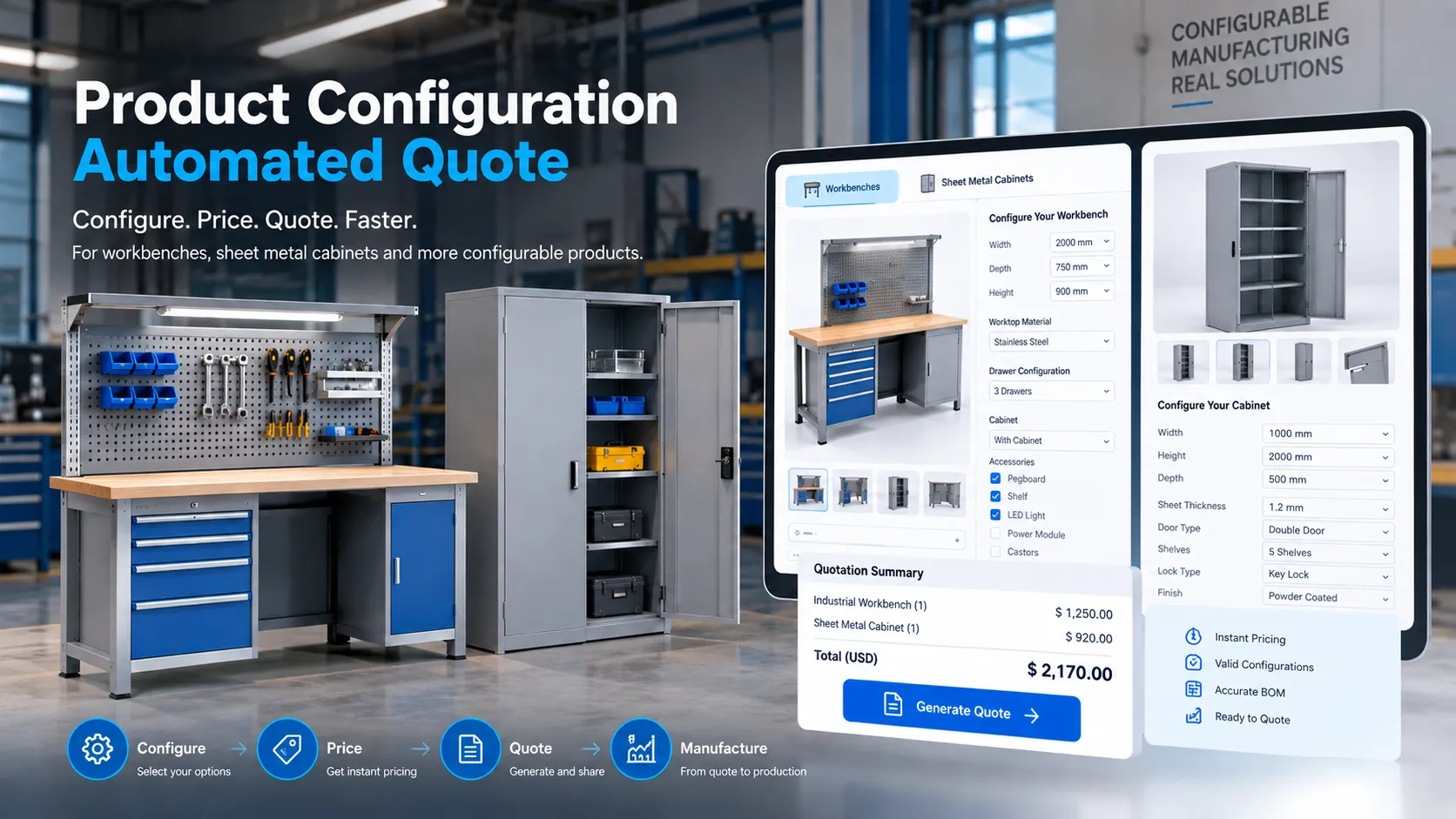
To understand how these systems support configurable manufacturing workflows in greater detail, explore how CPQ systems for manufacturing help automate pricing, quotation generation, and sales processes.
Rather than replacing engineering processes, CPQ helps streamline commercial operations associated with configurable products.
Benefits of CPQ
CPQ supports sales and commercial teams by making quotation processes faster and more consistent.
Some of its key benefits include:
- Faster quotation generation
- Consistent pricing across product variants
- Automated pricing calculations
- Standardized proposal generation
- Improved sales productivity
- Better coordination between sales and engineering
- Reduced manual effort in quotation preparation
- Integration with CRM and ERP platforms
- Improved customer response time
For organizations managing complex product portfolios, CPQ helps simplify commercial processes without compromising pricing accuracy.
CPQ vs Product Configurator: Understanding Their Roles
Although both technologies involve configurable products, they focus on different business functions.
| Product Configurator | CPQ |
| Configures products based on engineering rules | Configures commercial information for customer quotations |
| Supports product customization | Supports pricing and quotation management |
| Generates engineering outputs such as CAD models, BOMs, and drawings | Generates customer-ready quotations and proposals |
| Used by engineering, manufacturing, dealers, and customers | Used by sales, commercial, and customer service teams |
| Helps create technically valid product configurations | Helps create commercially accurate quotations |
The key distinction is that a Product Configurator focuses on how a product is built, while CPQ focuses on how that configured product is presented and quoted to customers.
Both contribute to different stages of the same workflow.
How CPQ and Product Configurators Work Together
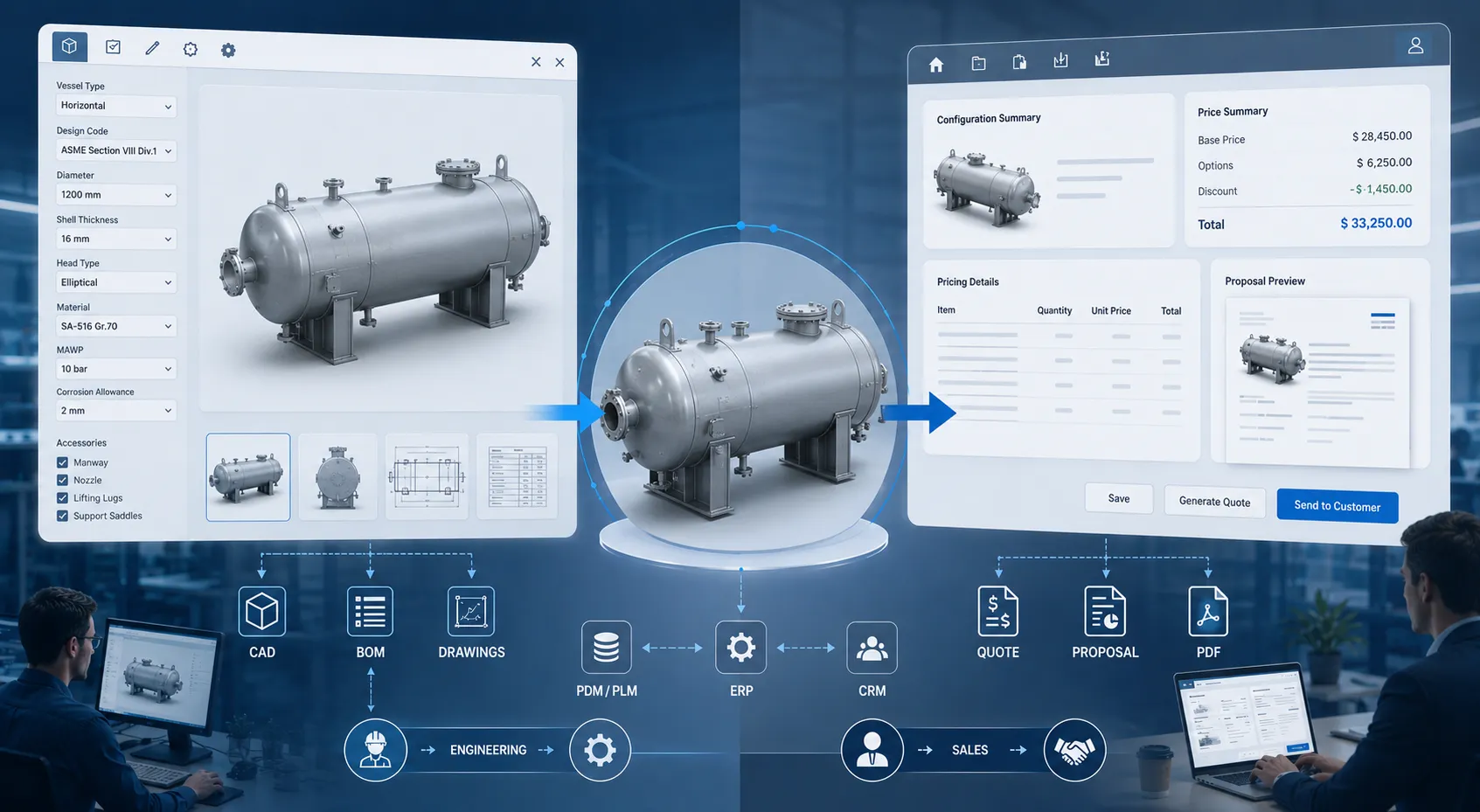
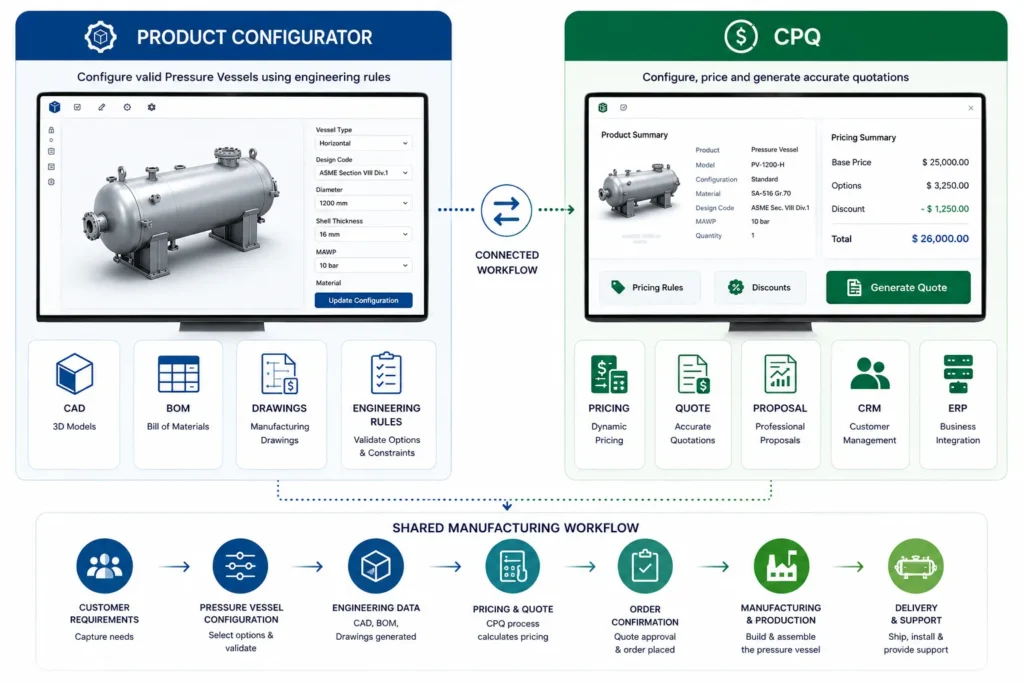
Many manufacturers combine both technologies to create a connected workflow between engineering and sales.
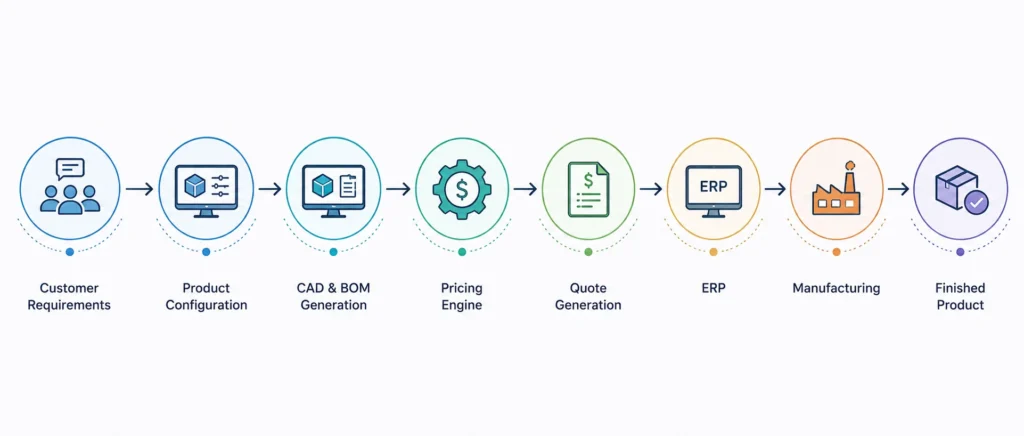
A typical process may look like this:
- A customer or sales representative selects product options.
- The Product Configurator validates the configuration using engineering rules.
- CAD models, BOMs, drawings, and manufacturing data are generated automatically.
- The configuration is transferred to the CPQ system.
- CPQ calculates pricing based on selected options and business rules.
- A professional quotation is generated and shared with the customer.
- Once approved, the order moves into production planning and manufacturing.
This integrated approach reduces manual data entry, improves consistency, and ensures engineering and commercial teams work from the same product configuration.
How Different Industries Benefit from Both Solutions
- Industrial Equipment Manufacturing
Industrial equipment often includes numerous configurable options related to size, capacity, materials, motors, controls, and accessories.
Product Configurators help engineering teams standardize these configurations, while CPQ enables sales teams to generate accurate quotations based on customer requirements. - Sheet Metal Manufacturing
Manufacturers producing sheet metal cabinets, enclosures, workstations, and fabricated assemblies frequently manage multiple product variants.
Product Configurators automate engineering documentation, while CPQ simplifies pricing for different configurations and production quantities. - Laboratory Furniture Manufacturing
Laboratory furniture projects often require customized layouts, storage options, worktops, accessories, and utility integrations.
Product Configurators help generate production-ready designs, whereas CPQ supports project quotations based on selected configurations and project scope. - Furniture Manufacturing
Manufacturers offering modular office furniture, storage systems, wardrobes, and retail fixtures can use Product Configurators to manage configurable designs and CPQ to prepare consistent customer quotations for customized orders. - Custom Manufacturing
Organizations delivering engineer-to-order (ETO) or configure-to-order (CTO) products benefit from combining engineering automation with quotation automation, improving collaboration across design, sales, procurement, and production teams.
Choosing the Right Approach
The discussion around CPQ vs Product Configurator should not be viewed as selecting one technology over another.
Instead, manufacturers should evaluate where they want to improve their workflows.
If the priority is engineering automation, product standardization, and automated manufacturing documentation, Product Configurators provide significant value.
If the priority is faster quotations, pricing consistency, and improved commercial processes, CPQ helps streamline customer-facing activities.
For many organizations, the greatest value comes from connecting both solutions into a unified digital workflow that links engineering, sales, and manufacturing.
Final Thoughts
Understanding CPQ vs Product Configurator is about recognizing how each technology contributes to the product lifecycle.
A Product Configurator enables manufacturers to configure products accurately while automating engineering outputs such as CAD models, BOMs, and manufacturing documentation. CPQ builds on that configuration by managing pricing, quotations, and commercial workflows.
Together, these technologies support product customization, improve collaboration between engineering and sales, and help manufacturers deliver configurable products with greater speed, consistency, and confidence.
Have a Project in Mind?
Need help with 3D animation, industrial visualization, HSE training animation, or product visualization? Tell us about your project and our team will get back to you.