

Table of Contents
Introduction
A manufacturing plant can be an interesting place to visit. From automated production lines and heavy machinery to material handling equipment and fabrication processes, there is a lot happening across the facility.
However, what may look like a routine factory tour or a short business visit can involve several safety risks.
Visitors may not be familiar with industrial equipment, moving machinery, vehicle movement, hazardous materials, or emergency procedures. Even someone spending only 15–20 minutes inside a manufacturing facility needs to understand the basic safety rules before entering.
This is where Visitor Safety Induction becomes important.
A visitor safety induction introduces people to the potential hazards within a manufacturing plant and explains the precautions they must follow during their visit. It helps visitors understand where they can go, what they should avoid, which personal protective equipment (PPE) they need, and how to respond during an emergency.
Whether someone is visiting for a business meeting, equipment inspection, supplier discussion, project evaluation, or factory tour, safety awareness should always come before access to the facility.
Let’s understand the essential visitor safety rules every manufacturing plant should communicate before allowing visitors inside.
What Is Visitor Safety Induction in a Manufacturing Plant?
Visitor Safety Induction is a short safety orientation provided to visitors before they enter an industrial or manufacturing facility.
Its purpose is to make visitors aware of the site’s safety policies, workplace hazards, emergency arrangements, and expected behaviour.
The importance of communicating site-specific safety requirements is also highlighted in the HSE guidance on site rules and induction, which discusses PPE, restricted areas, pedestrian routes, fire prevention, and emergency arrangement.
Unlike employee safety training, which covers job-specific responsibilities and operational procedures, visitor induction focuses on the safety information a non-employee needs to move around the facility without exposing themselves or others to unnecessary risks.
A typical visitor safety induction covers:
- General manufacturing plant safety rules.
- Mandatory personal protective equipment (PPE).
- Restricted and authorised access areas.
- Moving machinery and equipment hazards.
- Forklift and vehicle movement.
- Pedestrian walkways and designated routes.
- Emergency exits and evacuation procedures.
- Fire safety and emergency reporting.
- Photography and mobile phone restrictions.
- Visitor responsibilities and escort requirements.
The induction should be simple, easy to understand, and relevant to the actual conditions of the manufacturing facility.
Why Is Visitor Safety Induction Important for Manufacturing Plants?
Manufacturing facilities are designed around production activities. Different departments may involve welding, cutting, machining, material handling, assembly, chemical processing, electrical systems, and automated equipment.
Employees are generally familiar with these activities because they receive regular training. Visitors, on the other hand, may have little or no understanding of the risks.
Consider a visitor walking through a production area while looking at a machine demonstration. If they step outside the designated walkway or approach moving equipment, they could unknowingly enter a hazardous zone.
A proper visitor induction helps prevent such situations.
Here are some important reasons why manufacturing plants should implement a structured visitor safety induction programme.
1. Creates Awareness of Workplace Hazards
Visitors need to understand that industrial environments have risks that may not be immediately visible. Electrical hazards, hot surfaces, suspended loads, sharp edges, and moving machinery require particular attention.
2. Reduces the Possibility of Accidents
Clear instructions about safe walking routes, restricted areas, PPE, and prohibited activities help reduce the likelihood of visitor-related incidents.
3. Establishes Safety Responsibilities
Visitors should understand their responsibilities, including following instructions from authorised personnel, wearing mandatory PPE, and staying with their designated escort when required.
4. Improves Emergency Preparedness
Knowing where emergency exits are located and how to respond to alarms can make a significant difference during an unexpected situation.
5. Supports a Strong Workplace Safety Culture
When visitors are introduced to safety expectations before entering the facility, it reinforces the message that safety is a shared responsibility.
10 Essential Safety Rules Every Visitor Should Know
A visitor safety induction should not overwhelm people with complicated technical information. Instead, it should focus on practical instructions that visitors can easily understand and follow.
The following ten safety rules cover some of the most important areas.
1. Always Follow Site Entry and Registration Procedures
Every visitor should complete the required entry formalities before entering the manufacturing facility.
This may include:
- Registering their name and organisation.
- Providing the purpose of the visit.
- Receiving a visitor identification badge.
- Attending the mandatory safety induction.
- Understanding the emergency contact process.
- Receiving information about their designated escort.
Visitors should never enter production areas without proper authorisation.
A visitor badge also helps employees and security personnel identify individuals who are not part of the regular workforce.
2. Wear the Required Personal Protective Equipment (PPE)
Personal Protective Equipment is one of the first things visitors should understand during their safety induction.
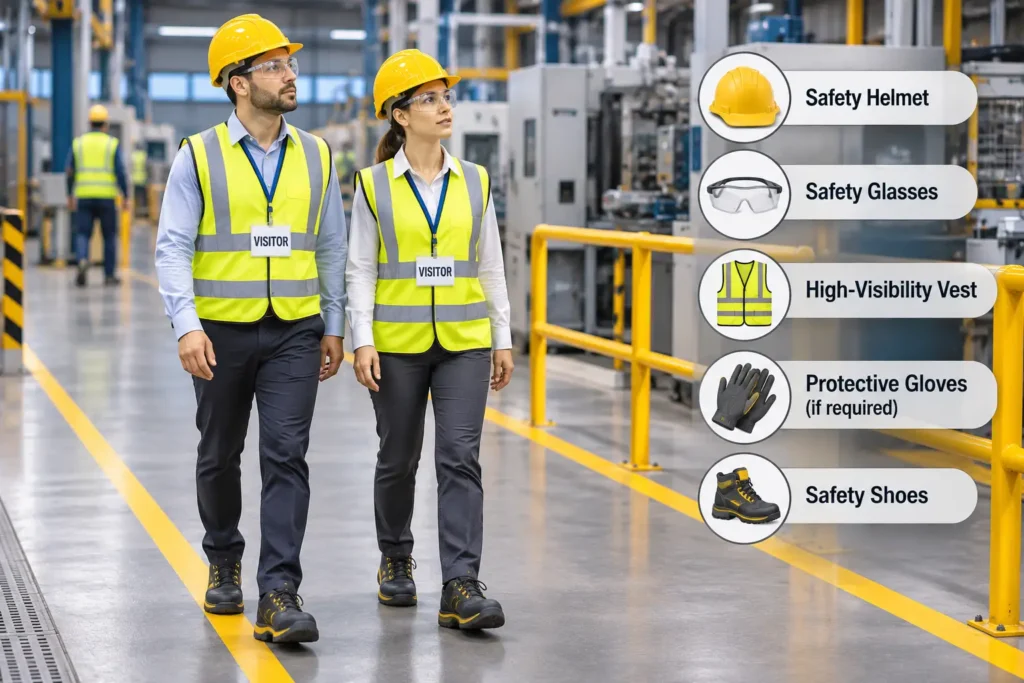
Depending on the manufacturing process and site-specific hazards, visitors may need to wear:
- Safety helmets.
- Safety shoes.
- High-visibility jackets or vests.
- Safety glasses or goggles.
- Hearing protection.
- Protective gloves, where appropriate.
- Respiratory protection, where specifically required and authorised.
Not every visitor will require every type of PPE. The selection should be based on the hazards present in the areas they will visit.
For example, someone entering a fabrication workshop may require safety shoes, a helmet, and eye protection. A visitor entering a high-noise production area may also need hearing protection.
Visitors should be shown how to wear the required PPE correctly rather than simply being handed the equipment.
3. Stay Within Designated Pedestrian Walkways
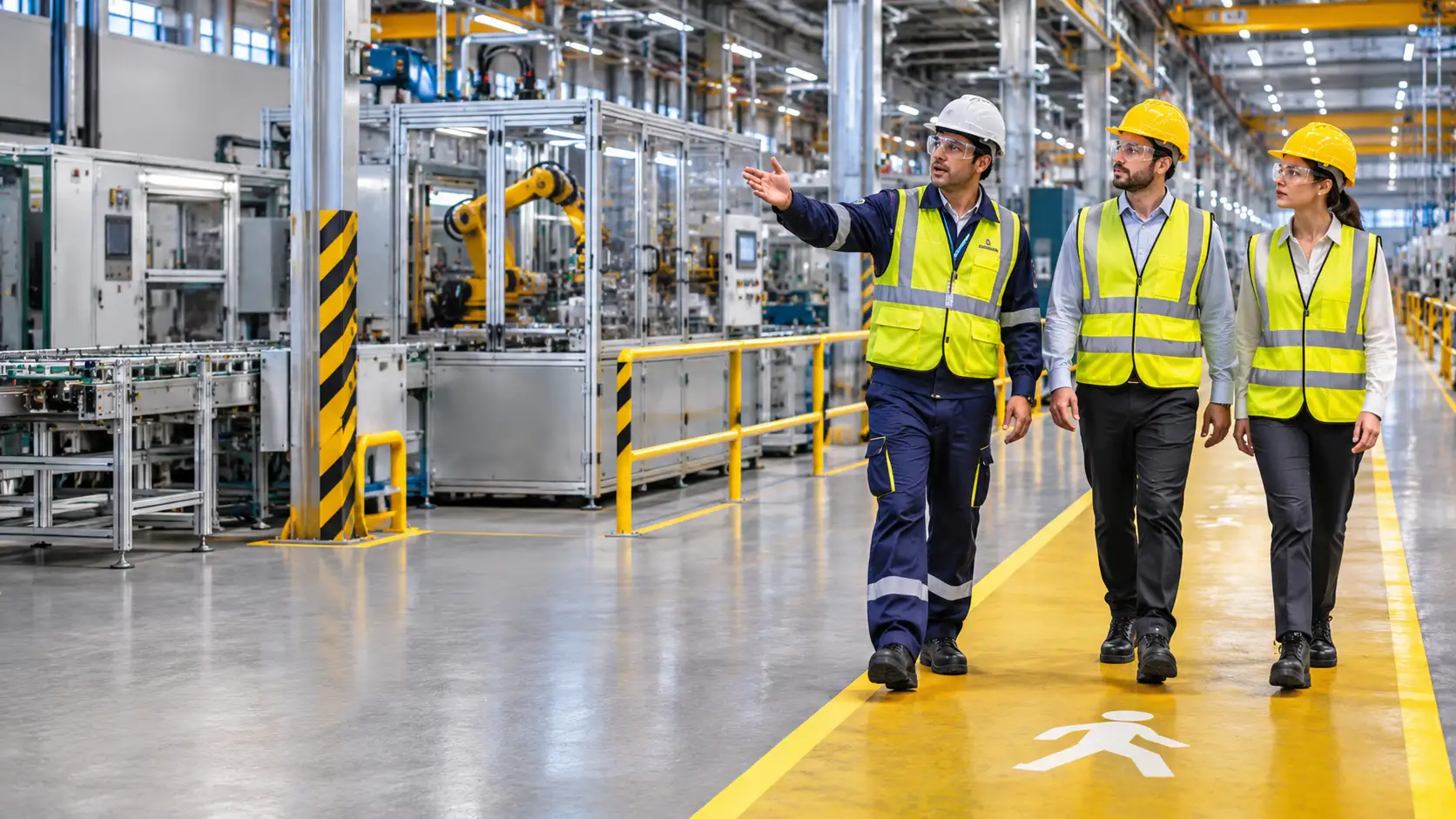
Manufacturing plants often have separate routes for pedestrians and moving equipment.
Forklifts, pallet trucks, overhead cranes, and other material-handling equipment may operate continuously throughout the facility.
Visitors should:
- Use only marked pedestrian walkways.
- Follow floor markings and directional signs.
- Avoid walking through vehicle movement zones.
- Never take shortcuts through production areas.
- Maintain a safe distance from moving equipment.
- Follow instructions from plant personnel.
One important point is that visitors should never assume a production area is safe to cross simply because no vehicle is visible at that moment.
Separating pedestrian routes from vehicle movement areas is an important workplace safety measure, as explained in the HSE guidance on separating pedestrians and vehicles.
4. Maintain a Safe Distance from Moving Machinery
Machines are among the most obvious hazards in a manufacturing environment, but visitors may not understand how quickly an incident can happen.
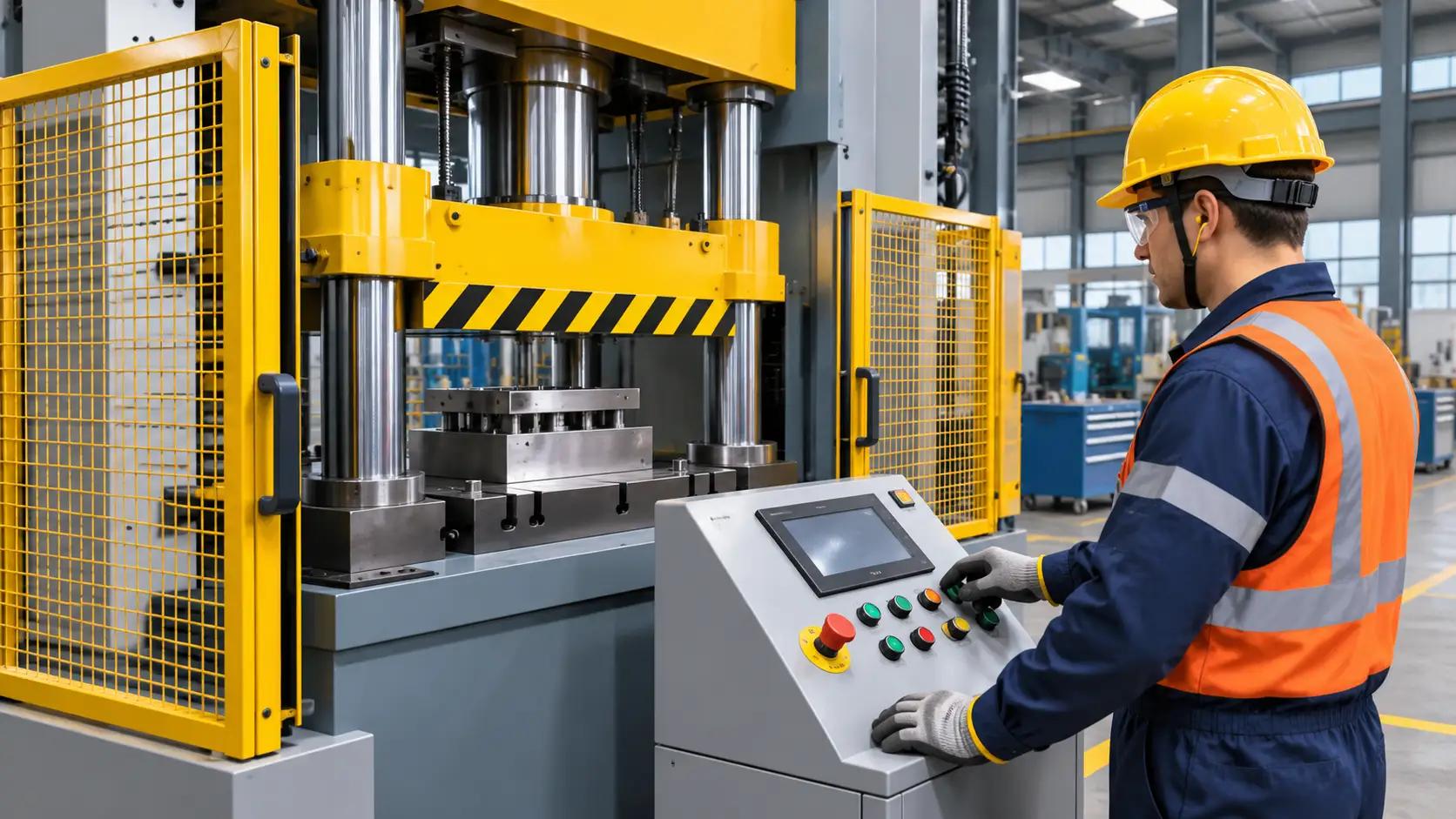
Rotating components, conveyor belts, cutting tools, robotic arms, and automated production systems can create serious hazards.
Visitors must:
- Never touch operating machinery.
- Avoid approaching moving components.
- Never reach inside machine guards or enclosures.
- Stay outside marked safety barriers.
- Avoid distracting machine operators.
- Never attempt to operate equipment without authorisation.
Even when a machine appears to be idle, it may restart automatically or be controlled remotely.
Visitors should observe machinery only from designated safe viewing locations.
5. Respect Restricted and Hazardous Areas
Not every part of a manufacturing plant is open to visitors.
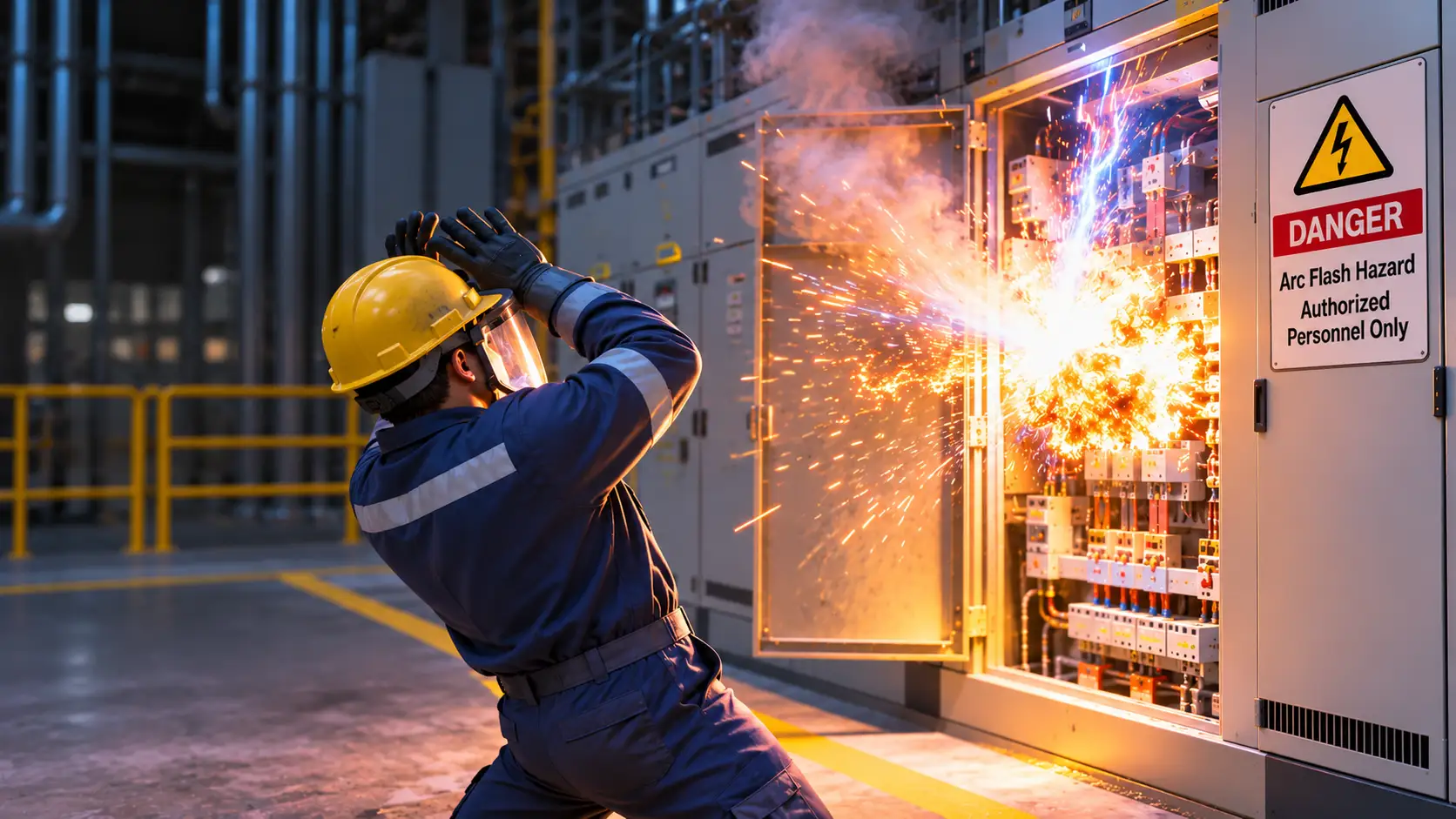
Certain areas may involve high temperatures, electrical equipment, chemical handling, welding operations, press machines, or other hazardous processes.
These areas may be marked with warning signs, barriers, access-control systems, or floor markings.
Visitors should never enter:
- Electrical rooms or substations without authorisation.
- Chemical storage and handling areas.
- Welding and cutting zones without appropriate controls.
- Confined spaces.
- Crane operating zones.
- Machine maintenance areas.
- Restricted production sections.
If a visitor needs access to a restricted area for inspection or project-related work, the required authorisation and safety precautions must be arranged in advance.
6. Understand Fire Safety and Emergency Procedures
Every visitor should know what to do if an emergency occurs.
A manufacturing plant may have different emergency situations, including fire, chemical spills, gas leaks, equipment failures, and medical emergencies.
The visitor induction should explain:
- How emergency alarms are communicated.
- Where the nearest emergency exits are located.
- Which evacuation route to follow.
- Where the designated assembly point is located.
- Whom to contact during an emergency.
- Whether visitors must remain with their escorts during evacuation.
Visitors should follow the facility’s approved evacuation procedure and avoid collecting personal belongings or returning to the building until authorised personnel declare it safe.
For a deeper understanding of how animated scenarios can communicate emergency procedures, explore our article on Emergency Response Training Using 3D Safety Animation.
7. Follow Safety Signs, Warnings and Floor Markings
Safety signs communicate important information about hazards, mandatory precautions, and restricted access.
Visitors should understand the basic meaning of common industrial safety signs.
For example:
- Warning signs: Indicate potential hazards such as electrical risks, hot surfaces, or moving machinery.
- Mandatory signs: Specify actions such as wearing helmets, safety shoes, or eye protection.
- Prohibition signs: Identify activities that are not allowed, such as smoking or unauthorised entry.
- Emergency signs: Indicate exits, first-aid facilities, and emergency equipment.
Visitors should never ignore a safety sign simply because they do not understand its meaning. They should ask their escort or site representative for clarification.
8. Avoid Distractions and Follow Mobile Phone Restrictions
Using a mobile phone while walking through a manufacturing plant can distract visitors from their surroundings.
A moment of inattention may cause someone to miss a warning signal, walk into a vehicle route, or approach an unsafe area.
Manufacturing plants may also restrict photography, video recording, or mobile phone use because of operational safety, confidentiality, or security requirements.
Visitors should:
- Keep their phones away while walking.
- Avoid taking photographs without permission.
- Follow site-specific mobile phone restrictions.
- Never use phones near designated hazardous or restricted areas unless explicitly permitted.
If visitors need to make a call, they should move to an authorised safe location.
9. Never Interfere with Production Activities
A manufacturing plant operates through coordinated activities involving people, machines, materials, and production schedules.
Visitors should not interfere with these activities.
They must never:
- Operate machinery without permission.
- Touch raw materials or finished products without authorisation.
- Move tools or equipment.
- Remove machine guards.
- Interrupt operators during critical tasks.
- Block emergency access routes.
- Handle chemicals or industrial materials without approval.
Even a small action, such as moving a tool or standing too close to a workstation, can create an unexpected hazard.
Visitors should observe, ask questions, and follow their escort’s instructions.
10. Stay with Your Designated Escort
One of the simplest but most important visitor safety rules is to remain with the authorised host or escort.
A designated escort understands the plant layout, operational activities, and access restrictions.
They can guide visitors through approved routes, explain potential hazards, and ensure that visitors do not accidentally enter unsafe areas.
Visitors should never wander around the facility independently unless they have received specific authorisation.
If they become separated from their escort, they should stop in a safe location and contact the designated site representative.
How Should Manufacturing Plants Conduct an Effective Visitor Safety Induction?
Having safety rules documented is important, but communicating those rules effectively is equally important.
A visitor may receive a printed safety document at reception, but will they remember every instruction while walking through a busy production facility?
This is why manufacturing plants should make their visitor induction process structured, visual, and easy to understand.
Here are some practical ways to improve it.
1. Keep the Induction Short and Site-Specific
A visitor attending a business meeting does not need the same level of training as a contractor performing maintenance work.
The induction should match the purpose of the visit and the risks associated with the areas the visitor will access.
For example:
- Office visitors may need basic emergency and access information.
- Factory tour visitors need PPE, pedestrian movement, and machinery safety instructions.
- Equipment inspection visitors may need additional hazard awareness and supervision.
- Contractors performing work require more detailed, task-specific safety arrangements.
2. Use Visual Communication Instead of Text-Heavy Instructions
Visitors may come from different professional backgrounds and may not understand technical industrial terminology.
Using photographs, diagrams, safety symbols, and 3D animations can make safety instructions easier to understand.
For example, instead of simply displaying the instruction “Maintain a Safe Distance from Moving Machinery”, a short animation can demonstrate:
- A visitor approaching an operating machine.
- The potential danger of entering the machine’s operating zone.
- The correct safe viewing distance.
- The consequences of ignoring safety barriers.
Visual demonstrations help connect safety instructions with real workplace situations.
Beyond visitor orientation, organisations can also use Safety Training Videos for Industrial Workplaces to communicate machinery hazards, PPE requirements, emergency procedures, and safe working practices across different departments.
3. Explain Emergency Procedures Through Practical Scenarios
Emergency instructions should not be limited to identifying an exit sign.
Visitors should understand what an alarm sounds like, which route to follow, where the assembly point is, and whom to contact.
A short animated emergency evacuation scenario can demonstrate the correct response step by step.
4. Provide Multilingual Safety Instructions
Manufacturing facilities may receive visitors from different regions and countries.
When visitors are unfamiliar with the language used during the induction, important instructions may be misunderstood.
Providing safety induction videos with subtitles, voiceovers, or translated scripts can improve accessibility and communication.
The language used should be simple, accurate, and consistent with the site’s approved safety procedures.
5. Check Whether Visitors Understand the Instructions
An induction should not become a formality where visitors simply watch a video and proceed inside.
Manufacturing plants can include a few simple questions to confirm that visitors understand essential instructions.
For example:
- What should you do when an emergency alarm sounds?
- Can you enter a restricted production area without permission?
- Where should you walk when moving through the factory?
- Whom should you contact if you become separated from your escort?
A short acknowledgement or confirmation process can also help maintain visitor induction records.
How 3D Safety Animation Can Improve Visitor Safety Induction
One challenge with traditional visitor induction is that it often depends on verbal explanations, printed instructions, and presentation slides.
These methods can communicate important information, but they may not always demonstrate how hazards actually occur inside a manufacturing environment.
This is where 3D Safety Animation can make a difference.
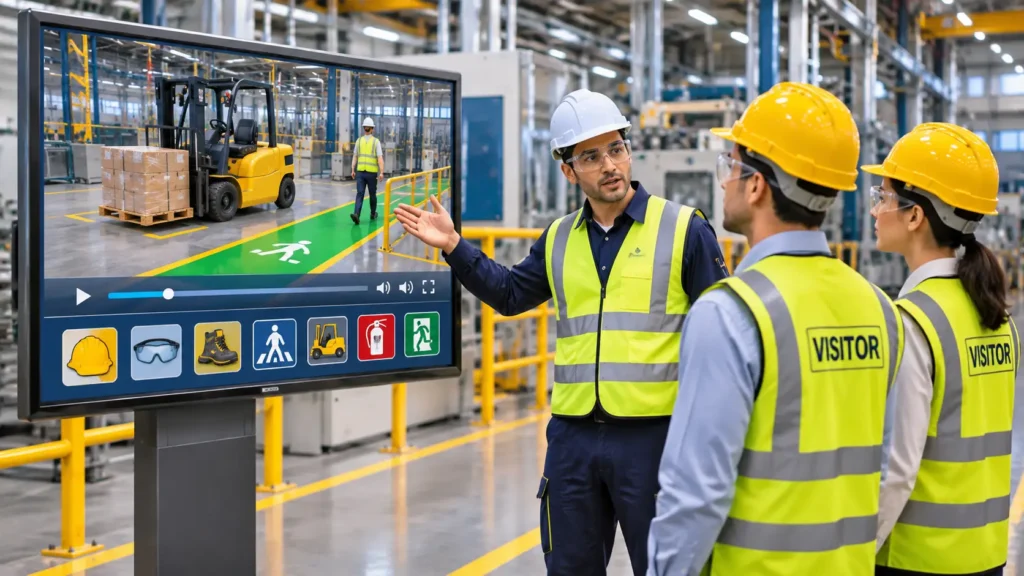
3D animation allows manufacturing plants to recreate their actual workplace environment and demonstrate safety procedures through realistic visual scenarios.
For example, a visitor induction video can visually demonstrate:
Factory Layout and Safe Routes: A 3D walkthrough can introduce visitors to the facility layout, designated pedestrian routes, production zones, and restricted areas.
PPE Requirements: Animation can demonstrate the correct use of safety helmets, shoes, high-visibility clothing, safety glasses, and other required protective equipment.
Machinery and Equipment Hazards: Visitors can see how moving machinery, robotic equipment, conveyor belts, and overhead cranes create potential hazards.
Forklift and Vehicle Safety: Animated scenarios can show blind spots, pedestrian crossing points, reversing vehicles, and the importance of maintaining a safe distance.
Emergency Evacuation: A visual demonstration can explain alarm signals, emergency exits, evacuation routes, and assembly points.
Prohibited Activities: Animation can demonstrate why visitors should not touch machinery, cross safety barriers, enter restricted areas, or use mobile phones in prohibited zones.
Another advantage is consistency. Once a visitor induction video is approved, it can be used to communicate the same essential safety instructions to different visitors without depending entirely on repeated verbal explanations.
However, animated induction videos should complement site-specific briefings, supervision, and practical emergency arrangements. They should not replace the safety controls required by the facility.
What Should a Manufacturing Plant Include in Its Visitor Safety Induction Video?
A well-structured visitor safety induction video should follow the visitor’s actual journey through the facility.
Here is a suggested sequence:
| Video Section | Information to Communicate |
|---|---|
| 1. Welcome and Introduction | Facility overview and purpose of the induction |
| 2. Visitor Registration | Entry procedures, visitor badges, and authorisation |
| 3. Mandatory PPE | Required protective equipment and correct usage |
| 4. General Safety Rules | Behaviour, prohibited activities, and safety responsibilities |
| 5. Pedestrian Safety | Walkways, vehicle routes, and forklift movement |
| 6. Machinery Hazards | Safe distances, machine guards, and restricted zones |
| 7. Restricted Areas | Access limitations and warning signs |
| 8. Emergency Procedures | Alarm response, evacuation routes, and assembly points |
| 9. Visitor Responsibilities | Escort requirements and incident reporting |
| 10. Safety Acknowledgement | Confirmation of understanding before entry |
When developing the pedestrian safety module, manufacturing plants can also refer to OSHA forklift and pedestrian safety guidance to understand important precautions for managing pedestrian movement around powered industrial trucks.
The video should be customised according to the plant’s layout, actual hazards, safety policies, and emergency procedures.
A generic factory animation may explain general safety concepts, but a customised visitor induction video can help people understand the specific environment they are about to enter.
Common Mistakes to Avoid During Visitor Safety Induction
Even when a manufacturing plant has an established visitor induction process, certain gaps can reduce its effectiveness.
Some common mistakes include:
- Providing only written instructions: Long documents may be difficult for occasional visitors to understand and remember.
- Using generic safety content: Instructions that do not reflect actual site hazards may confuse visitors.
- Ignoring language differences: Visitors may miss important information if instructions are available in only one language.
- Not explaining emergency arrangements: Knowing that emergency exits exist is not the same as understanding the evacuation procedure.
- Allowing visitors to move independently: Unescorted access without appropriate authorisation can expose visitors to unnecessary risks.
- Not updating induction material: Changes to plant layouts, equipment, access routes, and emergency procedures should be reflected in the training content.
The goal should be to make visitor safety induction practical, relevant, and easy to follow.
Frequently Asked Questions (FAQs)
Visitors should wear the required PPE, follow designated pedestrian routes, maintain a safe distance from machinery, respect restricted areas, and remain with their authorised escort.
Depending on site hazards, visitors may need safety helmets, safety shoes, high-visibility vests, safety glasses, and hearing protection.
Visitors should stop their activities, follow the designated evacuation route, move to the assembly point, and follow instructions from authorised personnel.
Marked walkways help separate pedestrians from forklifts, moving vehicles, material-handling equipment, and other operational hazards.
Only when authorised and when the required safety precautions, PPE, supervision, and access controls are in place.
The video should cover visitor registration, PPE, pedestrian safety, machinery hazards, restricted areas, emergency procedures, and visitor responsibilities.
3D animation can recreate factory environments and demonstrate machinery hazards, safe walking routes, PPE usage, and emergency evacuation procedures through visual scenarios.
Yes. Customised safety induction videos can include multilingual voiceovers and subtitles to help visitors understand site-specific safety instructions in their preferred language.
How Immersiv Techsphere Supports Visitor Safety Induction Through 3D Animation
At Immersiv Techsphere, we understand that effective safety communication is not just about explaining rules. It is about helping people recognise hazards, understand risks, and follow the correct safety practices.
Organisations can explore our HSE Animation Services to develop customised visual training content covering workplace hazards, visitor induction, PPE requirements, and industrial emergency procedures.
We create customised 3D EHS and HSE animation videos to help organisations communicate industrial safety procedures through engaging visual demonstrations.
For manufacturing plants, we can support the development of visitor safety induction videos covering:
- Factory Safety Walkthroughs: 3D visualisation of manufacturing facilities, production areas, access routes, and restricted zones.
- PPE Awareness: Demonstration of mandatory personal protective equipment and its correct usage.
- Machinery Safety: Visual representation of machinery-related hazards and safe operating distances.
- Pedestrian and Forklift Safety: Demonstration of vehicle movement, pedestrian walkways, and potential collision risks.
- Emergency Response: Animated evacuation procedures, fire safety, emergency exits, and assembly points.
- Customised Safety Scenarios: Visual demonstrations based on actual workplace hazards and approved safety procedures.
Our team combines 3D modelling, industrial visualisation, and animation to develop safety training content based on the client’s requirements.
Whether you need a visitor induction video for a single manufacturing facility or a series of EHS training animations for multiple industrial locations, customised visual communication can help make safety instructions more accessible and consistent.
Explore our EHS and Industrial Animation Services to understand how 3D animation can support workplace safety communication.
Conclusion
Every visitor entering a manufacturing plant should understand the basic safety rules before stepping into an operational area.
From wearing the correct PPE and following designated walkways to maintaining a safe distance from machinery and understanding emergency procedures, these precautions help create a safer environment for everyone.
A structured Visitor Safety Induction programme ensures that visitors know what to expect, what to avoid, and how to respond if something goes wrong.
Manufacturing plants can make this process more effective by combining site-specific safety instructions with visual communication, customised 3D animation, multilingual content, and appropriate visitor supervision.
Ultimately, a factory visit should begin with safety awareness, not assumptions.
Because safety responsibilities do not stop at the factory gate. They extend to everyone who enters the workplace.
Have a Project in Mind?
Need help with 3D animation, industrial visualization, HSE training animation, or product visualization? Tell us about your project and our team will get back to you.