

Table of Contents
Introduction
Electrical hazards are among the most serious risks in industrial workplaces. A routine task such as inspecting an electrical panel, operating switchgear, or performing maintenance on an energized system can become life-threatening if the necessary safety precautions are overlooked.
One such hazard is an electrical arc flash.
An arc flash can release an enormous amount of energy within a fraction of a second, producing intense heat, bright light, pressure waves, molten metal, and flying debris. Even workers who are not directly touching electrical equipment can suffer severe injuries if they are within the affected area.
The challenge is that electrical arc flash hazards are not always easy to recognize. Workers may understand electrical safety rules theoretically but struggle to visualize what actually happens when an arc flash occurs.
This is where 3D safety training videos can make a significant difference.
By recreating electrical hazards through realistic 3D scenarios, industries can help workers understand how arc flashes happen, identify unsafe conditions, and recognize the importance of following electrical safety procedures before performing any task.
Let’s explore how 3D animation can make electrical arc flash awareness training more practical and effective.
What Is an Electrical Arc Flash?
An electrical arc flash is a sudden release of electrical energy through the air when an electrical fault creates an unintended conductive path between conductors or from a conductor to ground.
This can happen due to equipment failure, insulation damage, accidental contact, incorrect maintenance practices, loose connections, contamination, or improper handling of electrical equipment.
During an arc flash incident, the electrical energy can produce:
- Extreme heat: Temperatures can become high enough to cause severe burns and ignite nearby materials.
- Intense light: The bright flash can cause serious eye injuries.
- Pressure waves: Rapid expansion of heated air can create a powerful blast.
- Molten metal: Vaporized electrical components can produce hot metal particles.
- Flying debris: Equipment components and surrounding materials may be forcefully displaced.
According to OSHA electrical arc flash safety guidance, an electrical arc can produce extreme temperatures, explosive pressure, and molten metal particles, creating serious risks for workers.
An arc flash is different from an electric shock. Electric shock generally occurs when current passes through the human body, whereas an arc flash involves the release of energy through an electrical arc. Both hazards can occur during the same incident.
Understanding this difference is important for workers involved in electrical installation, operation, inspection, and maintenance.
Why Is Electrical Arc Flash Awareness Important in Industrial Workplaces?
Industrial facilities depend on electrical systems to operate machinery, production lines, control panels, motors, distribution boards, and other essential equipment.
Maintenance and troubleshooting activities often require workers to interact with electrical installations, making electrical safety awareness essential.
However, accidents can happen when workers:
- Open electrical panels without understanding the associated hazards.
- Perform maintenance without following approved isolation procedures.
- Assume that equipment is de-energized without verifying its electrical condition.
- Use incorrect tools or inappropriate PPE.
- Ignore warning labels and arc flash boundaries.
- Work on electrical equipment without proper authorization or training.
- Fail to recognize damaged cables, loose connections, or signs of equipment deterioration.
For industries, an arc flash incident can result in worker injuries, equipment damage, production interruptions, investigation costs, and regulatory consequences.
For workers, the consequences can be life-changing.
This makes arc flash awareness more than a compliance requirement. It is an important part of building a workplace where employees understand electrical risks and know how to respond safely.
Why Traditional Electrical Safety Training May Not Be Enough
Most electrical safety training programs explain hazards through classroom presentations, written procedures, safety manuals, and toolbox talks.
These methods are useful for communicating technical information, but they may not always help workers visualize the actual sequence of events during an electrical incident.
For example, a worker may know that opening an energized electrical panel is dangerous. But do they understand how an arc flash can develop, how quickly it can occur, and why maintaining the required safety distance matters?
This is where visual learning becomes valuable.
A 3D electrical safety training video can demonstrate the entire incident sequence, from the initial unsafe condition to the resulting arc flash and its consequences.
Instead of simply telling workers what not to do, the animation shows them why a particular action is dangerous.
How 3D Safety Training Videos Explain Electrical Arc Flash Hazards
3D animation allows safety trainers to recreate hazardous electrical situations in a controlled virtual environment.
Workers can observe equipment from different angles, understand how an electrical fault develops, and see the possible consequences of unsafe actions without being exposed to actual electrical hazards.
Here are some practical scenarios that can be covered through 3D electrical arc flash awareness training.
1. Understanding How an Arc Flash Occurs
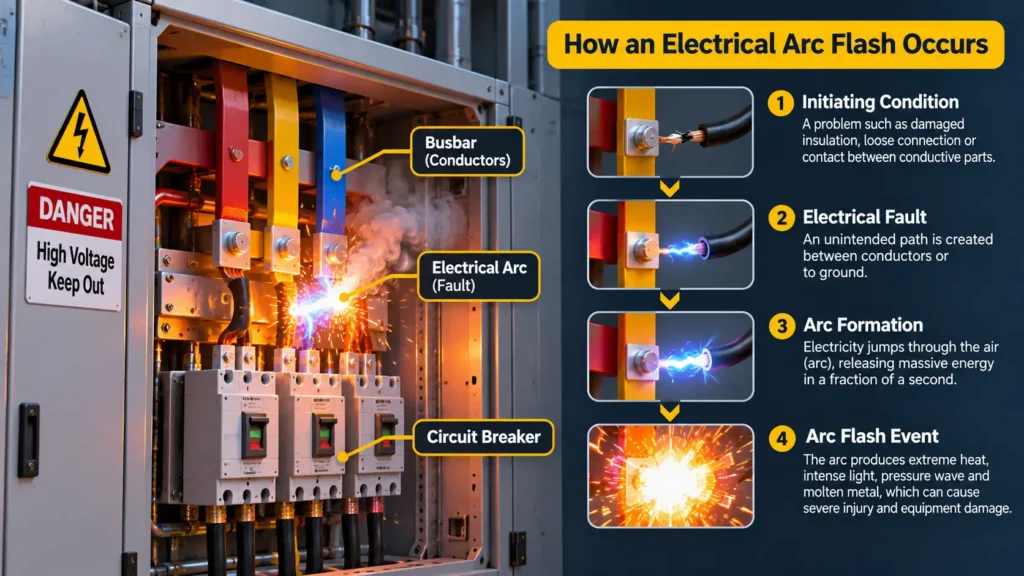
A 3D animation can begin by showing an industrial electrical panel with its internal components, including busbars, circuit breakers, cables, and electrical connections.
The animation can then demonstrate how an electrical fault develops due to damaged insulation, accidental contact, or loose connections.
The sequence can visually explain:
- How an electrical arc forms between conductors.
- How the arc generates intense heat and light.
- How pressure builds up inside the equipment.
- How the incident can affect nearby workers and equipment.
By showing the process step by step, workers gain a clearer understanding of what an arc flash actually looks like and why it is so dangerous.
2. Demonstrating the Consequences of Unsafe Electrical Work
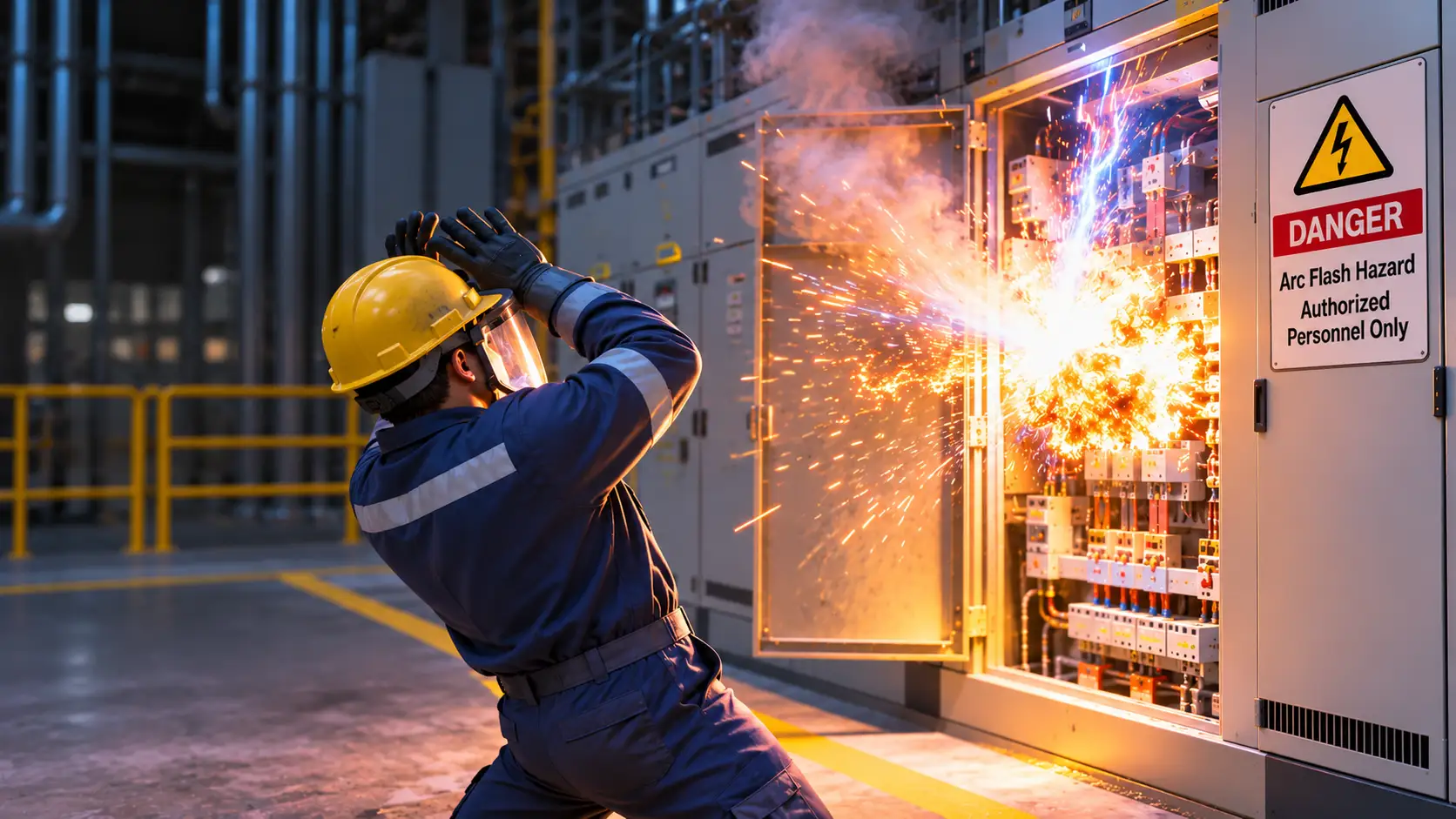
Consider a maintenance technician opening an electrical panel without following the required safety procedures.
A 3D safety training video can recreate this situation and show how a seemingly routine activity can lead to a serious electrical incident.
The animation can highlight:
- Working on energized equipment without proper authorization.
- Ignoring electrical warning signs.
- Using inappropriate tools.
- Standing too close to potentially hazardous equipment.
- Performing maintenance without an approved risk assessment.
The scenario can then demonstrate the possible consequences of an arc flash, including thermal burns, pressure injuries, and damage to electrical equipment.
This type of visual demonstration helps workers connect everyday workplace decisions with their potential consequences.
3. Explaining Arc Flash Boundaries and Safe Working Distances
Understanding electrical safety boundaries is essential for anyone working near electrical equipment.
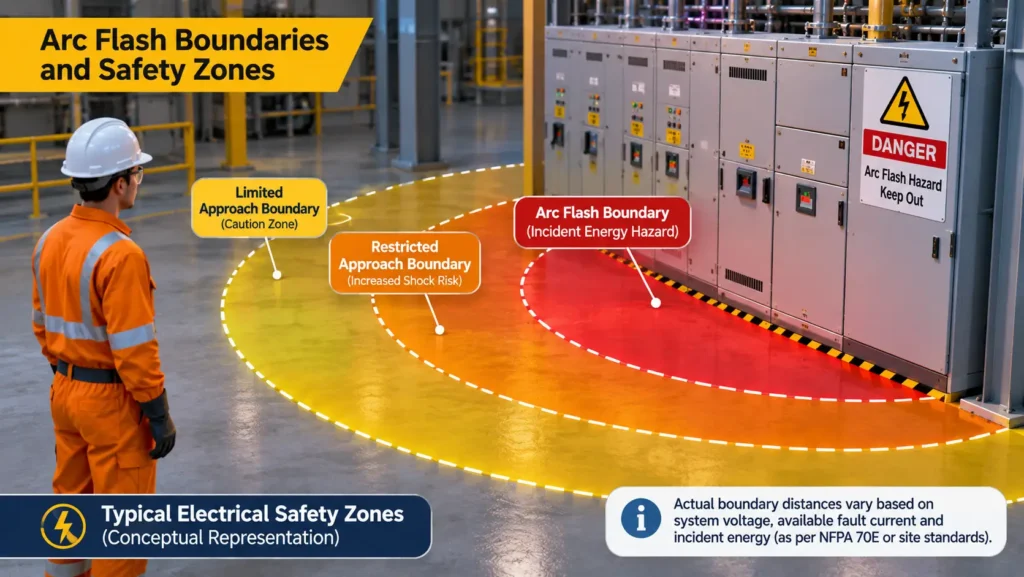
However, terms such as limited approach boundary, restricted approach boundary, and arc flash boundary can be difficult to understand through written explanations alone.
A 3D animation can represent these boundaries visually around electrical equipment.
It can demonstrate:
- Where the arc flash boundary is established.
- Why unauthorized personnel should remain outside designated hazardous areas.
- How access restrictions help control exposure.
- Why risk assessment and electrical safety procedures must be followed before work begins.
The animation can also show workers entering restricted areas without proper authorization and explain why this creates additional risk.
Importantly, the video should clarify that arc flash boundaries and shock protection boundaries serve different safety purposes.
4. Demonstrating the Importance of Electrical PPE
Personal Protective Equipment (PPE) plays an important role in reducing the risk of injury during electrical work.
However, wearing ordinary industrial PPE does not automatically provide protection against arc flash hazards.
A dedicated 3D safety animation can demonstrate the purpose of different protective equipment, including:
- Arc-rated clothing selected according to the hazard assessment.
- Arc-rated face shields or appropriate protective hoods.
- Insulated gloves suitable for the electrical task.
- Safety helmets and protective footwear.
- Hearing protection where required.
The video can also demonstrate how incorrect PPE selection, damaged protective equipment, or incomplete protection can increase worker exposure.
For industrial organizations, this makes PPE training more understandable and easier to incorporate into electrical safety induction programs.
5. Showing Safe Electrical Isolation and Lockout/Tagout Procedures
One of the most important ways to control electrical hazards is to establish and verify a safe electrical isolation condition before maintenance begins.
A 3D training video can explain the Lockout/Tagout (LOTO) process through a realistic maintenance scenario.
The animation can demonstrate:
- Identifying all relevant energy sources.
- Shutting down equipment according to the approved procedure.
- Isolating electrical energy sources.
- Applying personal locks and identification tags.
- Verifying the absence of voltage using an appropriate test instrument and approved procedure.
- Performing the maintenance activity only after the safe condition has been established.
This helps workers understand that switching off equipment alone does not necessarily make it safe to work on.
The video should also reinforce that isolation, testing, and re-energization must follow the facility’s approved electrical safety procedures.
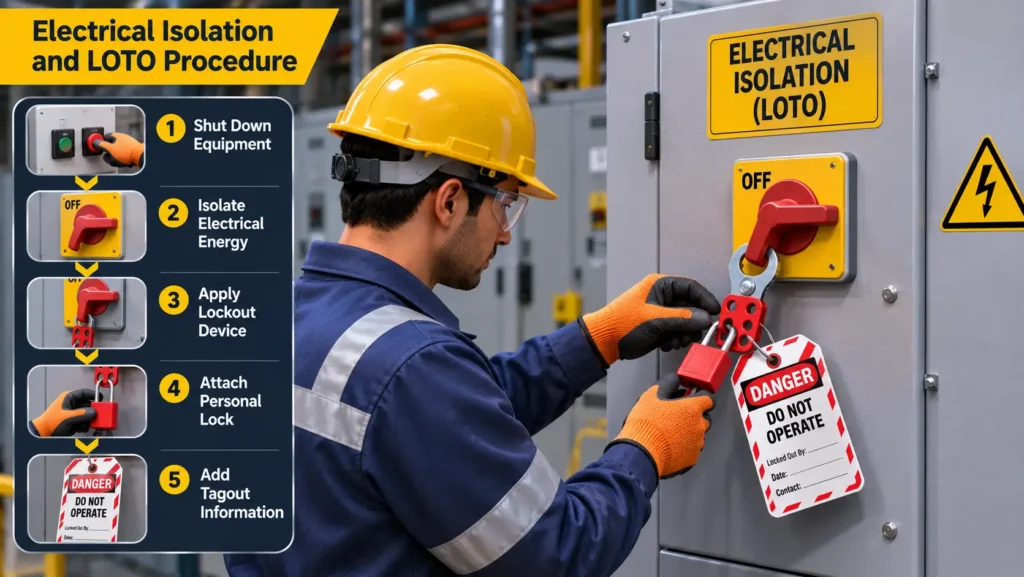
For a more detailed understanding of hazardous energy isolation, explore our article on Lockout Tagout (LOTO) training using 3D safety animation, which explains how visual scenarios can demonstrate safe isolation procedures.
6. Explaining Emergency Response After an Arc Flash Incident
Even with preventive measures, workers should know what to do if an electrical incident occurs.
A 3D animation can recreate an emergency situation and demonstrate the correct response sequence.
Depending on the facility’s emergency procedures, the video can cover:
- Raising the alarm and notifying emergency response personnel.
- Keeping others away from the affected electrical area.
- Avoiding direct contact with a person who may still be in contact with an energized source.
- Ensuring the electrical source is isolated by authorized personnel.
- Arranging emergency medical assistance.
- Following approved first-aid and burn-response procedures.
Visualizing these situations helps workers understand the importance of acting quickly without putting themselves or others at additional risk.
How 3D Electrical Safety Training Benefits Industries and Workers
3D electrical arc flash awareness videos offer value beyond simply explaining electrical hazards. They help organizations communicate safety procedures in a consistent, visual, and engaging way.
The benefits extend to both employers and employees.
Benefits for Industries
1. More effective safety communication
Electrical hazards involve technical concepts that are not always easy to explain through written documents. 3D animation simplifies these concepts through visual demonstrations.
2. Consistent training across departments
The same training video can be used for electrical maintenance teams, operators, supervisors, contractors, and new employees, helping maintain consistency in safety communication.
3. Safer demonstration of high-risk scenarios
Industries can demonstrate dangerous situations virtually without deliberately exposing workers to hazardous electrical conditions.
4. Better safety induction and refresher training
3D electrical safety videos can be incorporated into employee onboarding, contractor induction, toolbox talks, and periodic refresher training.
5. Improved understanding of safety procedures
By visually demonstrating electrical isolation, PPE requirements, warning signs, and safe working practices, organizations can make technical safety information easier to understand.
Benefits for Workers
1. Better hazard recognition
Workers learn to identify common electrical hazards, unsafe working conditions, and warning signs before starting a task.
2. Understanding real-world consequences
Seeing how an arc flash develops helps workers understand why electrical safety procedures must never be ignored.
3. Improved understanding of PPE
Visual demonstrations explain the purpose of arc-rated clothing, protective equipment, and correct PPE selection.
4. Better emergency preparedness
Workers become more familiar with emergency response procedures and the importance of avoiding unsafe rescue attempts.
5. Increased safety awareness
Scenario-based training encourages workers to think about potential risks before performing electrical operations or maintenance activities.
What Should an Electrical Arc Flash Awareness Training Video Include?
A well-planned 3D electrical safety training video should focus on actual workplace activities rather than simply presenting general electrical safety information.
The content should be developed around the electrical equipment, work environment, and risks relevant to the organization.
A typical training video can include the following modules:
| Training Module | Key Learning Objective |
|---|---|
| Introduction to Arc Flash | Understand what an arc flash is and how it occurs |
| Electrical Hazard Identification | Recognize common electrical risks |
| Unsafe Work Practices | Understand how incorrect actions can lead to incidents |
| Arc Flash Boundaries | Understand designated safety boundaries |
| Electrical PPE | Recognize appropriate protective equipment |
| LOTO Procedures | Understand safe electrical isolation |
| Emergency Response | Learn the correct response to an electrical incident |
For more advanced training, organizations can also include equipment-specific scenarios involving low-voltage and medium-voltage switchgear, motor control centres (MCCs), electrical distribution panels, transformers, and industrial substations.
The technical content should be reviewed by qualified electrical safety professionals to ensure that the animation reflects the applicable standards and site-specific procedures.
Electrical safety training programs should consider applicable requirements and recognized guidance, including the NFPA 70E Standard for Electrical Safety in the Workplace, which addresses safe work practices for reducing exposure to electrical shock, electrocution, arc flash, and arc blast hazards.
Why Choose 3D Animation for Electrical Arc Flash Awareness Training?
One of the biggest advantages of 3D animation is its ability to explain events that are difficult, dangerous, or impossible to demonstrate in a real workplace.
For example, showing the internal development of an electrical arc inside a switchgear panel would be difficult using conventional live-action filming.
With 3D animation, the camera can move inside the equipment, highlight electrical components, show the formation of an arc, and demonstrate how the incident affects the surrounding environment.
Other advantages include:
- Equipment-specific visualization: Recreate actual electrical panels, switchgear, and industrial environments.
- Technical cutaway views: Show internal equipment components and explain how electrical faults develop.
- Realistic incident recreation: Demonstrate arc flash incidents without staging dangerous activities.
- Visual hazard highlighting: Use colour coding, labels, and annotations to identify hazardous areas.
- Multilingual training: Combine 3D visuals with different language voiceovers and subtitles to support a diverse workforce.
- Reusable training content: Use the same animation across induction programs, refresher sessions, and internal safety campaigns.
This makes 3D animation a practical training medium for manufacturing plants, power generation facilities, oil and gas installations, chemical industries, electrical maintenance contractors, and other workplaces where electrical hazards are present.
How Immersiv Techsphere Supports Electrical Safety Training Through 3D Animation
At Immersiv Techsphere, we create 3D industrial safety animation and EHS training videos that help organizations explain workplace hazards through realistic visual scenarios.
Our approach focuses on converting technical safety procedures into clear, engaging, and easy-to-understand training content.
For electrical arc flash awareness, we can develop customized 3D animation videos covering:
- Electrical arc flash incident recreation.
- Electrical panel and switchgear hazard identification.
- Unsafe electrical maintenance practices.
- Arc flash boundaries and electrical safety zones.
- Arc-rated PPE and protective equipment awareness.
- Lockout/Tagout (LOTO) procedures.
- Electrical emergency response and safety precautions.
We can also customize the animation according to your equipment, workplace environment, safety procedures, and training requirements. You can explore our industrial animation and EHS animation portfolio to see examples of visual communication for industrial applications.
Whether the objective is to train electrical maintenance personnel, conduct contractor safety induction, or strengthen workplace electrical hazard awareness, 3D safety animation provides a visual way to communicate important safety information.
Our focus is simple: help workers understand the hazard before they encounter it in the workplace.
Explore our 3D EHS and Safety Animation Services to understand how customized safety animation can support your industrial training requirements.
Frequently Asked Questions (FAQs)
Electrical arc flash awareness training educates workers about arc flash hazards, their causes, potential injuries, preventive measures, PPE, and safe electrical work practices.
3D animation visually recreates electrical faults, arc flash incidents, equipment damage, and unsafe working conditions, helping workers understand hazards that are difficult to demonstrate in real life.
Electrical technicians, maintenance engineers, electricians, equipment operators, supervisors, and contractors working near electrical installations may require training based on their job responsibilities and exposure to electrical hazards.
Yes. 3D animation can demonstrate electrical isolation, lock application, tagging, verification of zero energy, and safe maintenance procedures.
Yes. 3D safety training videos can be customized for manufacturing plants, oil and gas facilities, power plants, chemical industries, and other workplaces according to their equipment and safety procedures.
Yes. The same 3D animation can be adapted with different voiceovers and subtitles to help workers understand electrical safety procedures in their preferred languages.
Conclusion
Electrical arc flash incidents can happen within seconds, but their consequences can last a lifetime. Understanding how these hazards develop and how to prevent them is essential for anyone working around industrial electrical systems.
Traditional training methods remain important, but combining them with 3D electrical safety training videos makes it easier to demonstrate hazardous situations, explain technical procedures, and communicate the consequences of unsafe actions.
For industries, this means more consistent safety communication and better visual training resources. For workers, it means a clearer understanding of electrical risks and the precautions required to work safely.
Looking to improve electrical safety awareness in your workplace? Let’s connect to create customized 3D EHS and Safety Training Videos based on your equipment, workplace hazards, and SOPs. Help your workforce understand electrical risks through realistic visual scenarios with Immersiv Techsphere.
Contact us to discuss your custom safety animation requirements
Have a Project in Mind?
Need help with 3D animation, industrial visualization, HSE training animation, or product visualization? Tell us about your project and our team will get back to you.