

Table of Contents
Introduction
Every B2B manufacturer knows the moment. A customer asks for a pump with a different flange, a conveyor with a longer span, or a control cabinet with a non-standard voltage. The salesperson cannot be sure the combination is possible, so the request goes to engineering. Engineering is busy, so it waits. Days later a drawing and a price come back, and by then the buyer has already been talking to a competitor.
This is the engineering-to-sales divide, and for manufacturers of configurable, engineer-to-order or highly customized products, it is one of the most expensive gaps in the business. The good news is that it is now closable. Interactive 3D product configurators, paired with Configure, Price, Quote (CPQ) software, let customers and sales teams design valid products, see them in real time, and receive accurate quotes in minutes rather than weeks.
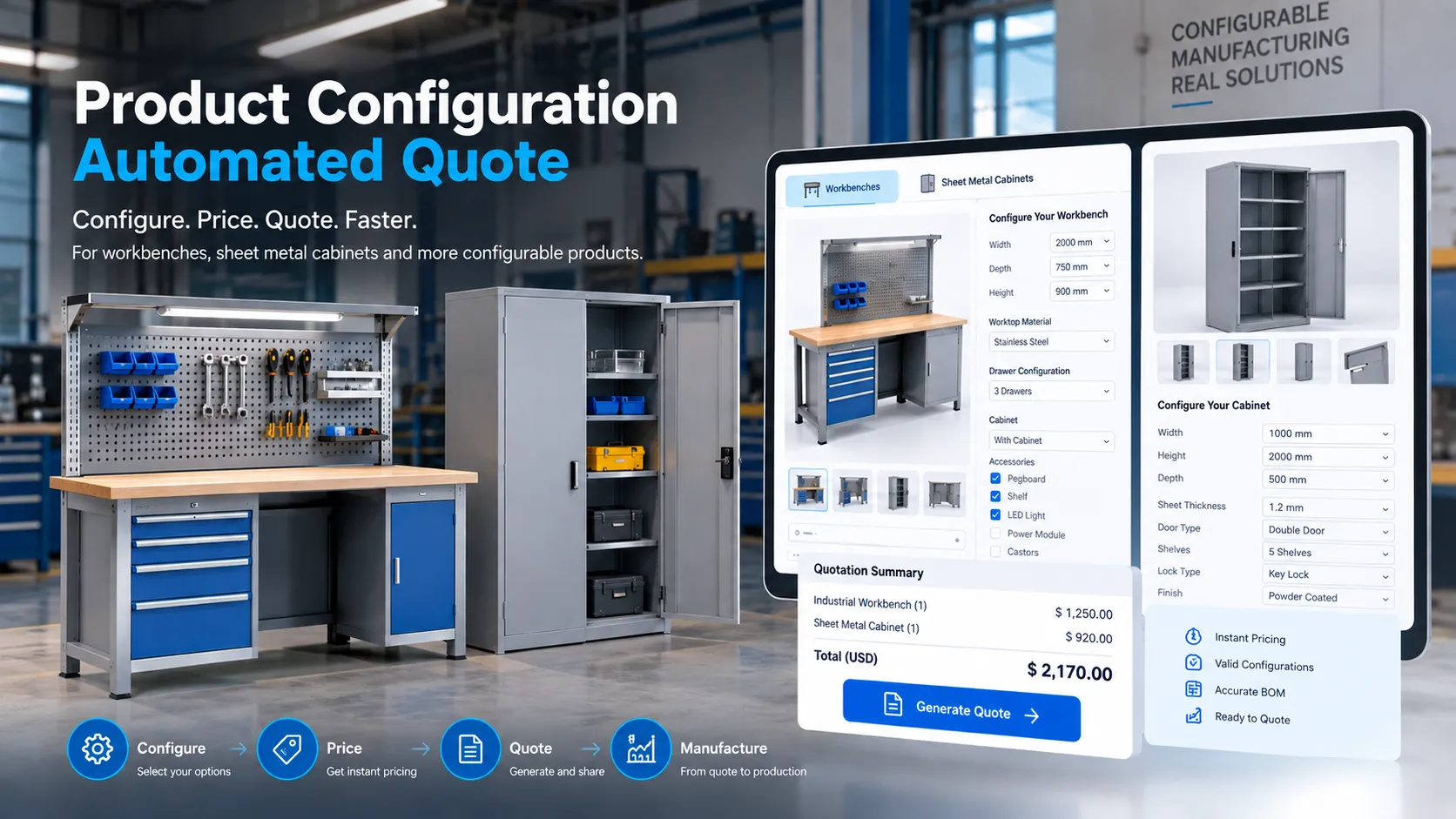
To address these challenges, manufacturers can implement custom Configurator & CPQ solutions that connect product selection, engineering rules, automated pricing and quotation workflows.
In this article we look at why the divide exists, what these technologies actually do, how they work together, and how to implement them successfully.
Why the Engineering-to-Sales Divide Exists
Engineering and sales speak different languages because they are measured differently.
Engineering optimizes for correctness, manufacturability and safety. Its knowledge lives in CAD models, bills of materials (BOMs), design rules and the heads of senior engineers.
Sales optimizes for speed, responsiveness and winning deals. Its tools are the CRM, spreadsheets, PDF catalogs and price lists.
When products are simple, the gap barely matters. When products are configurable, with hundreds of options, dependencies and exclusions, the gap becomes a bottleneck. Typical symptoms include:
- Long quote turnaround. Every non-standard request becomes an engineering ticket.
- Inconsistent or incorrect quotes. Spreadsheets and tribal knowledge produce pricing errors and configurations that cannot actually be built.
- Costly downstream rework. An order that was sold but cannot be manufactured as specified leads to change orders, delays and unhappy customers.
- Engineering overload. Skilled engineers spend their time answering repetitive sales questions instead of designing new products.
- Poor buyer experience. Today’s B2B buyers expect the same self-service convenience they get as consumers, yet they receive a PDF and a promise to follow up.
None of this is a people problem. It is a systems problem: the knowledge needed to sell correctly is locked away from the people who need it.
What Is an Interactive 3D Product Configurator?
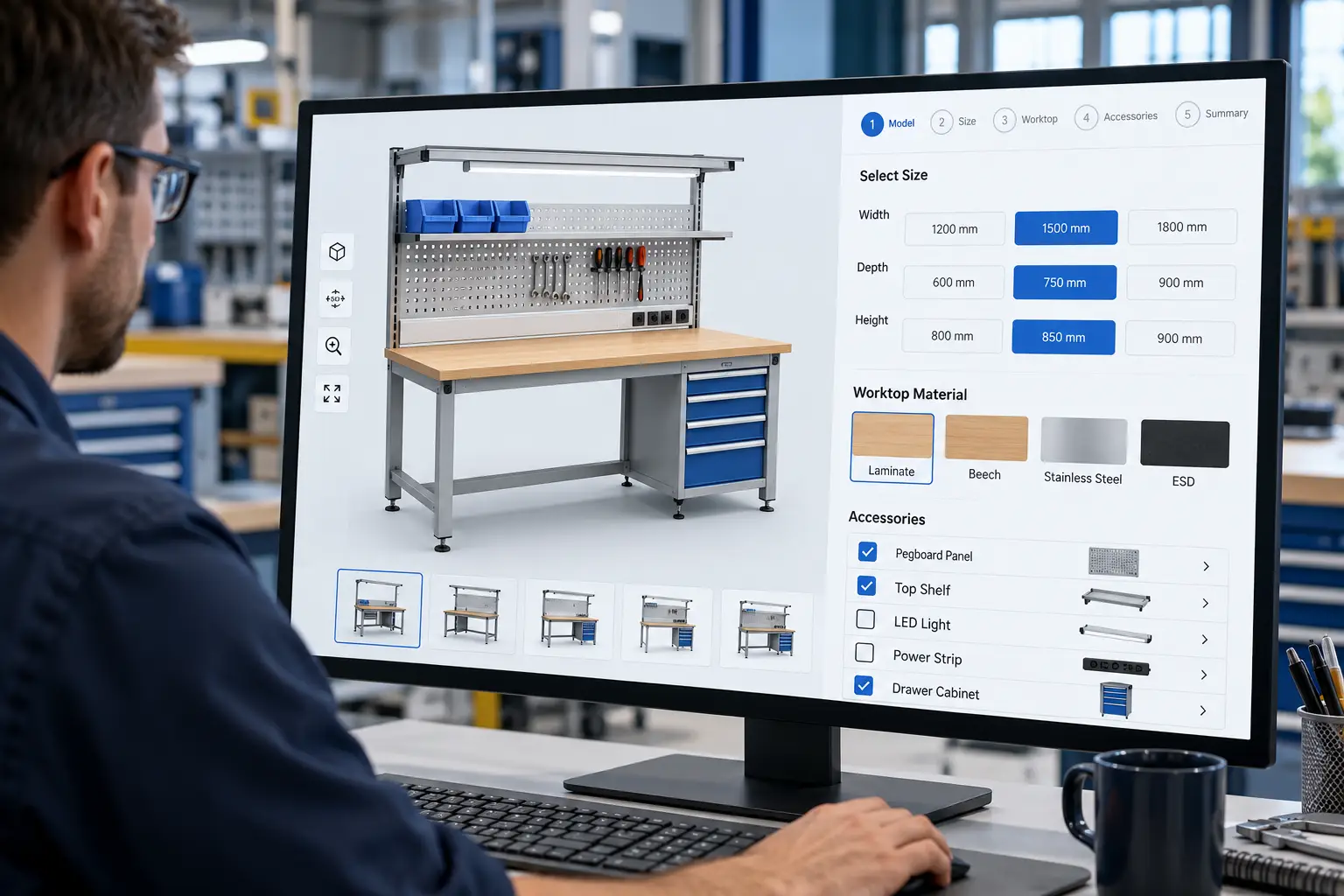
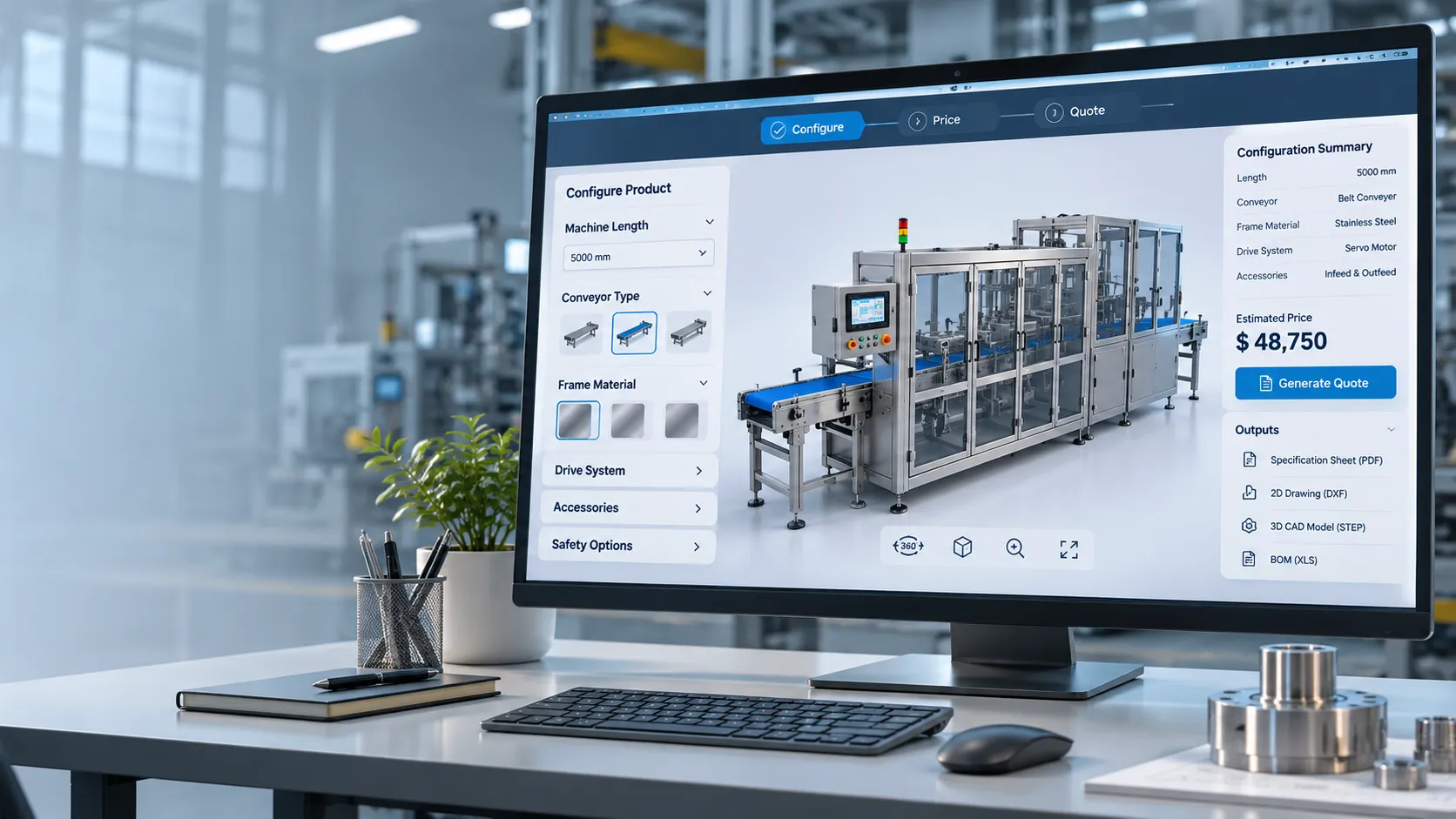
An interactive 3D product configurator is a web-based tool that lets a user select options, dimensions, materials, colors and accessories for a product and instantly see the result as a photorealistic 3D model they can rotate, zoom, and in many cases view in augmented reality.
The key word is interactive. Rather than browsing static images of pre-built variants, the buyer builds the exact product they need. The configurator enforces the manufacturer’s rules behind the scenes, so only valid combinations are possible. Selecting a particular motor, for example, might automatically limit the compatible gearboxes, or add a required mounting kit.
A strong 3D configurator typically offers:
- Real-time visualization that updates with every choice
- Rule-based validation so invalid combinations are blocked or flagged
- Dynamic dimensions and parametric geometry for made-to-measure products
- AR and mobile viewing so buyers can place a machine in their own facility
- Shareable configurations that can be saved, emailed or sent to a colleague for approval
- Output of useful downloads such as spec sheets, 2D drawings and CAD files
What Is CPQ, and Why Does It Matter?
CPQ stands for Configure, Price, Quote. It is the commercial and logic layer that sits behind the visuals.
- Configure: a rules engine defines which options, components and combinations are valid.
- Price: pricing logic applies list prices, volume discounts, customer-specific agreements, regional rates, margins and approval thresholds automatically.
- Quote: the system generates a professional, accurate proposal, often integrated directly with the CRM and ERP.
A 3D configurator without CPQ is a pretty picture. CPQ without a visual configurator is a powerful but abstract form that many buyers and even salespeople find hard to interpret. Together, they provide both what it looks like and what it costs and whether it can be built.
When product configuration is connected with pricing and quotation generation, manufacturers can simplify the entire sales process. Learn more about how product configurators automate online quotation for manufacturers.
How the Two Work Together: One Source of Truth
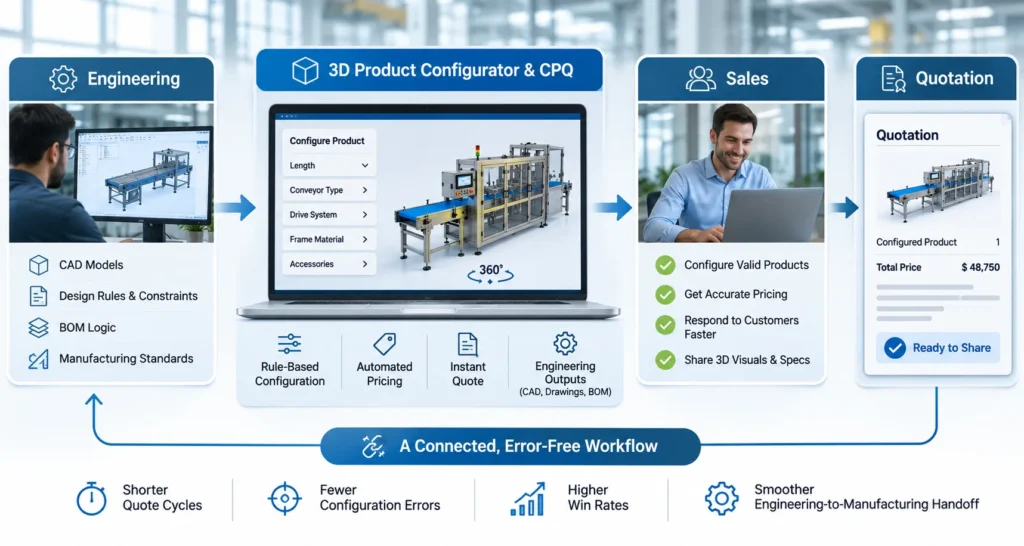
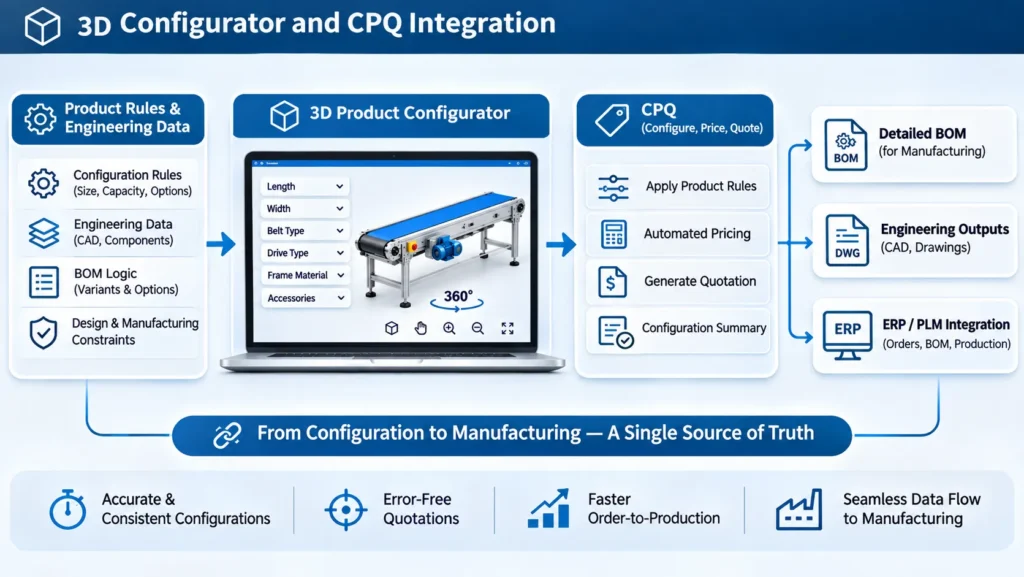
The real transformation happens when the configurator and CPQ share a single, governed source of product knowledge. Here is what the flow looks like in practice:
- Engineering encodes its knowledge once. Design rules, constraints, compatibility matrices and BOM logic are defined in the configuration model, often derived from existing CAD and PLM data.
- The configurator exposes that logic visually. A buyer or salesperson selects options and sees the 3D model update, with invalid choices prevented in real time.
- CPQ prices the configuration instantly. Because every option maps to a part or service with a known cost, the price is calculated as the product is configured.
- A quote is generated automatically. The proposal includes the 3D rendering, technical specifications, pricing, lead time and terms.
- The order flows downstream cleanly. A validated configuration can generate a manufacturing-ready BOM and routing, and pass directly into ERP and production planning.
The result is that engineering’s expertise is embedded in the sales process instead of being a gate in front of it.
The Business Benefits for B2B Manufacturers
1. Dramatically faster quotes
When quoting no longer requires an engineering review for every request, turnaround can shrink from days or weeks to minutes. Speed is often the deciding factor in competitive B2B deals, and the first credible quote frequently wins.
2. Fewer errors and less rework
Because the configurator only allows buildable combinations, the typical “we sold something we can’t make” scenario largely disappears. Fewer errors at the quote stage mean fewer corrections at the production stage, which protects margins and customer trust.
By validating product combinations before an order reaches production, manufacturers can reduce avoidable engineering revisions and quotation errors. Read more about how product configurators reduce engineering rework and quotation errors.
3. Freed-up engineering capacity
Engineers spend less time on repetitive quote support and more on innovation and genuinely custom work. For many manufacturers this is the most valuable benefit, because skilled engineering talent is scarce and expensive.
4. Higher win rates and larger deals
Buyers who can see and adjust a product in 3D understand it better, trust it more and feel ownership of the design. Guided selling also makes it natural to suggest compatible accessories, upgrades and service packages, which lifts average order value.
5. Pricing consistency and margin protection
Automated pricing rules and discount approval workflows prevent ad hoc discounting and keep quotes aligned with company policy across every salesperson, distributor and region.
6. A modern buyer experience
B2B buyers increasingly research and specify products on their own before ever speaking to sales. A self-service configurator available around the clock meets them where they are, captures qualified leads, and gives your sales team richer information when the conversation begins.
7. Easier channel and distributor enablement
Dealers and distributors can configure and quote your products accurately without calling the factory, extending your reach without extending your support burden.
Where It Delivers the Most Value
These solutions are especially powerful for manufacturers whose products share these traits:
- High variability: many options, sizes, materials or finishes
- Engineer-to-order or configure-to-order models
- Complex dependencies between components
- Long, technical sales cycles with multiple stakeholders
- Significant cost of errors, such as industrial machinery, HVAC systems, enclosures, custom furniture, lifting equipment, packaging lines, doors and windows, and medical or laboratory equipment
If your team regularly answers the question “can we build it this way, and what would it cost?”, you are a strong candidate.
A Practical Roadmap to Implementation
Successful projects are rarely about the software alone. They are about capturing knowledge and aligning teams. A proven approach looks like this:
Step 1: Start with a focused product family
Resist the urge to model your entire catalog at once. Choose a product line with meaningful volume and complexity, and prove the value there before scaling.
Step 2: Involve engineering and sales together from day one
The configuration model must reflect real design rules, and the user experience must reflect real selling workflows. Joint ownership prevents the very divide you are trying to close.
Step 3: Capture and clean your product logic
Document options, constraints, dependencies and pricing. This process often reveals inconsistencies and undocumented rules that are worth resolving regardless of the software.
Step 4: Reuse existing data
Leverage CAD models, PLM data and BOM structures wherever possible. Optimize 3D assets for web performance so the experience is fast on any device.
Step 5: Integrate with your core systems
Connect to your CRM, ERP and, where relevant, PLM and e-commerce platforms. Integration is what turns a standalone tool into a connected workflow.
Step 6: Pilot, measure and iterate
Track metrics such as quote turnaround time, quote-to-order conversion, error rate, engineering hours per quote and average deal size. Use real feedback from sales, partners and customers to refine the experience.
Step 7: Plan for governance
Products change. Assign clear ownership for maintaining rules, pricing and 3D assets so the system stays accurate as your portfolio evolves.
Common Pitfalls to Avoid
- Treating it as an IT project only. Without business ownership from both engineering and sales, adoption stalls.
- Over-modeling on day one. Complexity for its own sake slows launch and frustrates users.
- Ignoring performance. Heavy 3D files that load slowly will lose buyers before they see the product.
- Neglecting change management. Salespeople and engineers need training and a clear explanation of what is in it for them.
- Forgetting maintenance. An outdated configurator is worse than none, because it creates confidence in wrong answers.
What to Look for in a Solution
When evaluating platforms, consider:
- Rules engine power and flexibility for handling your real product complexity
- True 3D quality and speed, including AR support and mobile performance
- Native or proven integrations with your CRM, ERP and CAD/PLM environment
- Scalability across product lines, regions, languages and currencies
- Ease of maintenance so non-developers can update rules and pricing
- Analytics that show how customers configure and where they drop off
- Security and enterprise readiness appropriate for B2B use
The Future: Smarter, More Connected Configuration
The category is evolving quickly. AI-assisted configuration is beginning to let buyers describe what they need in plain language and receive a recommended starting configuration. Digital twins and richer simulation will allow performance to be validated before anything is built. Tighter links between configurators, e-commerce and production will move manufacturers closer to a seamless digital thread from first click to finished product.
Manufacturers that build the foundation now, a clean configuration model, connected systems and a culture of shared ownership, will be best positioned to take advantage of each of these advances.
Conclusion
The engineering-to-sales divide has long been treated as an unavoidable cost of selling complex products. It is not. By embedding engineering knowledge into an interactive 3D configurator and powering it with CPQ, manufacturers can give salespeople, partners and customers the ability to design, price and quote accurate products on their own, while engineers focus on what only engineers can do.
The outcome is faster quotes, fewer errors, happier buyers and a more scalable business. In a market where speed and precision decide who wins, closing the divide is no longer a nice-to-have. It is a competitive advantage.
Frequently Asked Questions
A product configurator guides users through choosing valid options, often with 3D visualization. CPQ adds pricing and quoting logic on top. Used together, they deliver a complete configure-to-quote workflow.
Existing CAD models are usually a starting point, but they typically need to be optimized for web use. A good implementation partner will help prepare assets and connect them to your configuration rules.
It depends on product complexity and data readiness. Many manufacturers begin with a single product family pilot and expand once results are proven.
Yes. Integration with systems such as ERP, CRM and PLM is a core part of getting full value, allowing configurations and quotes to flow directly into orders and production.
No. Any manufacturer with configurable or customized products and a quoting bottleneck can benefit, regardless of size.
Ready to Close the Gap?
Want to see how an interactive 3D configurator and CPQ could work for your products? Book a demo or Contact our team to discuss your configuration challenges.
Have a Project in Mind?
Need help with 3D animation, industrial visualization, HSE training animation, or product visualization? Tell us about your project and our team will get back to you.