

Table of Contents
Introduction
Creating an effective EHS training video involves more than putting together visuals, adding a voiceover and explaining safety instructions. Every scene needs to communicate the right procedure, demonstrate realistic workplace conditions and help employees understand what they should do in an actual situation.
With Artificial Intelligence (AI) becoming increasingly common in video production, creating training content is becoming faster. AI tools can help generate scripts, create visual concepts, produce voiceovers and speed up certain animation workflows.
But there is one important question: Can AI create technically accurate EHS training videos without compromising safety information?
The answer depends on how AI is used.
For industrial safety training, faster production is useful, but accuracy cannot be optional. A video demonstrating incorrect PPE usage, an unsafe operating procedure or an unrealistic emergency response can create confusion instead of improving workplace safety.
This is where the combination of AI tools and professional EHS animation production becomes important.
In this blog, we will explore how AI is changing EHS animation production, where it can improve efficiency and why technical validation still needs to remain part of the process.
How AI Is Changing EHS Training Video Production
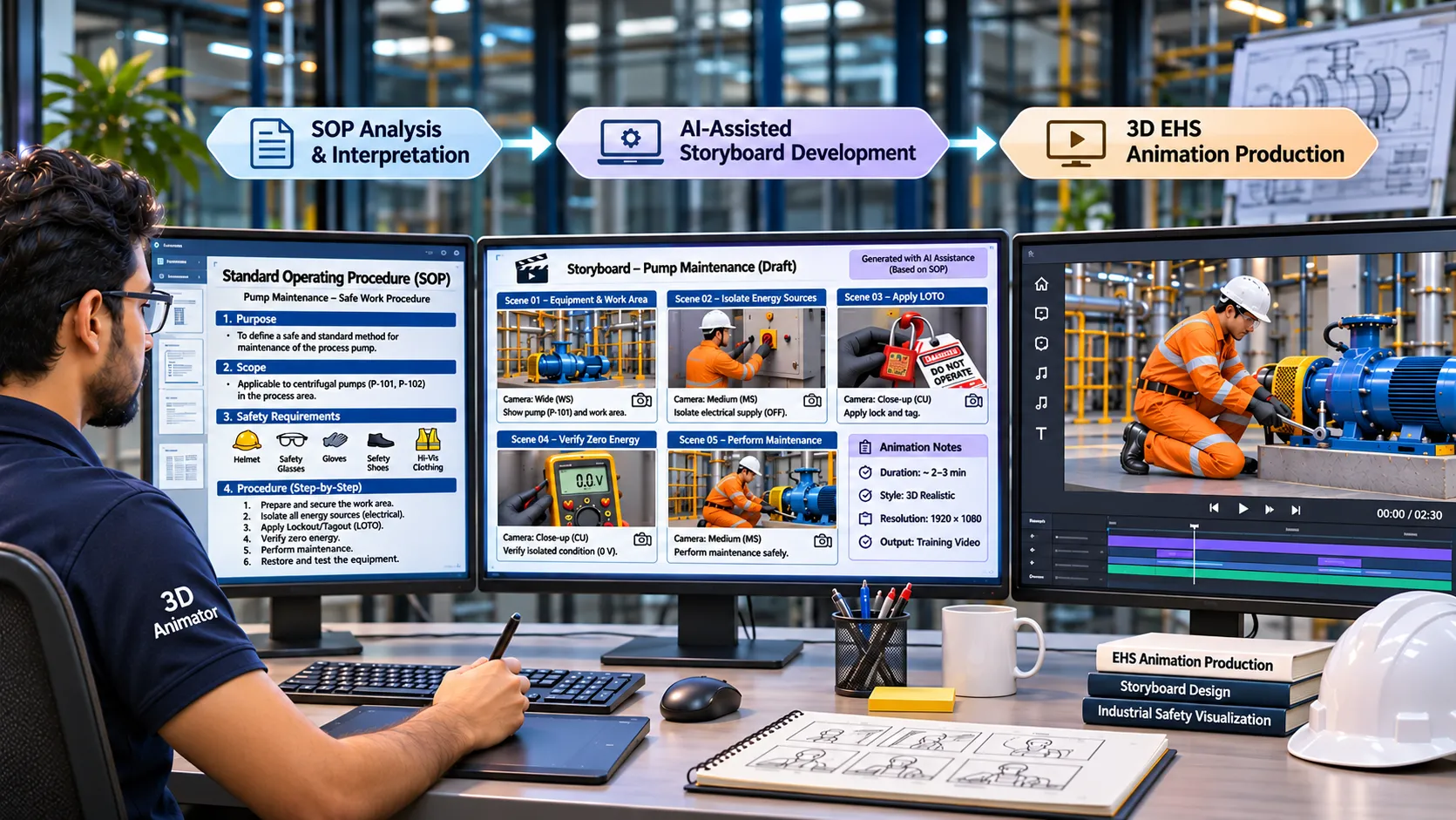
Traditionally, producing an EHS training video involves several stages, including understanding safety requirements, script development, storyboard preparation, 3D modelling, animation, rendering, voiceover and final editing.
Each stage requires time, coordination and technical understanding.
AI is helping production teams speed up some of these activities.
For example:
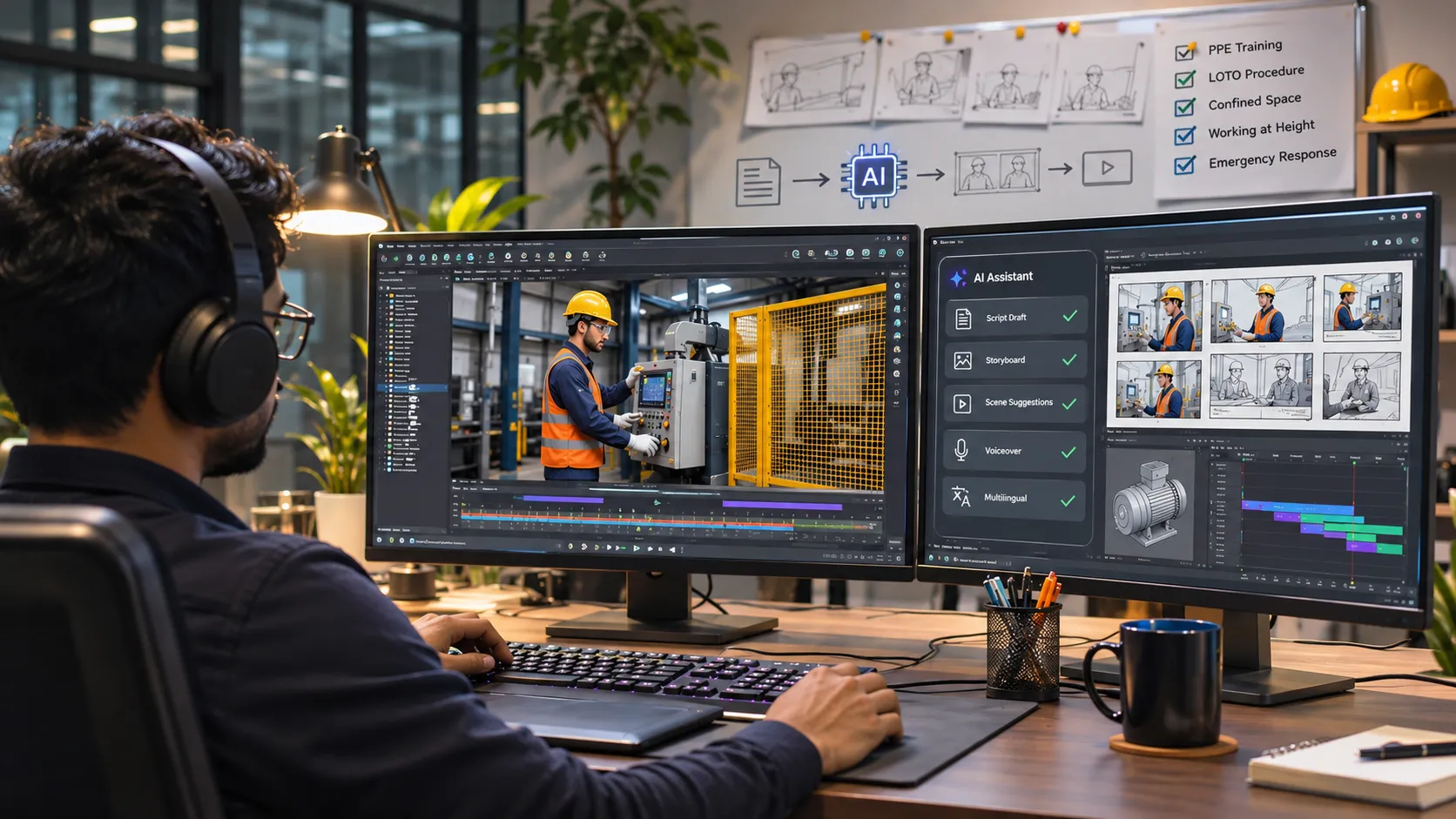
- Script Development: AI can help organise safety information, create initial scripts and simplify technical language for different employee groups.
- Visual Concept Development: AI image-generation tools can help explore scene layouts, workplace environments and visual references.
- Voiceover Production: AI-generated voices can provide narration in different languages and support faster revisions.
- Video Editing: AI-assisted editing tools can help with subtitles, scene organisation, audio cleanup and other post-production tasks.
- Content Adaptation: Existing training material can be adapted into shorter learning modules, awareness videos and different language versions.
These capabilities can reduce repetitive production work and help teams develop training content more efficiently.
AI-assisted production is also influencing the broader AI-assisted industrial animation workflow, where generative tools, 3D assets and automation can work together to improve production efficiency.
However, AI-generated content still requires human review, particularly when it involves industrial processes, equipment operation and workplace safety procedures.
Where AI Can Improve the EHS Animation Workflow
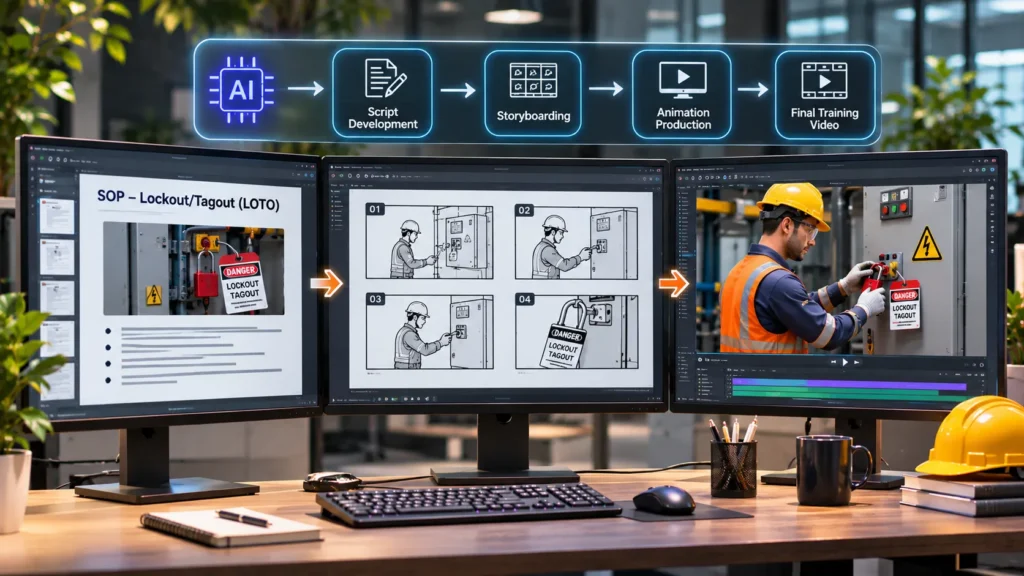
AI is most useful when it supports the production process rather than trying to replace the entire process.
Let’s look at a few areas where it can make a practical difference.
1. Faster Scriptwriting and Training Content Development
Developing scripts for EHS training videos often starts with lengthy documents, safety manuals, SOPs and industry guidelines.
AI can help convert this information into structured training scripts. It can also simplify technical terminology, organise instructions into logical sequences and suggest examples that employees can easily understand.
For instance, a Lockout/Tagout (LOTO) training video may need to explain:
- Identifying hazardous energy sources.
- Shutting down the equipment.
- Isolating energy sources.
- Applying locks and tags.
- Verifying zero-energy conditions before maintenance.
AI can help organise these steps into a clear narrative. However, the final script must be checked against the company’s approved LOTO procedure and applicable safety requirements.
2. Faster Visual Planning and Storyboarding
Before animation begins, the production team needs to decide what each scene should communicate.
AI-generated visual references can help explore different workplace environments, equipment arrangements and scene compositions.
For example, when planning a working-at-height safety animation, AI can help generate initial visual concepts showing workers, scaffolding, access platforms and industrial surroundings.
These references can help the animation team establish the visual direction before creating detailed 3D scenes.
However, AI-generated images should be treated as references, not automatically accepted as technically correct representations of equipment or safety practices.
3. Multilingual Voiceovers and Training Adaptation
Industrial organisations often have employees from different language backgrounds.
AI voice generation and translation tools can help create multilingual versions of training videos without repeating the entire production process.
A company may need the same safety induction video in English, Hindi, Arabic or other regional languages.
AI can reduce the time required for narration and translation workflows. However, technical terminology, safety instructions and local workplace language must be reviewed by someone familiar with the subject.
4. Faster Video Editing and Post-Production
AI-assisted editing can simplify repetitive tasks such as subtitle generation, audio enhancement, background noise removal and scene organisation.
This is particularly useful when producing multiple training modules or updating an existing EHS video library.
The production team can spend more time improving the visual explanation and technical details rather than handling every repetitive editing task manually.
Why Technical Accuracy Matters More Than Production Speed
This is where EHS animation production becomes different from ordinary marketing or promotional video production.
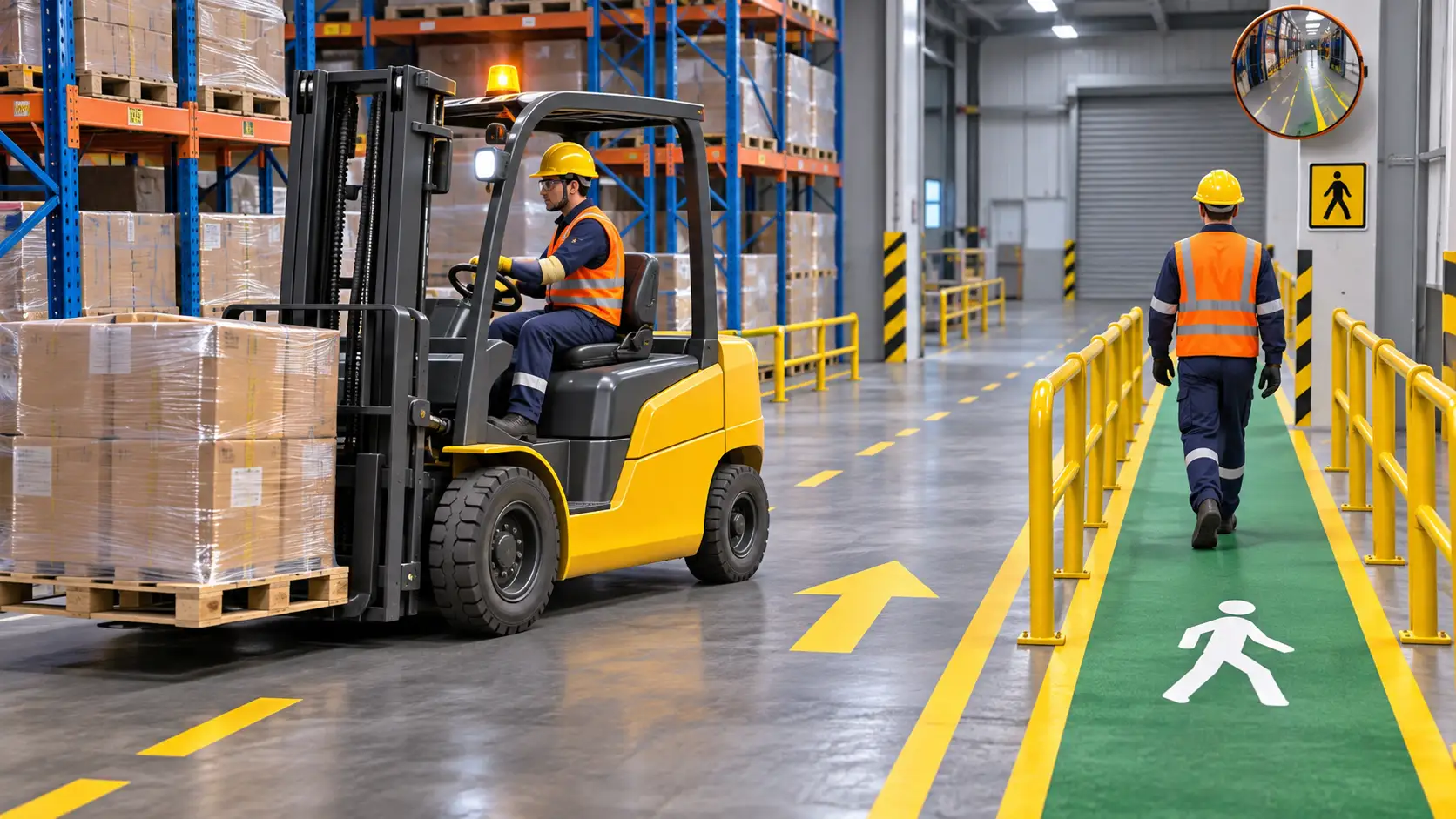
Professional 3D safety animation for high-risk industrial procedures helps demonstrate equipment interactions, workplace hazards and correct safety actions in a controlled visual environment.
In a promotional video, a visually appealing scene may be enough to communicate the intended message. In an EHS training video, every important visual detail can influence how an employee understands a safety procedure.
Consider a few examples.
- PPE Training: A worker wearing a safety helmet and safety shoes may appear correctly equipped, but the animation could still be inaccurate if the worker is not wearing the appropriate eye protection, gloves or respiratory equipment required for the specific task.
- Fire Safety Training: An AI-generated fire safety scene might show an employee using a fire extinguisher. But does the scene demonstrate the correct extinguisher type, PASS technique, safe distance and emergency evacuation decision?
- Confined Space Entry: A confined space animation needs to explain atmospheric testing, ventilation, authorisation, communication and rescue arrangements. Missing even one critical step can make the training incomplete.
Explore how confined space entry training through EHS animation can help employees understand entry procedures, potential hazards and emergency response requirements. - Machine Guarding: A machine animation may look realistic, but if it shows an operator accessing moving components without appropriate guarding or isolation, it communicates an unsafe practice.
For a practical example, Lockout/Tagout training using 3D safety animation demonstrates how hazardous energy isolation and equipment-specific procedures can be explained visually.
These examples highlight an important point: AI can generate convincing visuals, but convincing visuals are not necessarily technically accurate.
For EHS training, the content must be validated against approved SOPs, applicable standards and site-specific safety requirements.
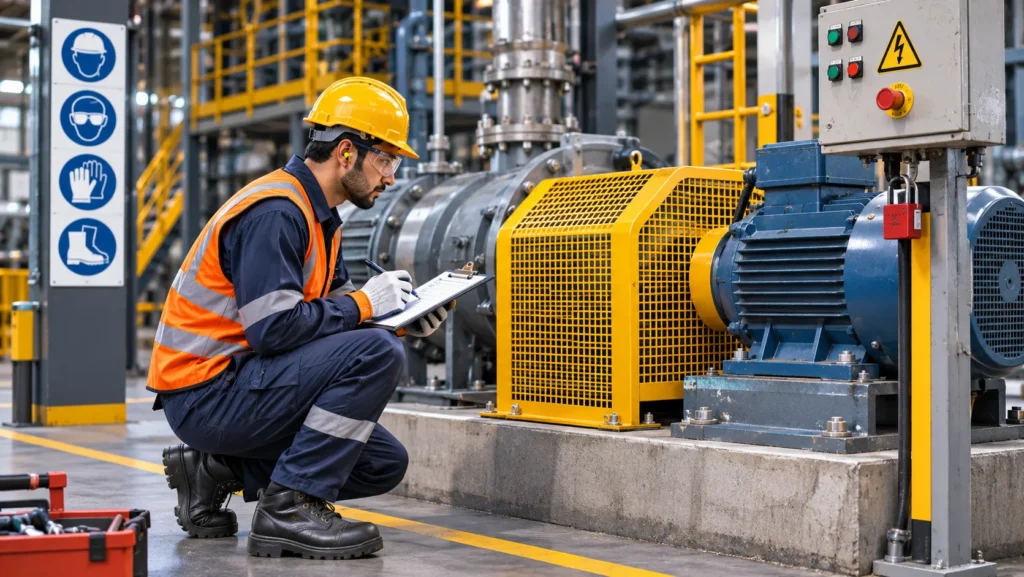
AI-Generated Visuals vs Professional 3D EHS Animation
AI-generated video tools are improving rapidly, but they are not always suitable for explaining complex industrial activities.
Professional 3D animation offers a different level of control over the visual content.
| Area | AI-Generated Video | Professional 3D EHS Animation |
|---|---|---|
| Scene creation | Can generate visuals quickly | Requires modelling and scene development |
| Equipment accuracy | May generate incorrect details | Allows control over equipment geometry |
| PPE representation | May produce inconsistent PPE details | Allows specific PPE selection and placement |
| Step-by-step procedures | May struggle with sequence consistency | Allows controlled animation of each step |
| Camera angles | Depends on generated output | Precise camera positioning and movement |
| Revisions | May require regenerating scenes | Specific models and actions can be modified |
| Technical control | Requires careful validation | Greater control over the visual representation |
This does not mean AI-generated videos have no place in EHS training.
They can be useful for awareness content, introductory explanations and visual concept development.
However, when the objective is to demonstrate a specific industrial operation, equipment interaction, hazard scenario or emergency response procedure, controlled 3D animation is often a more suitable approach.
The choice should depend on the complexity and risk associated with the training topic.
Where AI Should Support Human Expertise, Not Replace It
An effective AI-assisted EHS animation workflow needs collaboration between technology, animation professionals and safety experts.
Each has a different responsibility.
- AI Tools: Support research organisation, initial script development, visual references, voiceovers and repetitive production activities.
- EHS Professionals: Validate safety procedures, identify hazards, review control measures and confirm that the content reflects approved practices.
- 3D Animation Professionals: Develop accurate equipment models, demonstrate workplace activities, control character movements and communicate procedures visually.
- Technical Reviewers: Check the final animation for missing steps, incorrect equipment representation and inconsistencies before publication.
This approach allows production teams to benefit from AI without making it responsible for decisions that require engineering and safety knowledge.
It also creates a more reliable review process.
A simple rule is worth following: AI can help create the content, but qualified professionals must validate what the content teaches.
A Practical Workflow for AI-Assisted EHS Animation Production
Instead of using AI for every stage, organisations can combine AI-assisted tools with a structured animation production workflow.
A practical approach could look like this:
- Understand the training requirement: Identify the target audience, workplace hazards, training objectives and approved safety procedures.
- Develop the training script: Use AI to organise information and prepare an initial script. Have EHS professionals verify the technical content.
- Prepare the storyboard: Define the scenes, camera angles, characters, equipment and important safety actions.
- Develop 3D models and environments: Create or modify equipment models, industrial environments, PPE and other visual elements according to the actual requirements.
- Produce the animation: Animate the required activities, hazard scenarios, safe working procedures and emergency responses.
- Integrate AI-assisted elements: Use AI voiceovers, subtitles, translations and editing assistance wherever they improve production efficiency.
- Conduct technical validation: Review the animation with the relevant safety and technical teams. Correct inaccurate details before final delivery.
- Publish and update training content: Deliver the final videos in suitable formats for safety induction, employee training, presentations and e-learning platforms.
This workflow keeps technical accuracy at the centre while allowing AI to reduce repetitive production activities.
How Immersiv Techsphere Approaches EHS Animation Production
At Immersiv Techsphere, we believe industrial safety training should be easy to understand, visually engaging and technically meaningful.
Our approach to EHS animation production focuses on explaining real workplace activities rather than simply creating attractive visuals.
We develop customised 3D EHS and HSE animation videos for organisations that want to communicate safety procedures, demonstrate workplace hazards and improve employee awareness.
Our animation services can support different training requirements, including:
- Safety Induction Videos: Introduce employees and visitors to workplace rules, site hazards, PPE requirements and emergency procedures.
- PPE Training Animations: Demonstrate the correct selection and use of personal protective equipment for different industrial activities.
- Fire Safety Animations: Explain fire prevention, extinguisher usage, evacuation procedures and emergency response.
- Working at Height Animations: Demonstrate fall prevention, fall protection systems, ladder safety and scaffolding practices.
- Confined Space Safety: Explain entry procedures, atmospheric testing, ventilation, monitoring and emergency rescue arrangements.
- Machine and Equipment Safety: Visualise machine hazards, guarding requirements, safe operation and maintenance procedures.
- Incident and Accident Recreation: Recreate workplace incidents to explain how hazards develop, what went wrong and how similar situations can be prevented.
We also understand that every industrial organisation has different equipment, processes and safety requirements. Therefore, customised animation is important when generic training material does not adequately represent the actual workplace.
Our production approach combines 3D modelling, technical understanding, animation and structured content development to create training videos relevant to the intended audience.
AI-assisted tools can support selected stages of this process, but the objective remains the same: deliver clear, consistent and technically reviewed safety communication.
Explore our EHS Animation Services to understand how customised industrial safety animations can support your employee training programmes.
The Future of AI in EHS Training Videos
AI will continue to influence how organisations develop and deliver safety training content.
Some emerging opportunities include:
- Faster development of customised safety training modules.
- Multilingual training content for geographically distributed workforces.
- AI-assisted learning assessments and knowledge checks.
- Easier adaptation of existing training videos when procedures change.
- Integration of animation with interactive learning and digital training platforms.
- More personalised learning experiences based on employee roles and training requirements.
However, the future of EHS training will not depend on production speed alone.
Organisations need training content that employees can understand, remember and apply in real working environments.
AI can help make content development more efficient, but engineering knowledge, safety expertise and visual accuracy will continue to play an important role.
Frequently Asked Questions
AI can assist with scriptwriting, visual concept development, voiceover generation, translation, subtitles and video editing. It helps reduce repetitive production tasks, while technical and safety professionals remain responsible for validating the content.
AI tools can generate video content from text prompts and visual references. However, they may not consistently reproduce industrial equipment, PPE, workplace procedures and safety actions accurately. Professional review is essential before using such videos for formal safety training.
It depends on the training objective. AI-generated videos can be useful for general awareness and introductory content. Professional 3D EHS animation offers greater control over equipment, character movements, camera angles and step-by-step industrial procedures.
EHS animations demonstrate workplace hazards, operating procedures and emergency responses. Incorrect visuals or missing safety steps can mislead employees. Technical accuracy ensures that the training reflects approved procedures and applicable safety requirements.
Yes. AI-assisted translation, voice generation and subtitle tools can help create training content in multiple languages. However, technical terminology and safety instructions should be reviewed by competent language and subject-matter professionals.
Companies should evaluate the animation team’s understanding of industrial environments, experience with 3D modelling, ability to interpret technical documentation, customisation capabilities and approach to technical review. The final animation should accurately represent the company’s training requirements.
Conclusion: Faster Production Should Never Mean Compromising Safety
The growing use of AI in EHS Training Video production presents valuable opportunities for industrial organisations and animation studios.
From script development and visual planning to voiceovers and post-production, AI can simplify several activities and reduce repetitive work.
But safety training is not just about creating videos quickly. It is about communicating the correct information in a way that employees can understand and apply.
A technically incorrect animation can create confusion, even when it looks highly realistic.
The most effective approach is to combine AI-assisted production with professional 3D animation, engineering knowledge and EHS validation.
For organisations investing in workplace safety training, this balance can help create more engaging, relevant and reliable training content.
At Immersiv Techsphere, our focus is on making complex industrial safety procedures easier to understand through customised 3D EHS and HSE animations. We believe technology should improve the way safety information is communicated, without compromising the accuracy of the message.
Have a Project in Mind?
Need help with 3D animation, industrial visualization, HSE training animation, or product visualization? Tell us about your project and our team will get back to you.