

Table of Contents
Introduction
Forklifts are essential for moving materials in warehouses, manufacturing plants, distribution centres and construction sites. They help workers handle heavy loads efficiently, reduce manual effort and keep material-handling operations moving. However, when forklifts operate in the same areas as pedestrians, even a routine movement can create a serious safety risk.
A forklift reversing out of a storage aisle, a worker crossing a vehicle route or an operator approaching a blind corner without warning can lead to a collision. These incidents can result in serious injuries, crushing accidents and, in some cases, fatalities.
Forklift and pedestrian safety is not just about training operators to drive carefully. It also involves teaching every worker how to recognise moving vehicle hazards, understand blind spots, follow designated walkways and respond safely when forklifts are operating nearby.
This is where structured workplace safety training, supported by practical demonstrations and 3D EHS animation videos, can make a difference.
Why Is Forklift and Pedestrian Safety Important?
In many industrial environments, forklifts and pedestrians share the same working space. Operators move pallets between storage racks, transport raw materials to production areas and load or unload goods while other employees perform their regular duties nearby.
This creates several opportunities for vehicle-pedestrian interaction.
Unlike smaller vehicles, forklifts are designed to carry heavy loads and have specific operating characteristics. Their rear wheels steer, their rear end swings during turns, and their stopping distance depends on factors such as speed, load and floor conditions. In addition, bulky loads can obstruct the operator’s forward visibility.
A pedestrian may assume that the operator has seen them, while the operator may not notice someone approaching from the side or walking behind the vehicle.
According to the Occupational Safety and Health Administration (OSHA), pedestrians can be injured when struck by forklifts or by falling loads. OSHA recommends separating forklift traffic from pedestrian movement wherever possible.
Therefore, forklift safety training must address both sides of the interaction: the person operating the vehicle and the person walking through the workplace.
What Are the Common Forklift and Pedestrian Collision Risks?
Understanding where and how collisions can happen is the first step towards preventing them. Workers should be familiar with the following situations.
- Reversing Forklifts :
Reversing is one of the situations that requires particular attention. Operators may have limited visibility behind the vehicle, especially in busy warehouses with storage racks, stacked materials and other equipment.
A pedestrian walking behind a reversing forklift may enter its path without realising that the vehicle is moving.
Training focus: Workers should never walk directly behind a reversing forklift. Operators should check their surroundings, look in the direction of travel and use appropriate warning systems and a spotter where necessary.
- Blind Corners and Intersections :
Blind corners are common in warehouses and manufacturing facilities. Storage racks, walls, equipment and stacked materials can block the view of both forklift operators and pedestrians.
For example, a worker may walk around the corner of a storage aisle just as a forklift approaches from the opposite direction.
Training focus: Operators should slow down and sound the horn at blind corners and obstructed intersections. Pedestrians should stop at designated crossing points, check for approaching vehicles and avoid stepping into a forklift’s path. - Forklift Blind Spots :
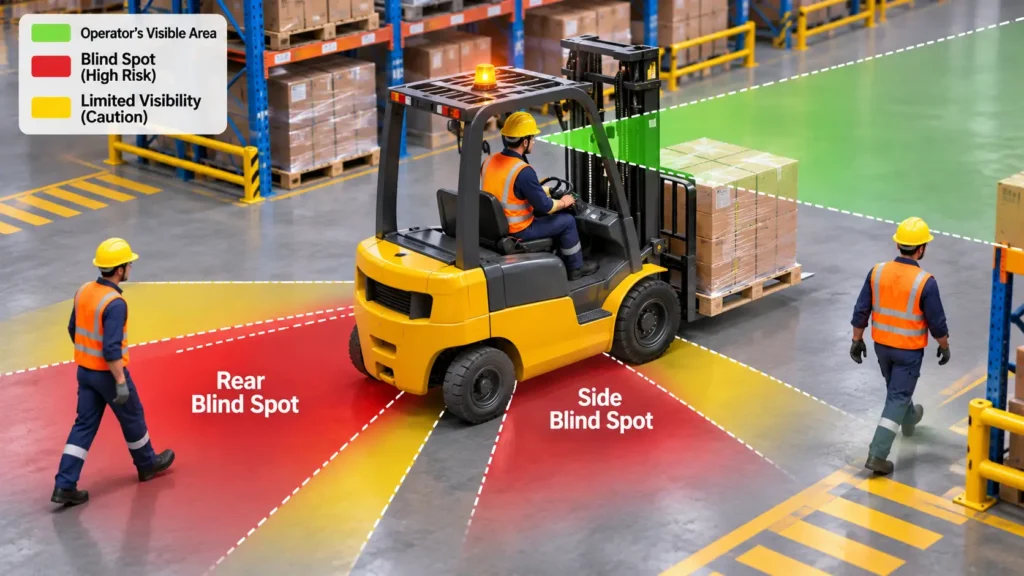
Forklifts have areas around the vehicle where the operator’s visibility is limited. The mast, overhead guard, load and vehicle structure can obstruct the operator’s view.
When carrying a large pallet, the load may block the forward line of sight. A worker standing close to the front or side of the vehicle may not be visible to the operator.
Training focus: Workers should understand that eye contact with an operator is not always possible and should never assume that the driver has seen them. Operators must maintain a clear view of their travel path and use an appropriate alternative direction of travel or visibility aid when required. - Turning and Rear-End Swing :
Unlike conventional cars, forklifts generally steer using their rear wheels. As a result, the rear end of the vehicle swings outward when turning.
A pedestrian standing near the side or rear of a forklift may be struck even when the vehicle is moving at a relatively low speed.
Training focus: Pedestrians should maintain a safe distance from operating forklifts, particularly when they are turning or manoeuvring in narrow aisles. Operators should reduce speed and check their surroundings before making turns. - Obstructed Loads and Falling Materials :
Large or improperly arranged loads can obstruct the operator’s view and create additional risks during transportation.
An unstable load may also shift or fall, striking pedestrians working nearby.
Training focus: Operators should ensure that loads are stable and properly positioned before moving them. Pedestrians must never walk or stand beneath elevated loads or near an active lifting operation. - Shared Loading and Unloading Areas :
Loading docks and material transfer areas involve frequent movement of forklifts, delivery vehicles and workers.
Pedestrians entering these areas without following designated routes may be exposed to reversing vehicles, moving loads and restricted visibility.
Training focus: Clearly identify pedestrian exclusion zones, vehicle movement routes and safe waiting areas around loading and unloading operations.
How Can Workers Recognise Forklift Collision Hazards?
Recognising hazards before an incident occurs is an important part of forklift and pedestrian safety training.
Workers should be trained to observe their surroundings rather than rely only on warning signs or vehicle alarms.
Some important warning situations include:
- A forklift approaching from behind or entering an aisle.
- A vehicle reversing near a pedestrian walkway.
- A forklift carrying a load that blocks the operator’s visibility.
- A worker standing close to the turning radius of a forklift.
- A pedestrian crossing a vehicle route without checking both directions.
- A forklift operating near a loading dock or material storage area.
- Poor lighting, noisy surroundings or obstructed visibility.
- Pedestrians walking outside designated walkways to save time.
Consider a simple workplace situation.
An employee is walking towards a production area while looking at a work instruction on a handheld device. At the same time, a forklift is reversing out of a storage aisle. The operator’s view is partially blocked, and the employee does not notice the warning light.
Both individuals are following their regular work routines, but neither has recognised the developing collision risk.
Safety training should help workers identify this type of situation and understand the correct response: stop, remain outside the vehicle’s operating path and allow the forklift to complete its movement safely.
What Safety Rules Should Forklift Operators Follow?
Forklift operators have a direct responsibility to operate the vehicle safely and remain aware of pedestrians in the surrounding area.
Important forklift operating practices include:
- Check the vehicle before operation: Inspect brakes, steering, tyres, lights, horns, mirrors and warning devices. Report defects and do not operate an unsafe vehicle.
- Maintain a safe operating speed: Travel at a speed that allows the forklift to stop safely under the existing workplace conditions. Reduce speed near intersections, corners, pedestrians and congested areas.
- Keep the travel path visible: Always look in the direction of travel. If a load obstructs forward visibility, follow the appropriate operating procedure, which may require travelling with the load trailing.
- Use horns and warning systems: Sound the horn at blind corners, doorways and other locations where visibility is restricted. Use reversing alarms, flashing lights and other installed warning systems appropriately.
- Give pedestrians the right of way: Stop when pedestrians cross the planned travel path. Do not attempt to move through a crowded area until there is sufficient safe clearance.
- Maintain safe turning distances: Reduce speed before turning and remain aware of the rear-end swing. Avoid manoeuvring too close to workers, racks and fixed objects.
- Never move with an unsafe load: Check load stability, capacity and positioning before transportation. Do not allow anyone to stand or walk beneath an elevated load.
- Use a spotter when required: When visibility is restricted and a spotter is necessary, follow the established communication procedure. Stop immediately if the spotter is no longer visible.
These practices should be included in practical forklift operator training and reinforced through regular workplace safety communication.
What Should Pedestrians Do to Stay Safe Around Forklifts?
Forklift safety is not limited to operators. Employees, contractors, visitors and other pedestrians must understand how to move safely around industrial vehicles.
Here are some essential precautions:
- Use designated pedestrian walkways: Follow marked routes instead of taking shortcuts through forklift operating areas.
- Stop at crossing points: Look in both directions and check for approaching forklifts before crossing.
- Maintain a safe distance: Stay clear of moving vehicles, particularly during reversing, turning and load-handling activities.
- Avoid blind spots: Never assume the operator can see you, even when you are standing close to the forklift.
- Stay away from elevated loads: Never walk or stand beneath raised forks or suspended materials.
- Pay attention to warning signals: Watch for flashing lights and listen for horns or reversing alarms.
- Avoid distractions: Do not use mobile phones or engage in activities that reduce awareness while walking through vehicle movement areas.
- Follow site instructions: Respect barriers, floor markings, warning signs and restricted-access zones.
One important point that workers should remember is that forklifts cannot always stop immediately. Their braking and handling characteristics are different from those of passenger vehicles.
Pedestrians should never try to cross in front of a moving forklift or assume that an operator can stop in time.
How Can Workplaces Prevent Forklift and Pedestrian Collisions?
Training becomes more effective when it is supported by proper workplace design and traffic management.
Organisations should not depend entirely on workers remembering safety instructions. They should create an environment where safe behaviour is easier to follow.
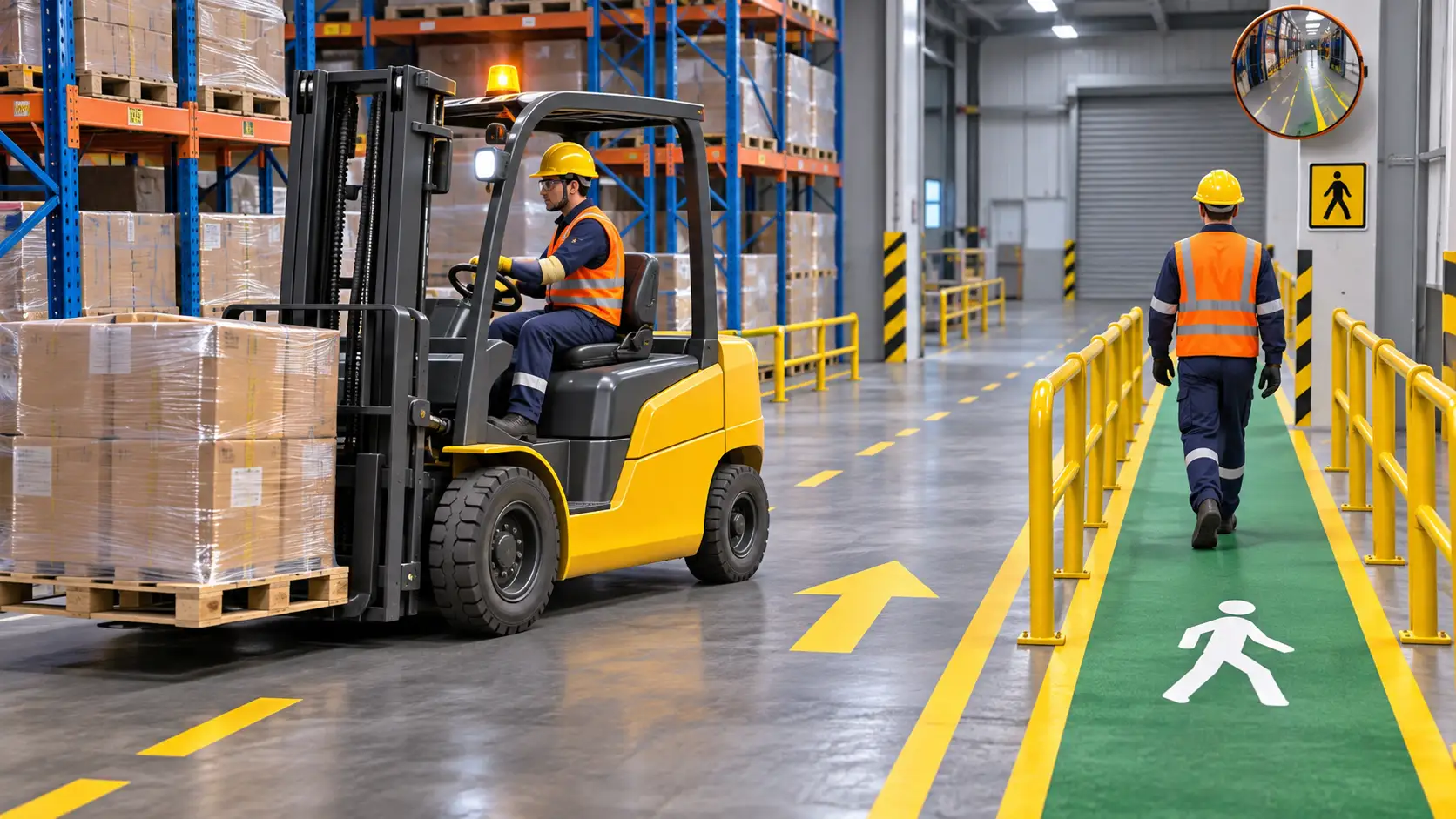
- Separate Pedestrian and Forklift Routes: Wherever possible, establish separate routes for pedestrians and industrial vehicles. Use permanent barriers, guardrails and clearly marked walkways to reduce direct interaction.
- Establish Designated Crossing Points: Provide clearly identified pedestrian crossings at locations where vehicle and foot traffic must intersect. Ensure workers can see approaching forklifts before crossing.
- Improve Visibility: Install suitable lighting, convex mirrors at blind intersections and appropriate visibility aids on forklifts. Review areas where racks, equipment or stored materials obstruct sightlines.
- Introduce Traffic Management Rules: Establish site-specific speed limits, one-way vehicle routes, parking areas and loading zones. Display appropriate warning signs at high-risk locations.
- Minimise Reversing: Review material-handling routes and operational layouts to reduce unnecessary reversing. Where reversing cannot be avoided, implement appropriate visibility controls and communication procedures.
- Maintain Forklifts and Safety Devices: Regularly inspect brakes, steering, tyres, horns, lights, mirrors and reversing alarms. Ensure that safety devices are functional and defects are addressed promptly.
- Conduct Workplace Risk Assessments: Evaluate how pedestrians and forklifts interact during normal operations, shift changes, material deliveries, loading and unloading, and maintenance activities.
The UK Health and Safety Executive (HSE) recommends separating pedestrian and vehicle routes wherever reasonably practicable. It also highlights the importance of designing routes around the natural movement of people.
This is important because a pedestrian walkway that is inconvenient or poorly positioned may encourage employees to take shortcuts through vehicle operating areas.
How Does 3D EHS Animation Improve Forklift Safety Training?
Explaining forklift collision risks through written instructions alone can be challenging. Workers may understand that blind spots or reversing vehicles are dangerous, but they may not fully visualise how quickly a collision situation can develop.
This is where 3D EHS animation can support workplace safety training.
A 3D forklift safety animation can recreate realistic warehouse and industrial environments, showing how forklifts move, where pedestrians may enter their path and how unsafe actions can lead to accidents.
For example, a training video can demonstrate:
- Forklift blind spot demonstrations: Show the operator’s limited field of vision and explain why pedestrians should never assume they have been noticed.
- Reversing collision scenarios: Recreate a situation where a worker walks behind a reversing forklift and demonstrate how the incident could be prevented.
- Blind corner hazards: Visualise a forklift approaching an obstructed intersection and explain the correct use of horns, mirrors and pedestrian crossing points.
- Rear-end swing during turning: Use different camera angles to show how the rear of a forklift moves outward during a turn and why workers must maintain sufficient clearance.
- Unsafe pedestrian behaviour: Demonstrate common mistakes such as taking shortcuts, using mobile phones while walking, standing near moving loads or crossing without checking.
- Correct safety procedures: Present the same workplace situations again, this time showing the correct actions expected from both the operator and pedestrians.
The advantage of 3D animation is that it allows organisations to demonstrate hazardous situations without exposing employees to actual operating risks.
It can also help standardise safety communication across multiple departments, shifts and locations.
For organisations with multilingual workforces, animation can be combined with voiceovers, subtitles and on-screen instructions in different languages.
How Can Companies Implement Effective Forklift Safety Training?
An effective forklift safety programme should combine formal instruction, practical demonstrations, workplace evaluations and continuous reinforcement.
The following approach can help organisations structure their training activities.
Step 1: Identify workplace-specific risks
Review forklift routes, pedestrian movement, blind corners, loading zones and areas with limited visibility. Identify the situations where collisions are most likely to occur.
Step 2: Train forklift operators
Provide training on vehicle controls, load handling, reversing, turning, visibility, speed management and pedestrian awareness. Operator training should be appropriate to the vehicle type and workplace conditions.
Step 3: Train pedestrians and other employees
Explain designated walkways, crossing procedures, exclusion zones, warning signals and safe distances from operating forklifts.
Step 4: Use scenario-based training videos
Introduce realistic collision scenarios through 3D EHS animation. Show both unsafe actions and the correct response so employees can understand the difference.
Step 5: Conduct practical demonstrations
Allow workers to observe forklift movements, identify blind spots from different positions and practise safe pedestrian crossing procedures under controlled conditions.
Step 6: Evaluate understanding
Use knowledge assessments, practical observations and workplace evaluations to determine whether employees understand and follow the required safety procedures.
Step 7: Reinforce training regularly
Repeat safety briefings, toolbox talks and refresher sessions. Update training materials when workplace layouts, equipment or operating procedures change.
Importantly, animation-based awareness training should complement, not replace, the practical operator training and competency evaluations required by applicable regulations.
Frequently Asked Questions
Forklift and pedestrian safety refers to the procedures, workplace controls and training practices used to prevent collisions between industrial vehicles and people working or walking nearby. It includes traffic segregation, designated walkways, operator training, pedestrian awareness and safe material-handling practices.
Common causes include reversing without adequate visibility, blind corners, obstructed loads, excessive speed, poor traffic management, pedestrians entering vehicle routes and inadequate communication between operators and workers.
Pedestrians should use designated walkways, stop at marked crossing points, maintain a safe distance from moving forklifts, avoid blind spots and never walk beneath elevated loads. They should also remain alert to warning signals and avoid distractions in vehicle operating areas.
Forklift blind spots occur when parts of the vehicle, such as the mast, overhead guard or transported load, obstruct the operator’s view. A pedestrian entering these areas may remain unnoticed, increasing the risk of a collision.
Operators should reduce speed, sound the horn, check for approaching pedestrians and other vehicles, and proceed only when the travel path is clear. Mirrors and spotters can provide additional assistance where necessary.
Yes. 3D EHS animation can demonstrate reversing hazards, blind spots, turning risks, pedestrian movement and correct safety procedures through realistic visual scenarios. It helps workers understand potential accidents and recognise the actions needed to prevent them.
Training frequency should follow applicable regulations, workplace risk assessments and company procedures. Refresher training or reassessment may be necessary when unsafe operating practices are observed, incidents occur, equipment or workplace conditions change, or an employee’s performance indicates a need for additional instruction.
Conclusion
Forklift and pedestrian collisions can often be prevented through proper traffic management, hazard recognition and consistent safety training.
The important thing is to ensure that workers understand how these incidents develop, where collision risks exist and what actions they should take to avoid them. Both forklift operators and pedestrians have a role in maintaining a safe working environment.
Combining practical demonstrations with 3D EHS animation and industrial safety training videos can make these risks easier to understand and remember.
At Immersiv Techsphere, we develop custom 3D EHS animation videos that help organisations communicate workplace hazards, demonstrate safe operating procedures and improve employee safety awareness through realistic visual storytelling.
Need a custom forklift and pedestrian safety training video for your workplace? Connect with Immersiv Techsphere to discuss your EHS animation requirements.
Have a Project in Mind?
Need help with 3D animation, industrial visualization, HSE training animation, or product visualization? Tell us about your project and our team will get back to you.