

Table of Contents
Introduction
Process Equipment Animation gives industrial companies a practical way to explain complex equipment beyond what static drawings, photographs, and technical documentation can communicate.
Process equipment such as heat exchangers, pressure vessels, pumps, reactors, filtration systems, skids, compressors, tanks, valves, and process lines often contains interconnected components and operating sequences that are difficult to visualize from a conventional drawing.
A technical sales engineer may need to explain how a system works to a prospective customer. An operations team may need to understand an equipment sequence. A maintenance technician may need to visualize how an internal component is accessed or replaced.
The communication requirement is different in each case, but the underlying engineering data can be the same.
That is where Process Equipment Animation becomes valuable.
By combining 3D engineering models, equipment geometry, process flow, movement, cutaway views, and technical callouts, an animation can turn complex equipment information into a visual explanation that different stakeholders can understand.
For equipment manufacturers, EPC companies, process plants, OEMs, and engineering organizations, this makes Industrial Animation useful across the equipment lifecycle rather than only as a marketing asset.
What Is Process Equipment Animation?
Process Equipment Animation is a 3D engineering visualization method used to demonstrate how industrial equipment operates, interacts with other equipment, is assembled, installed, inspected, or maintained.
Unlike a conventional product promotional video, the objective is not simply to make the equipment look attractive. The animation is structured around a technical communication objective.
Depending on the application, a Process Equipment Animation can demonstrate:
- Equipment operation
- Process flow
- Fluid or material movement
- Internal mechanisms
- Valve operation
- Equipment sequencing
- Assembly and disassembly
- Installation procedures
- Maintenance access
- Component replacement
- Equipment interfaces
- Safety-critical areas
- Start-up and shutdown concepts
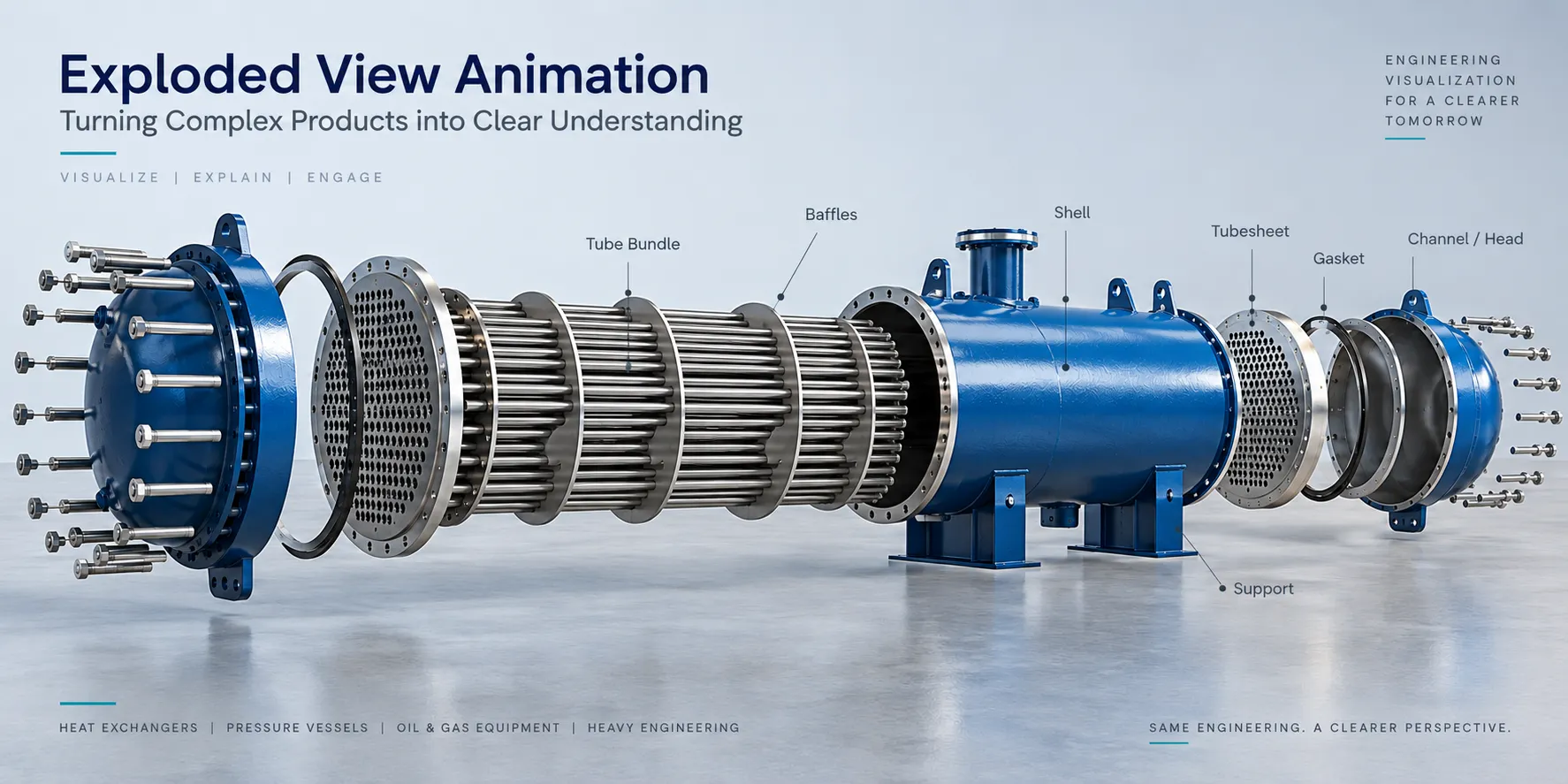
For example, an animation of a heat exchanger can show the equipment externally and then transition into a cutaway view to explain the shell, tube bundle, baffles, tube sheets, channels, and flow paths.
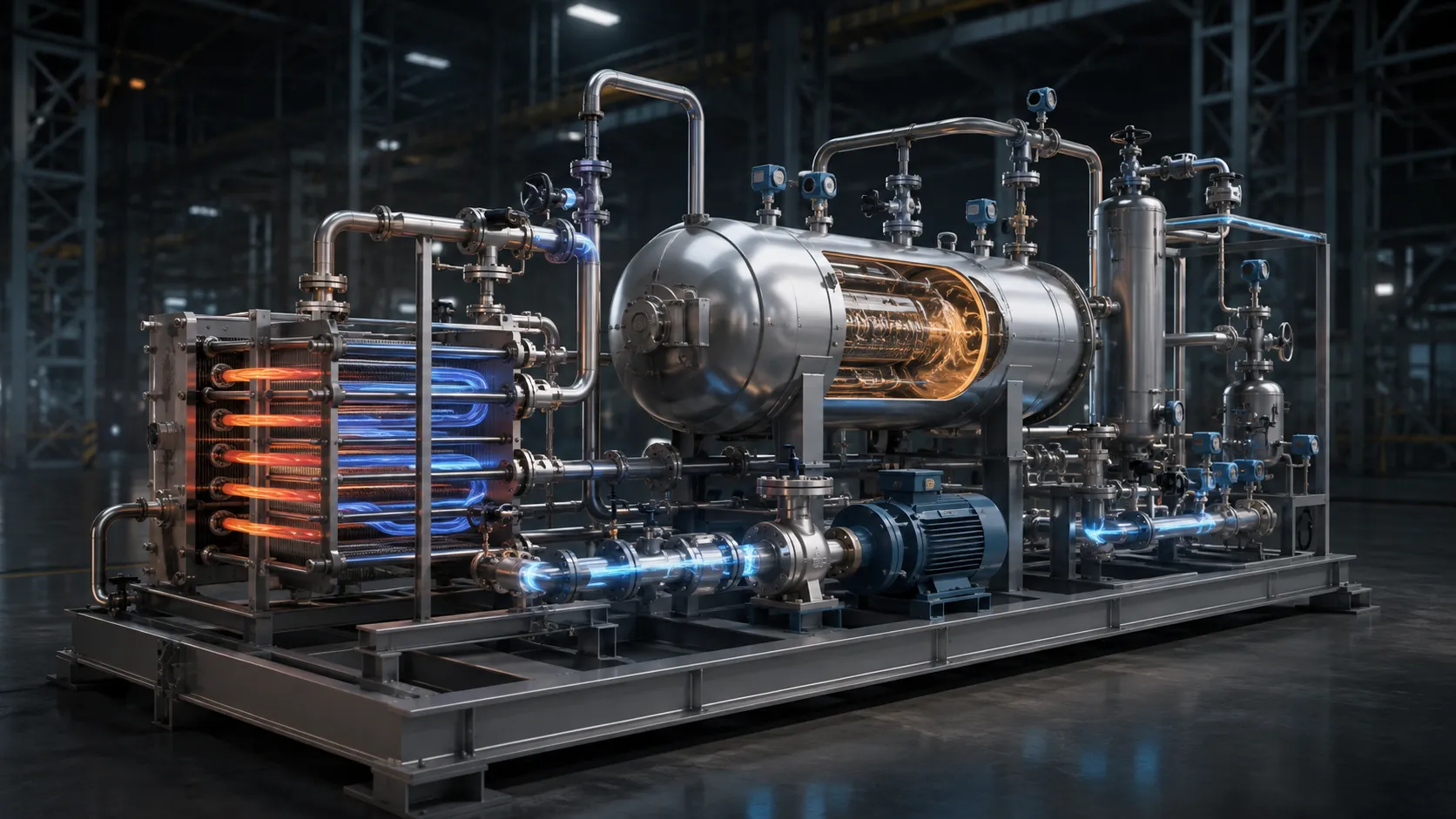
Similarly, an animation of a process skid can show how pumps, valves, piping, instrumentation, tanks, and other equipment interact during a process sequence.
The result is a visual explanation built around engineering information rather than generic industrial imagery.
Why Process Equipment Is Difficult to Explain
Industrial equipment usually contains more information than can be communicated effectively through a single image.
A photograph can show what equipment looks like. A CAD model can show its geometry. A P&ID can communicate process relationships. A technical drawing can communicate dimensions and construction details.
But stakeholders may still need to understand what happens when the equipment operates.
This becomes particularly important when the audience includes both technical and non-technical decision-makers.
A project owner may understand the business objective but not every engineering symbol. A procurement team may need to understand equipment functionality before approving a purchase. A maintenance team may need to visualize an internal assembly before beginning a service procedure.
Process Animation connects these different forms of information through movement and visual context. Process Equipment Animation improves technical communication by turning complex engineering information into a visual sequence that different stakeholders can understand.
Process Equipment Animation for Technical Sales
Technical sales is one of the strongest applications for industrial equipment animation.
Selling complex equipment often requires more than presenting specifications. Customers may want to understand how the equipment works, how it integrates into their existing process, and why a particular design is appropriate for their application.
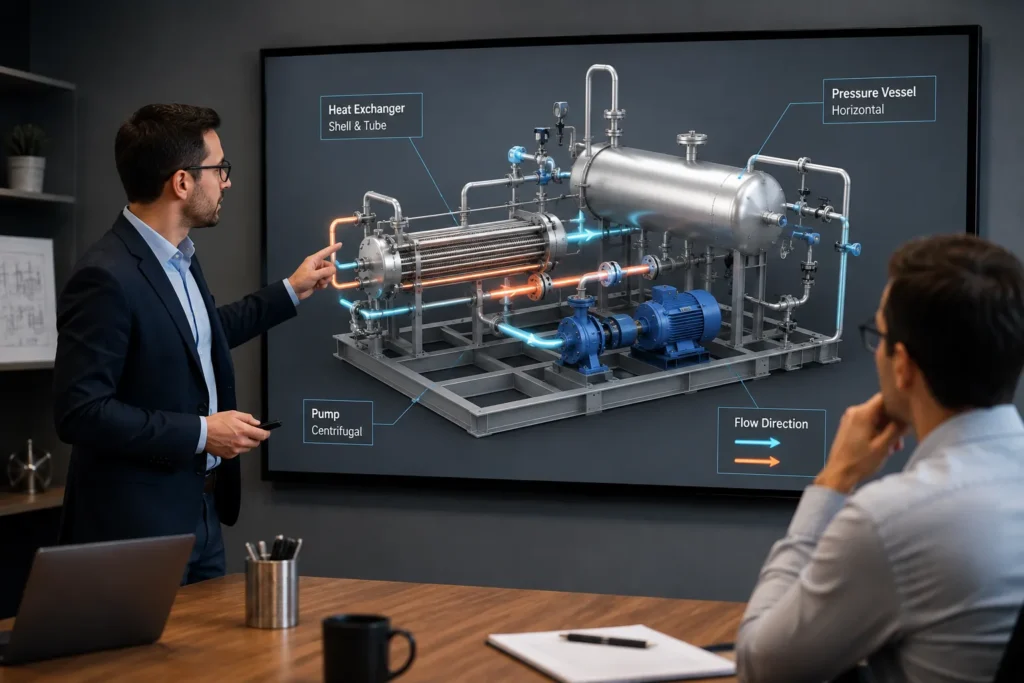
Demonstrating Equipment Function
A technical sales presentation can use animation to show:
- Equipment inlet and outlet connections
- Material or fluid flow
- Moving components
- Operating sequences
- Internal mechanisms
- System interfaces
- Key design features
Instead of asking the customer to interpret multiple engineering documents, the sales team can present the operating concept visually.
Explaining Complex Equipment to Multiple Stakeholders
A single equipment purchase may involve engineering, procurement, operations, maintenance, management, and project teams.
Each stakeholder may focus on different information.
An animation can provide a common visual reference.
For example:
- Management can see the overall equipment concept.
- Engineering can examine component relationships.
- Operations can understand the process sequence.
- Maintenance can review service access.
- Procurement can understand the equipment configuration.
This makes Industrial Animation particularly useful during customer presentations, technical meetings, proposal discussions, exhibitions, and remote sales demonstrations.
Process Equipment Animation for Operations
Operations teams need to understand how equipment behaves during normal operation.
A Process Equipment Animation can demonstrate the relationship between equipment, process flow, and operating sequence.
For example, a process animation could show:
Feed → Pump → Heat Exchanger → Reactor → Separator → Discharge
Each stage can be visually connected so operators and other stakeholders can understand where material moves and how equipment interacts.
The animation can also highlight valves, flow direction, rotating equipment, control points, and selected operating stages.
This type of visual explanation can complement operating procedures and other approved training materials.
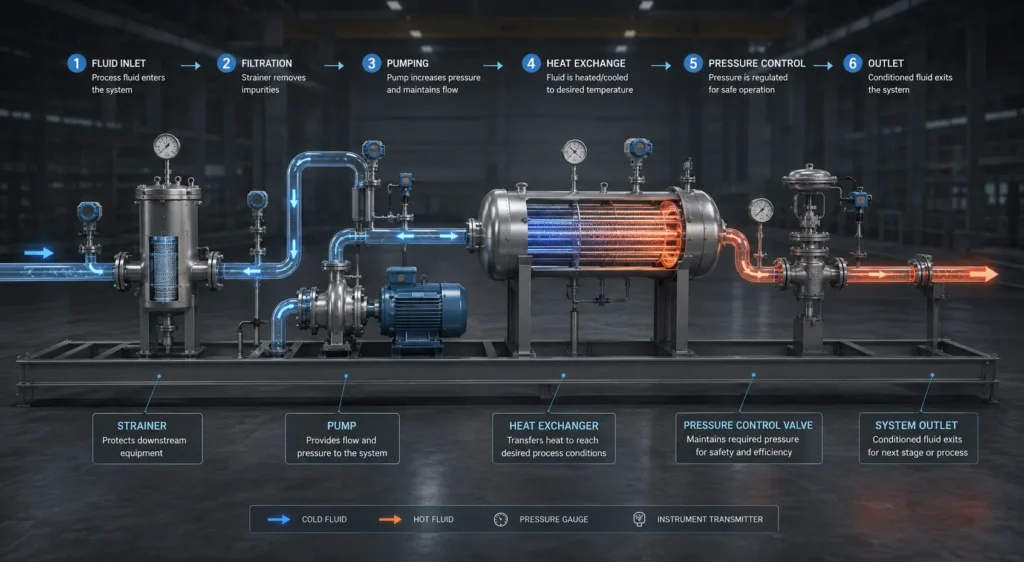
Process Animation can complement operating procedures, equipment documentation, and technical training by providing a visual explanation of how equipment operates within the process. It should be developed using accurate engineering information and reviewed by the relevant technical stakeholders.
Process Equipment Animation for Maintenance
Maintenance teams often deal with a different challenge: understanding what is inside the equipment and how components can be accessed.
Many industrial systems contain enclosed or difficult-to-visualize components.
A maintenance-focused animation can use:
- Exploded views
- Cutaway sections
- Transparent components
- Component highlighting
- Sequential movement
- Fastener visualization
- Removal and replacement sequences
- Maintenance access paths
For example, a heat exchanger animation could show the sequence for removing a channel cover, exposing the tube sheet and tube bundle, identifying gaskets, and showing the relationship between major components.
An equipment animation can also demonstrate the relative position of components before maintenance begins.
This is especially useful for equipment where physical access is limited or where a maintenance procedure involves multiple steps.
Benefits of Process Equipment Animation
1. Simplifies Complex Technical Information
Complex equipment can contain hundreds of components and multiple operating relationships.
Animation allows information to be revealed progressively.
Instead of showing every component simultaneously, the sequence can introduce:
- Complete equipment
- Major assemblies
- Internal components
- Process flow
- Equipment movement
- Operating sequence
- Maintenance or installation procedure
This makes technical information easier to follow.
2. Improves Technical Sales Presentations
A well-planned Industrial Animation can help sales engineers demonstrate equipment functionality without relying entirely on verbal explanations.
This is particularly useful for:
- EPC proposals
- OEM presentations
- Customer meetings
- Trade exhibitions
- Product launches
- Online demonstrations
- Technical tender presentations
The visual sequence can also be adapted into shorter clips for different customer requirements.
3. Supports Operator Training
Operators can use Process Animation as a visual supplement when learning equipment operation and process sequences.
The animation can show the relationship between equipment and the sequence described in operating procedures.
Process Animation can complement operator training by visually explaining equipment operation, process sequences, component relationships, and equipment interfaces. This can help operators build a clearer understanding of how individual equipment items function within the wider process.
4. Makes Maintenance Procedures Easier to Visualize
Maintenance instructions become easier to follow when technicians can see component relationships.
For example:
Identify component → Isolate equipment → Access assembly → Remove component → Inspect → Replace → Reassemble
A Process Equipment Animation can turn this sequence into a visual procedure.
5. Helps Explain Installation and Commissioning
Large industrial equipment often requires careful positioning, alignment, connection, and integration.
Animation can demonstrate:
- Equipment placement
- Assembly sequence
- Connection points
- Piping interfaces
- Structural supports
- Access requirements
- Installation sequence
This can help project teams discuss installation requirements before physical work begins.
6. Creates Reusable Technical Content
One accurately developed 3D model can support multiple communication requirements.
The same core animation can be adapted for:
- Technical sales
- Customer presentations
- Operator training
- Maintenance training
- Installation guides
- Technical manuals
- Website content
- Exhibition displays
This gives the engineering asset a longer useful life.
7. Bridges Engineering and Business Communication
Engineering teams communicate through drawings, specifications, CAD models, P&IDs, and technical documentation.
Sales and management teams often need a faster visual explanation.
Process Animation creates a bridge between those two communication styles.
It allows engineering information to remain technically grounded while making the message more accessible to customers and decision-makers.
How CAD-Based Industrial Animation Improves Accuracy
The foundation of a technically useful animation should be reliable engineering information.
Existing CAD models can provide:
- Accurate equipment geometry
- Component dimensions
- Assembly relationships
- Component positioning
- Mechanical interfaces
- Equipment structure
- Design intent
Using engineering CAD data reduces the need to recreate equipment from assumptions and helps maintain consistency between the engineering model and the final visualization.
CAD-based animation is particularly useful when the objective is to accurately represent equipment geometry, component relationships, operating sequences, and maintenance access.
When equipment also needs to be presented through photorealistic renders, exploded views, or product walkthroughs, the same engineering data can support 3D product visualization.
Process Animation for Different Equipment Types
The same visualization approach can be adapted to different categories of process equipment.
- Heat Exchangers: Show shell-and-tube construction, fluid paths, tube bundles, baffles, channels, and assembly relationships.
- Pressure Vessels: Visualize vessel construction, nozzles, internal components, flow paths, and maintenance access.
- Pumps: Demonstrate suction, discharge, rotating components, impeller operation, and equipment interfaces.
- Process Skids: Show the interaction between pumps, vessels, valves, piping, instrumentation, and control points.
- Filtration Systems: Explain filtration stages, media, flow direction, pressure relationships, and maintenance procedures.
- Reactors and Process Vessels: Visualize internal components, material movement, heating or cooling concepts, and process stages.
- Piping and Valve Systems: Show flow direction, valve operation, equipment connections, and system sequencing.
Process Equipment Animation Across the Equipment Lifecycle
One of the strongest reasons to invest in technical animation is that its value can continue after the sales presentation.
A single animation can support multiple lifecycle stages:
| Equipment Lifecycle Stage | Animation Application |
|---|---|
| Design | Visualize equipment concept and design intent |
| Sales | Demonstrate equipment functionality |
| Engineering Review | Explain component relationships |
| Manufacturing | Show assembly concepts |
| Installation | Demonstrate installation sequence |
| Commissioning | Explain operating sequence |
| Operations | Support equipment familiarization |
| Maintenance | Visualize servicing and component access |
| Customer Support | Provide reusable technical explanations |
| Training | Support visual learning and e-learning |
This lifecycle approach makes Industrial Animation more than a marketing deliverable.
How to Create an Effective Process Equipment Animation
A successful animation should begin with the communication objective.
Step 1: Define the Audience
Identify who will watch the animation:
- Customers
- Technical sales team
- Operators
- Maintenance technicians
- Project engineers
- Commissioning teams
- Management
The level of technical detail should match the audience.
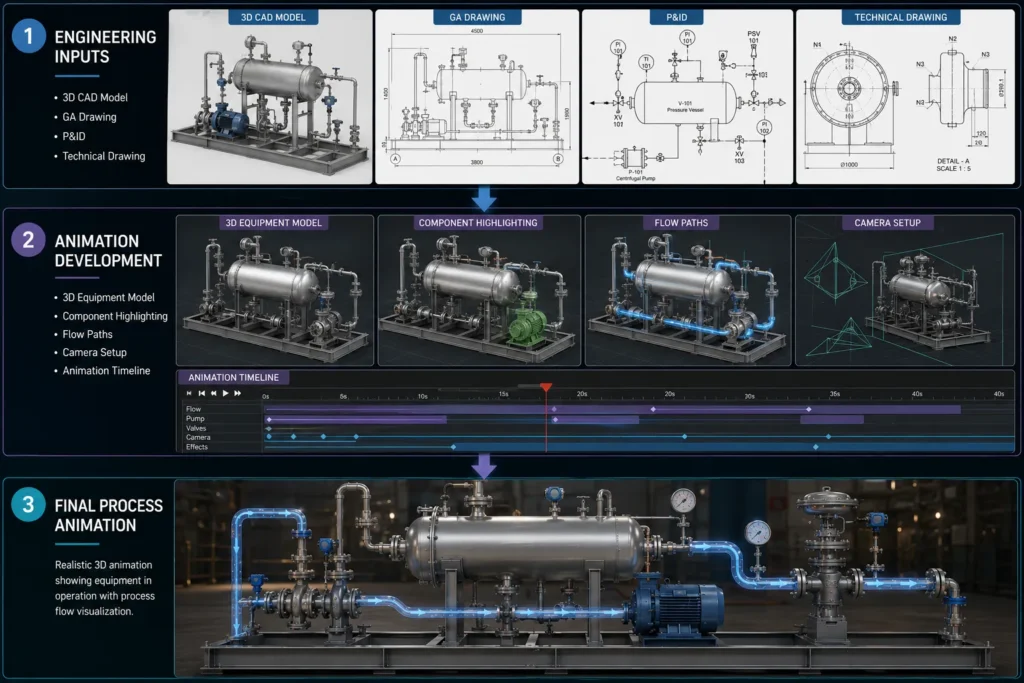
Step 2: Collect Engineering Information
Depending on the project, useful inputs can include:
- 3D CAD models
- General arrangement drawings
- P&IDs
- Equipment drawings
- BOMs
- Process information
- Manufacturer specifications
- Installation procedures
- Maintenance documentation
Step 3: Define the Visual Story
Determine what the viewer needs to understand.
For a sales animation:
Equipment → Function → Process → Key Features → Application
For maintenance:
Equipment → Component → Access → Removal → Inspection → Replacement
For operations:
Process → Equipment Interaction → Flow → Operating Sequence
Step 4: Develop the 3D Animation
The approved engineering data is converted into the required visual sequence.
Depending on the objective, this may include:
- Camera animation
- Equipment movement
- Flow animation
- Exploded views
- Cutaways
- Transparent sections
- Component highlighting
- Technical labels
- Motion graphics
Step 5: Technical Review
Engineering, operations, maintenance, or project stakeholders should review technically important sequences before final delivery.
This is especially important when the animation represents operating or maintenance procedures.
Best Practices for Industrial Animation
To make Industrial Animation technically useful and easier for different stakeholders to understand, follow these principles:
- Start with a clearly defined communication objective.
- Use approved engineering data wherever possible.
- Keep equipment geometry technically accurate.
- Show process flow and movement clearly.
- Use cutaway views when internal operation matters.
- Use labels only where they improve understanding.
- Avoid unnecessary visual effects.
- Divide complicated processes into logical sequences.
- Match the animation to the audience’s technical knowledge.
- Validate important technical sequences with subject-matter experts.
- Design the core 3D asset for reuse across sales, training, operations, and maintenance.
When Should a Company Use Process Equipment Animation?
Process Equipment Animation is particularly useful when:
- The equipment is difficult to explain using static images.
- Internal mechanisms are important.
- Multiple components interact during operation.
- The equipment has a complex installation sequence.
- Customers need to understand functionality before purchasing.
- Operators need visual equipment familiarization.
- Maintenance procedures involve multiple components.
- The equipment is part of a larger process system.
- The same technical information needs to be communicated to multiple departments.
If the objective is simply to show the appearance, finish, or configuration of a product, a high-quality 3D product render may be sufficient.
If the objective is to explain how the equipment works, animation becomes significantly more useful.
Frequently Asked Questions
Process Equipment Animation is a 3D visualization technique used to explain industrial equipment operation, process flow, assembly, installation, maintenance, and internal mechanisms.
Equipment manufacturers, OEMs, EPC companies, engineering firms, process plants, industrial machinery manufacturers, and maintenance and operations teams can use Process Equipment Animation for technical communication and training.
Yes. Existing CAD models can be used as the geometric foundation for technically accurate Industrial Animation. Additional engineering information may be required to accurately represent process flow, equipment movement, or operating conditions.
Yes. A core 3D equipment model can often be reused to create different sequences for technical sales, operations, maintenance, installation, training, and customer support.
Process Animation can be developed for equipment such as heat exchangers, pressure vessels, pumps, reactors, tanks, filtration systems, process skids, valves, piping systems, compressors, and other industrial machinery.
Yes.Process Equipment Animation can visually demonstrate equipment operation, process sequences, component relationships, and system interfaces. It can complement operating procedures and technical training by providing a clear visual explanation of how equipment functions within a process.
Industrial Animation is a broader category covering industrial products, machinery, processes, facilities, and technical workflows. Process Animation focuses specifically on explaining a process, sequence, system interaction, or flow. Process Equipment Animation sits at the intersection of both, using 3D visualization to explain how industrial equipment functions within a process.
Conclusion
Industrial equipment is often engineered with a high level of technical detail, but that detail does not automatically make the equipment easy to understand.
Process Equipment Animation provides a visual bridge between engineering information and practical understanding.
For technical sales teams, it can demonstrate equipment functionality and help customers understand complex solutions. For operations teams, it can visualize equipment interaction and process sequences. For maintenance teams, it can reveal internal components and demonstrate servicing workflows.
The strongest applications go beyond a single sales presentation.
A CAD-based animation can become a reusable technical asset for customer demonstrations, engineering communication, operator training, installation planning, maintenance education, and after-sales support.
Immersiv Techsphere combines 3D engineering visualization with mechanical engineering understanding to develop Industrial Animation content for complex products, equipment, processes, and industrial environments. Its 3D Animation portfolio covers technical visualization applications across industrial and manufacturing contexts.
When complex equipment needs to be explained clearly, Process Animation can turn static engineering information into a visual sequence that is easier to understand, communicate, train, and reuse.
Have a Project in Mind?
Need help with 3D animation, industrial visualization, HSE training animation, or product visualization? Tell us about your project and our team will get back to you.