

Table of Contents
Introduction
Manufacturers are under increasing pressure to offer customized products without increasing engineering workload. Customers want faster quotations, more product options, and shorter delivery timelines, while sales teams need to respond quickly to opportunities.
For companies selling configurable or engineered-to-order products, this creates a common problem: sales needs speed, but engineering needs accuracy.
A customer may request different dimensions, materials, accessories, capacities, finishes, or component combinations. Traditionally, each variation may require engineers to review specifications, validate compatibility, update CAD models, prepare bills of materials, calculate pricing, and support quotation preparation.
As the number of product variants increases, these repetitive activities can create significant engineering rework.
A Product Configurator and CPQ solution addresses these challenges by replacing manual interpretation with rule-based configuration. Instead of relying on spreadsheets, emails, and repeated CAD modifications, it validates product options, automates engineering outputs, and helps generate accurate quotations from a single source of truth.
When integrated with CPQ, CAD automation, ERP, or manufacturing systems, a product configurator can connect sales requirements with downstream engineering and production workflows.
The result is a more structured process that can reduce repetitive engineering effort while helping sales teams respond to customers faster.
What Is a Product Configurator?
A Product Configurator is a software system that allows users to customize a product from a predefined set of options while automatically applying product, engineering, and manufacturing rules.
Depending on the application, a configurator can control variables such as:
- Product dimensions
- Material selection
- Component combinations
- Capacity or performance requirements
- Accessories
- Finishes
- Manufacturing options
- Optional features
- Quantity
- Compatibility requirements
- Pricing parameters
For example, an industrial equipment manufacturer may offer a base product with multiple dimensions, materials, motor options, accessories, and capacity ranges.
Instead of asking an engineer to manually validate every customer request, the configurator can guide the user through approved combinations.
A typical workflow can look like:
Customer Requirements → Product Configuration → Rule Validation → Pricing → BOM → CAD/Engineering Data → Quotation → Manufacturing
This creates a controlled connection between sales and engineering.
Why Manual Product Configuration Creates Engineering Rework
Manual configuration is manageable when a company has a small product range and limited customization.
The challenge appears when product complexity increases.
Sales teams may receive customer requirements through emails, spreadsheets, PDFs, or informal discussions. The information is then transferred to engineering for technical validation.
This often creates several repetitive activities.
1. Repeated Engineering Validation
Engineers may need to verify whether a requested combination is technically possible.
For every quotation, they may check:
- Dimensions
- Component compatibility
- Load or capacity requirements
- Material combinations
- Available options
- Manufacturing constraints
- Standard component availability
When similar checks are repeated across hundreds of quotations, engineering capacity is consumed by routine work.
2. Repeated CAD Modifications
Configurable products frequently require modifications to existing CAD models.
Engineers may need to manually change dimensions, suppress or add components, update assemblies, revise drawings, and regenerate documentation.
Even when the underlying product follows a predictable design logic, manual CAD changes can introduce unnecessary work.
3. Incorrect Product Combinations
Manual selection increases the possibility of selecting incompatible options.
For example, one accessory may only be compatible with a specific frame size, while another component may require a particular material or mounting arrangement.
If these dependencies are not clearly defined, errors can reach engineering or even production.
4. Repeated Quotation Preparation
Sales teams may depend on engineering for technical information before they can prepare a quotation.
This creates a dependency chain:
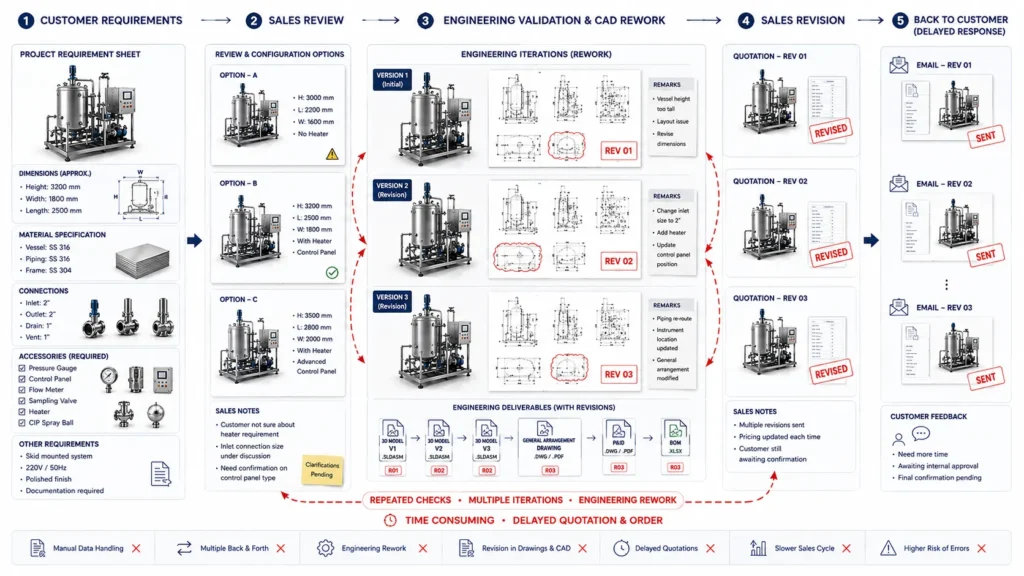
Customer → Sales → Engineering → Sales → Customer
Every additional review increases response time.
The problem often extends beyond configuration itself, as manual CAD workflows can consume significant engineering time through repeated model updates, drawing revisions, BOM changes, and file management.
How a Product Configurator Reduces Engineering Rework
The primary advantage of a product configurator is that it moves repetitive decision-making into a structured, rule-based system.
Instead of relying on engineers to manually validate every standard configuration, the system can automate predictable decisions.
1. Converts Engineering Knowledge Into Rules
Experienced engineers often have extensive knowledge about which combinations are valid and which are not.
A configurator can convert this knowledge into rules.
For example:
If: Frame Size = Large
Then: Accessory A = Available
Or:
If: Material = Stainless Steel
Then: Apply Stainless Steel Component Set
Or:
If: Capacity exceeds predefined limit
Then: Require reinforced configuration
This approach allows the organization to standardize engineering logic instead of repeatedly applying it manually.
2. Prevents Invalid Configurations
A well-designed product configurator does more than display product options.
It can prevent users from selecting combinations that violate predefined engineering or manufacturing constraints.
This can include:
- Dimension limits
- Component dependencies
- Material compatibility
- Capacity limits
- Manufacturing restrictions
- Optional feature dependencies
- Standard component requirements
By identifying invalid combinations during configuration, errors can be prevented before they reach engineering.
3. Reduces Repetitive CAD Work
Product configurators become even more valuable when connected to CAD automation.
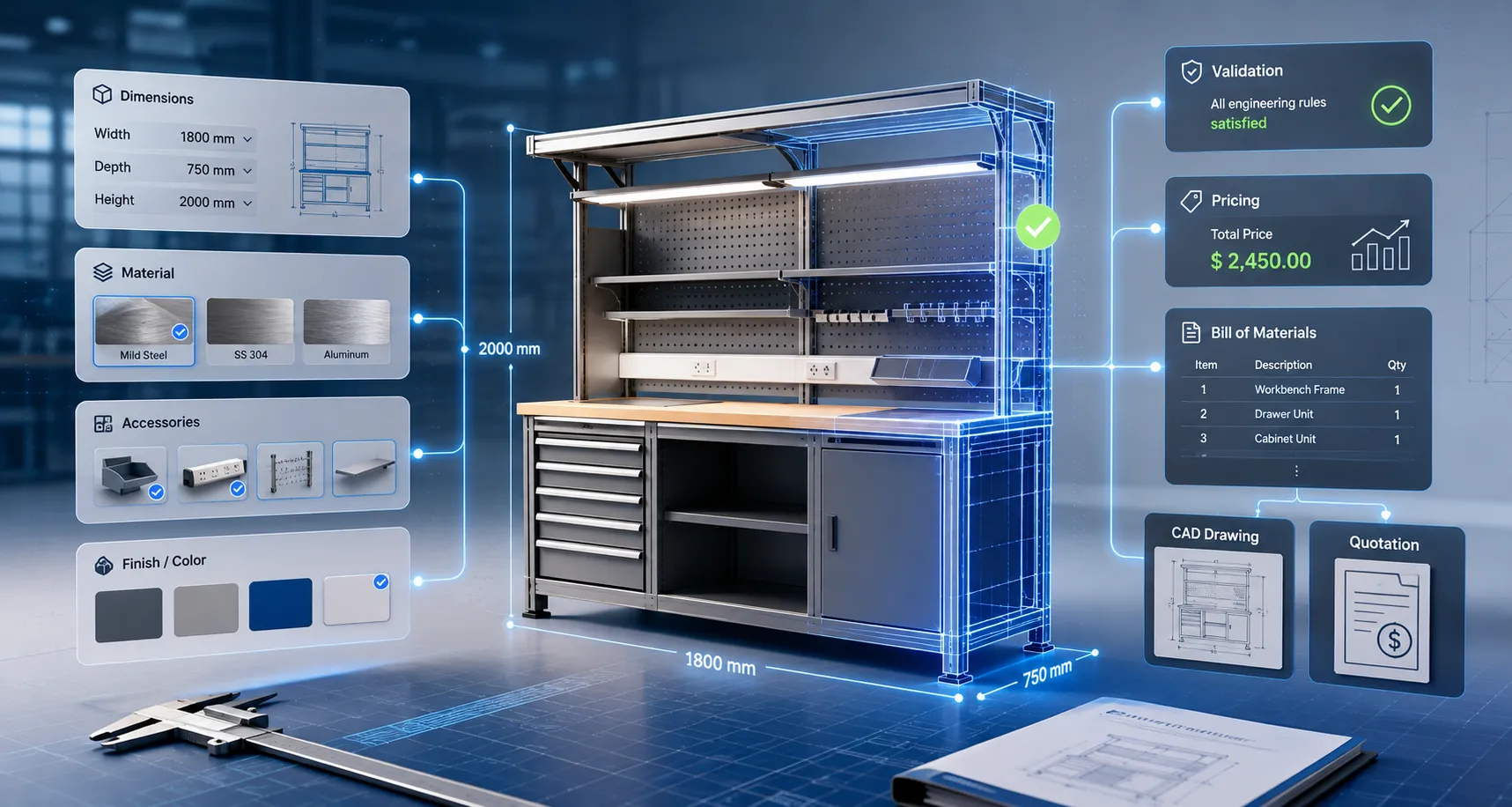
A configuration can provide parameters to an automated CAD workflow that updates the appropriate model, assembly, or drawing.
Depending on the application, the workflow can automate:
- Parameter changes
- Component selection
- Assembly configuration
- Part generation
- Drawing updates
- BOM generation
- Manufacturing documentation
- File naming
- Revision information
Instead of manually rebuilding each product variant, engineers can focus on exceptions and genuinely new design requirements.
A rule-based Product Configurator can validate compatibility, dimensional constraints, manufacturing requirements, and other predefined engineering rules before the configuration moves further into quotation or production.
How Product Configurators Accelerate Sales
Reducing engineering workload is only one side of the equation.
Product configurators can also significantly improve the sales process.
- Faster Customer Response: Customers often compare multiple suppliers based on responsiveness as well as price and technical capability. If a sales team needs several days to confirm a configuration, an opportunity may be delayed. A configurator can help sales teams work with predefined product options and rules, reducing the need for engineering intervention for routine configurations. This can shorten the time between receiving a customer requirement and issuing a quotation.
- Faster Quotation Generation: When product configuration is connected to pricing logic, the system can automatically calculate pricing based on selected options. For example: Base Product Price + Material Selection + Dimensions + Accessories + Quantity = Configuration Price. This reduces manual spreadsheet calculations and helps standardize quotations.
- Better Sales Confidence: Sales representatives may hesitate to commit to a configuration when they are unsure whether the selected combination is technically valid. A rule-based configurator provides greater confidence by guiding users through approved options.
Sales can therefore handle more standard product variations without waiting for engineering to validate every basic selection.
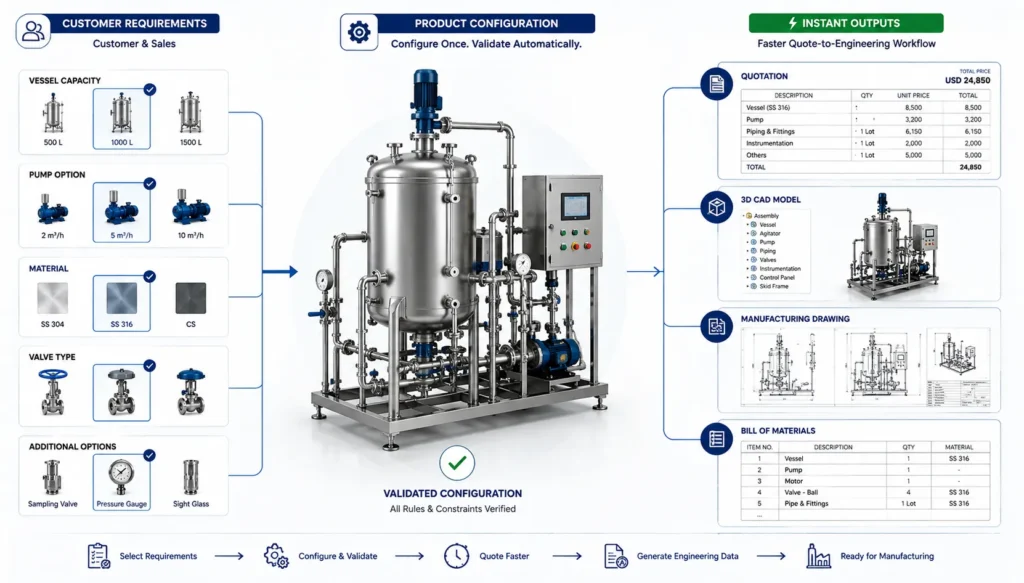
Product Configurator vs. Traditional Product Selection
The difference becomes clearer when comparing the two workflows.
| Traditional Workflow | Product Configurator Workflow |
|---|---|
| Customer sends requirements | User enters requirements |
| Sales reviews options manually | Configurator guides selections |
| Engineering validates configuration | Rules validate configuration |
| Engineer modifies CAD manually | CAD automation can generate/update models |
| BOM prepared manually | BOM can be generated automatically |
| Pricing calculated separately | Pricing rules can be integrated |
| Quotation prepared manually | Quotation can be generated automatically |
| Multiple approval cycles | Standard configurations follow predefined rules |
The objective is not necessarily to eliminate engineering involvement.
Instead, the goal is to reserve engineering resources for work that genuinely requires engineering expertise.
How Product Configurators Work With CPQ Systems
A product configurator and CPQ system are closely related but serve different functions.
Product Configuration determines what can be built.
CPQ – Configure, Price, Quote extends this workflow by helping determine what the selected configuration costs and how it should be presented commercially.
A combined workflow may look like:
- Configure: Select product options and requirements.
- Validate: Apply engineering and manufacturing rules.
- Price: Calculate the configuration price.
- Generate BOM: Create the required component structure.
- Generate Technical Data: Produce configuration information or engineering outputs.
- Generate Quote: Prepare the commercial quotation.
- Send to Engineering/Manufacturing: Transfer approved data to downstream workflows.
This creates a stronger connection between sales, engineering, and manufacturing.
Product Configurator and CAD Automation: A Powerful Combination
For engineering-driven manufacturers, the real value of a product configurator increases when it is connected to CAD automation.
Consider a company manufacturing customized sheet metal enclosures.
A customer may select:
- Enclosure width
- Enclosure height
- Depth
- Material
- Door type
- Lock type
- Mounting arrangement
- Ventilation option
- Finish
The configurator can validate these selections and pass the required parameters to a CAD automation workflow.
The CAD system can then potentially generate:
- 3D model
- Assembly
- Manufacturing drawings
- BOM
- DXF files
- PDF documentation
- Configuration-specific files
This creates a digital workflow from customer selection to engineering output.
For manufacturers producing large numbers of product variants, this can significantly reduce repetitive engineering work.
Where Product Configurators Are Most Useful
Product configurators are particularly useful when products have a stable base architecture but multiple variations.
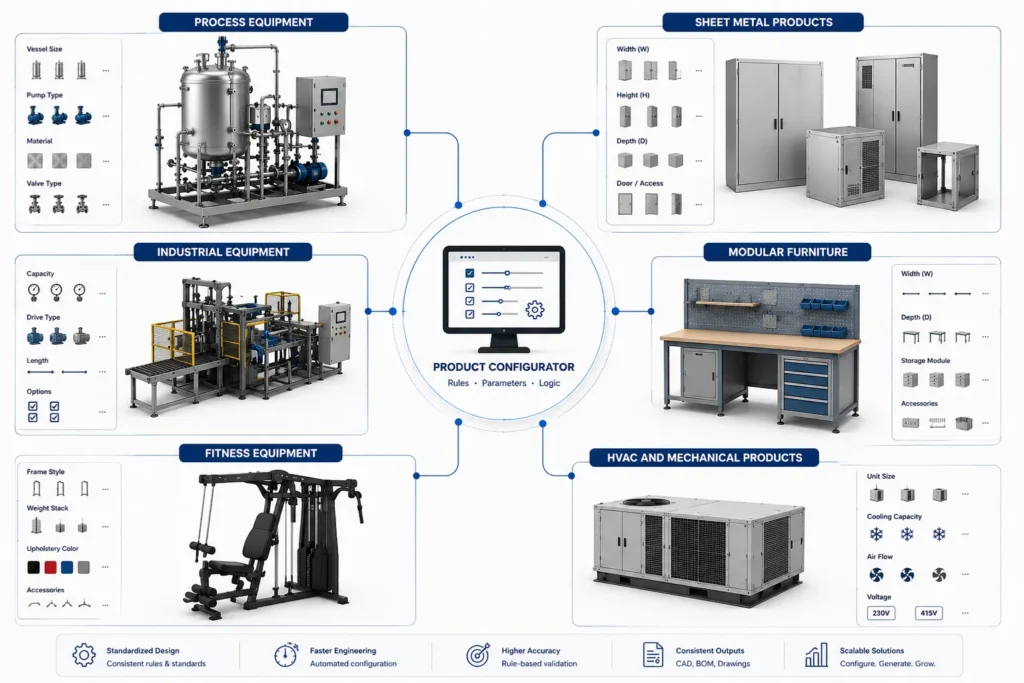
Common applications include:
- Industrial Equipment: Industrial machines often include different capacities, dimensions, motors, accessories, and operating configurations. A configurator can help standardize these variations while maintaining engineering rules.
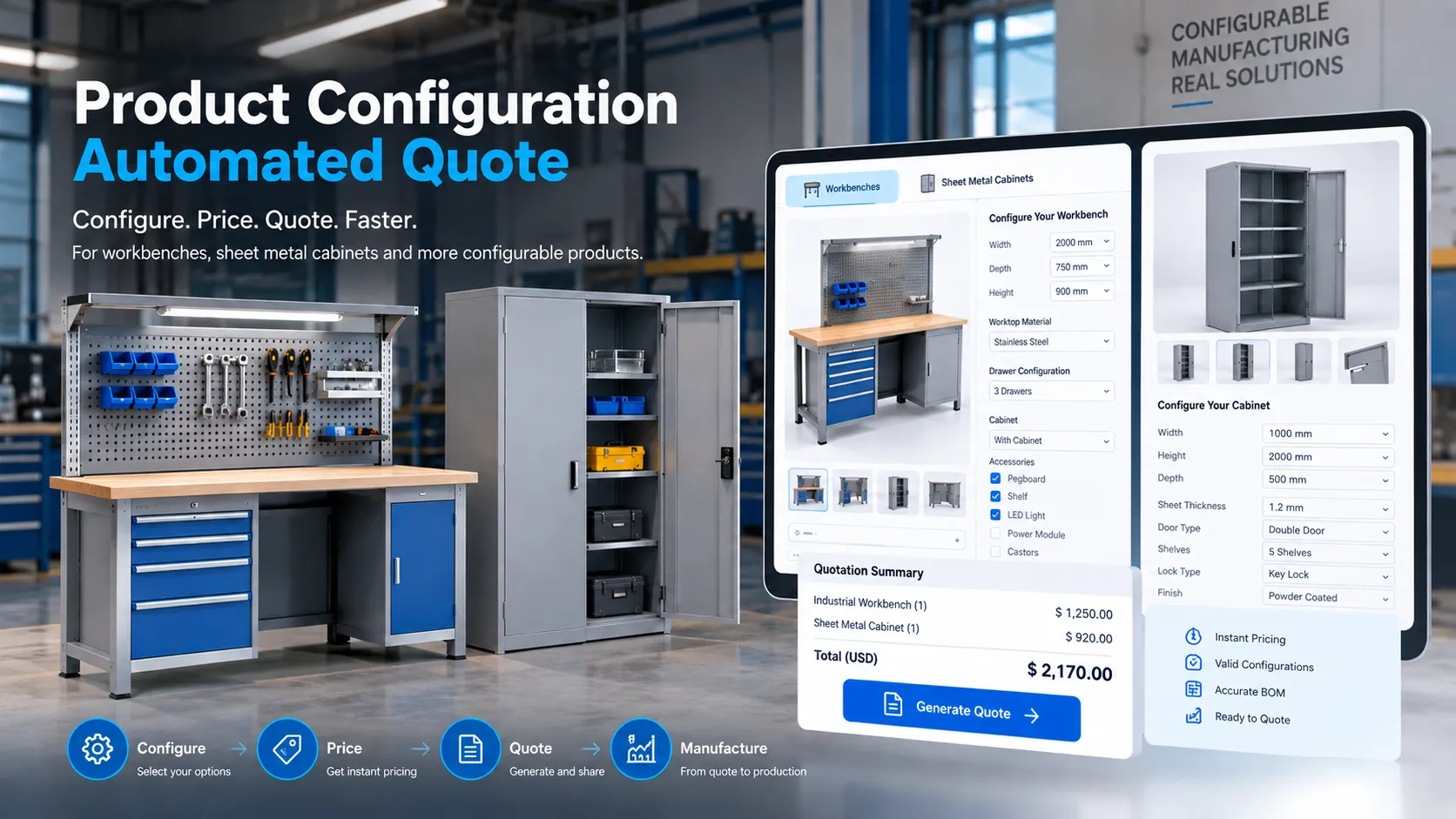
- Sheet Metal Products: Enclosures, cabinets, workstations, storage systems, and other sheet metal products often contain configurable dimensions and component combinations. A configurator can connect customer selections with CAD and manufacturing documentation.
- Modular Furniture: Laboratory furniture, workbenches, storage systems, and modular furniture can involve numerous combinations of dimensions, materials, accessories, and configurations. A configurable workbench demonstrates how users can select different product options and visualize a configuration based on their requirements. Configuration automation can reduce repetitive drawing and BOM preparation.
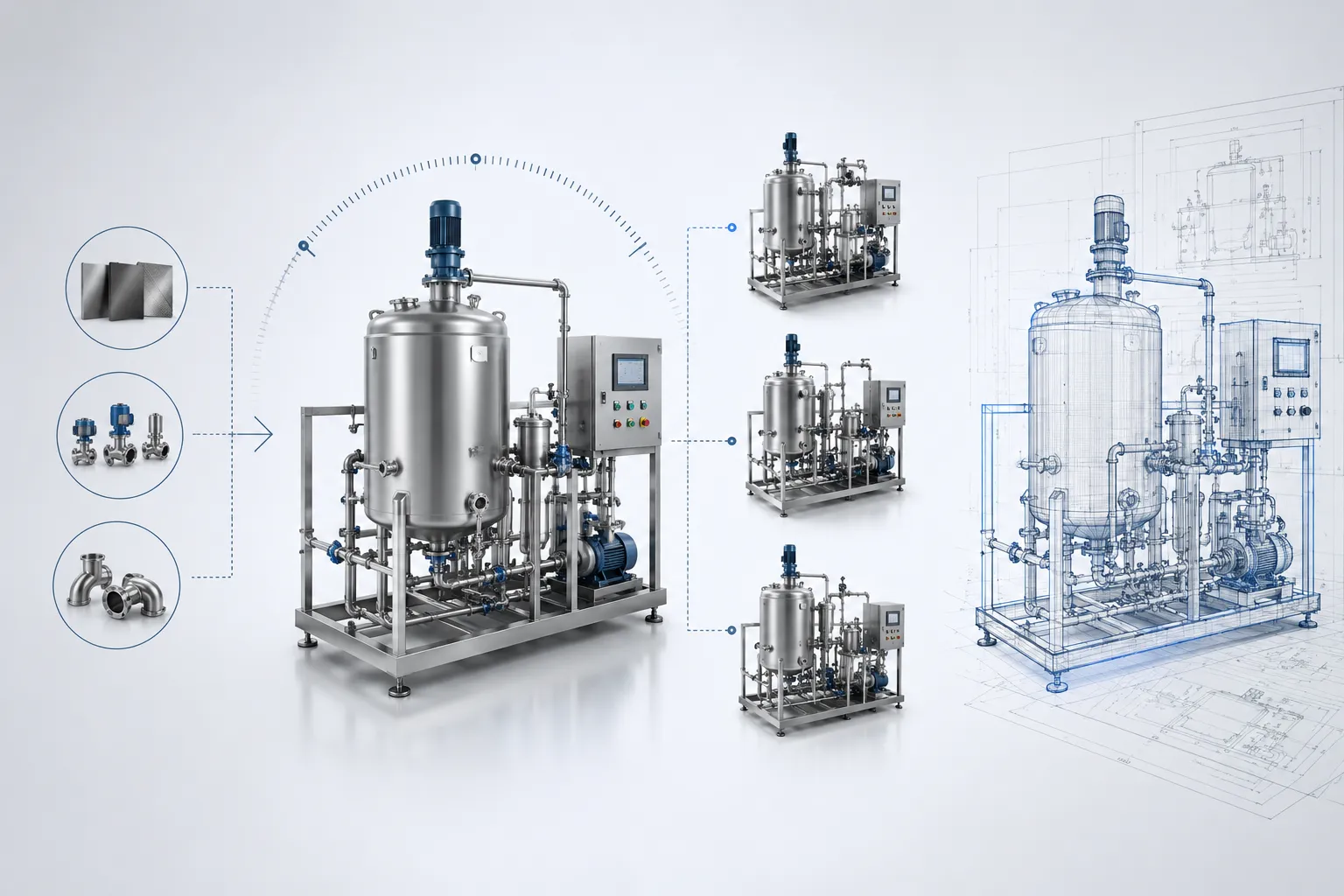
- Process Equipment: Equipment such as skids, tanks, process modules, and supporting systems can contain configurable components and engineering parameters. Rule-based configuration can help standardize common product variants.
- Fitness Equipment: Fitness equipment manufacturers may offer different frame sizes, attachments, resistance options, dimensions, and accessories. A configurator can help sales teams select validated product combinations.
- HVAC and Mechanical Products: Products with variable dimensions, capacities, components, and accessories can benefit from automated configuration and quotation workflows.
Key Benefits of Product Configurators for Manufacturers
A properly implemented product configurator can provide benefits across several departments.
For Engineering
- Reduced repetitive configuration work
- Fewer manual validation tasks
- Reduced CAD modification effort
- Standardized engineering rules
- Fewer configuration errors
- More time for complex engineering work
For Sales
- Faster customer response
- Faster quotation preparation
- Greater confidence in product selection
- Easier handling of product variants
- Improved sales-to-engineering coordination
For Manufacturing
- More consistent product information
- Improved BOM accuracy
- Better documentation
- Reduced configuration-related production errors
- More standardized product variants
For Management
- Improved workflow scalability
- Better utilization of engineering resources
- Reduced quotation cycle time
- Greater process standardization
- Improved visibility across sales and engineering
What Should Be Automated First?
Not every engineering process needs to be automated immediately.
The best starting point is usually a product family with:
- High quotation volume
- Repetitive configurations
- Clearly defined engineering rules
- Frequent engineering involvement
- Standardized components
- Predictable pricing logic
- Repeated CAD or documentation requirements
A practical automation strategy is to identify where engineers spend the most time on repetitive configuration activities.
For example:
High quotation volume + predictable product rules + repetitive CAD changes = Strong Product Configurator Opportunity
Starting with a focused product family also makes it easier to validate the automation logic before expanding it to additional products.
Implementation Considerations for a Product Configurator
A product configurator should not simply be treated as a product selection interface.
Its effectiveness depends on how accurately the underlying engineering logic is defined.
Important considerations include:
- Product Structure: Identify the base product, configurable parameters, standard components, optional components, and variant relationships.
- Engineering Rules: Document the rules that determine valid and invalid combinations.
- Manufacturing Constraints: Configuration logic should account for manufacturing limitations rather than focusing only on product appearance.
- Pricing Logic: Define how dimensions, materials, components, quantities, and other factors influence pricing.
- CAD Integration: Determine whether configuration data should update existing CAD models, generate new models, or trigger predefined CAD configurations.
- BOM and Documentation: Identify which technical documents should be generated automatically after configuration.
- ERP and PDM Integration: Where required, configuration data can be connected to ERP, PDM, or other business systems to maintain data consistency.
How Immersiv Techsphere Approaches Product Configuration Automation
Immersiv Techsphere focuses on engineering-driven Configurator & CPQ solutions for manufacturing and product businesses.
The approach can combine:
- Rule-based product configurators
- CAD automation
- Parametric product configuration
- Automated BOM generation
- Quotation automation
- SolidWorks API integration
- Web-based configurators
- Engineering workflow automation
- Product visualization
- Manufacturing documentation automation
The objective is to connect product selection with the engineering processes that follow it.
For businesses with configurable products, this can create a more structured workflow between sales, engineering, and manufacturing while reducing repetitive manual effort.
Frequently Asked Questions
A Product Configurator is a software system that allows users to customize products using predefined options and automatically applies product, engineering, and manufacturing rules to validate the selected configuration.
It automates repetitive product selection and validation tasks using predefined rules. This reduces the need for engineers to manually review every standard configuration.
Yes. Product configurators can integrate with CAD automation workflows to generate or modify parametric models, assemblies, drawings, BOMs, and other engineering outputs.
A Product Configurator focuses primarily on selecting and validating product options. CPQ extends the workflow by combining configuration with pricing and quotation generation.
Yes. A configurator can generate a configuration-specific BOM when product rules and component relationships are properly defined.
Yes. They are particularly useful when a manufacturer offers controlled customization, where products have a standard architecture but customers can select different dimensions, materials, components, or options.
Yes. By automating product selection, validation, pricing, and quotation data generation, configurators can reduce the manual work involved in preparing standard or configurable-product quotations.
Industrial equipment, sheet metal manufacturing, modular furniture, laboratory furniture, process equipment, HVAC, fitness equipment, and other engineering-driven manufacturing businesses can benefit from product configuration automation.
Conclusion
Product customization does not have to mean repetitive engineering work.
A well-designed Product Configurator can capture engineering rules, guide product selection, prevent invalid combinations, automate pricing and quotation workflows, and connect customer requirements with downstream engineering processes.
When combined with CPQ, CAD automation, BOM generation, and manufacturing documentation, product configuration can become more than a sales tool. It can become an important part of the digital engineering workflow.
For manufacturers, the key opportunity is to identify repetitive configuration tasks and convert predictable engineering decisions into structured automation.
The result can be a faster and more consistent process:
Configure Faster → Validate Automatically → Reduce Engineering Rework → Quote Faster → Accelerate Sales → Streamline Manufacturing
As product customization continues to increase, integrating product configuration with engineering automation can help manufacturers scale product variants without scaling repetitive manual work at the same rate.
Have a Project in Mind?
Need help with 3D animation, industrial visualization, HSE training animation, or product visualization? Tell us about your project and our team will get back to you.