

Table of Contents
Introduction
A safety procedure is only effective when everyone understands it correctly.
In industrial workplaces, employees, contractors, visitors, and other stakeholders often come from different linguistic backgrounds. While a company may use English or another common language for its safety documentation and training, not everyone may be equally comfortable understanding technical instructions in that language.
This creates a communication gap, particularly when explaining critical safety procedures, emergency response instructions, PPE requirements, equipment handling, and workplace hazards.
This is where AI can make a difference.
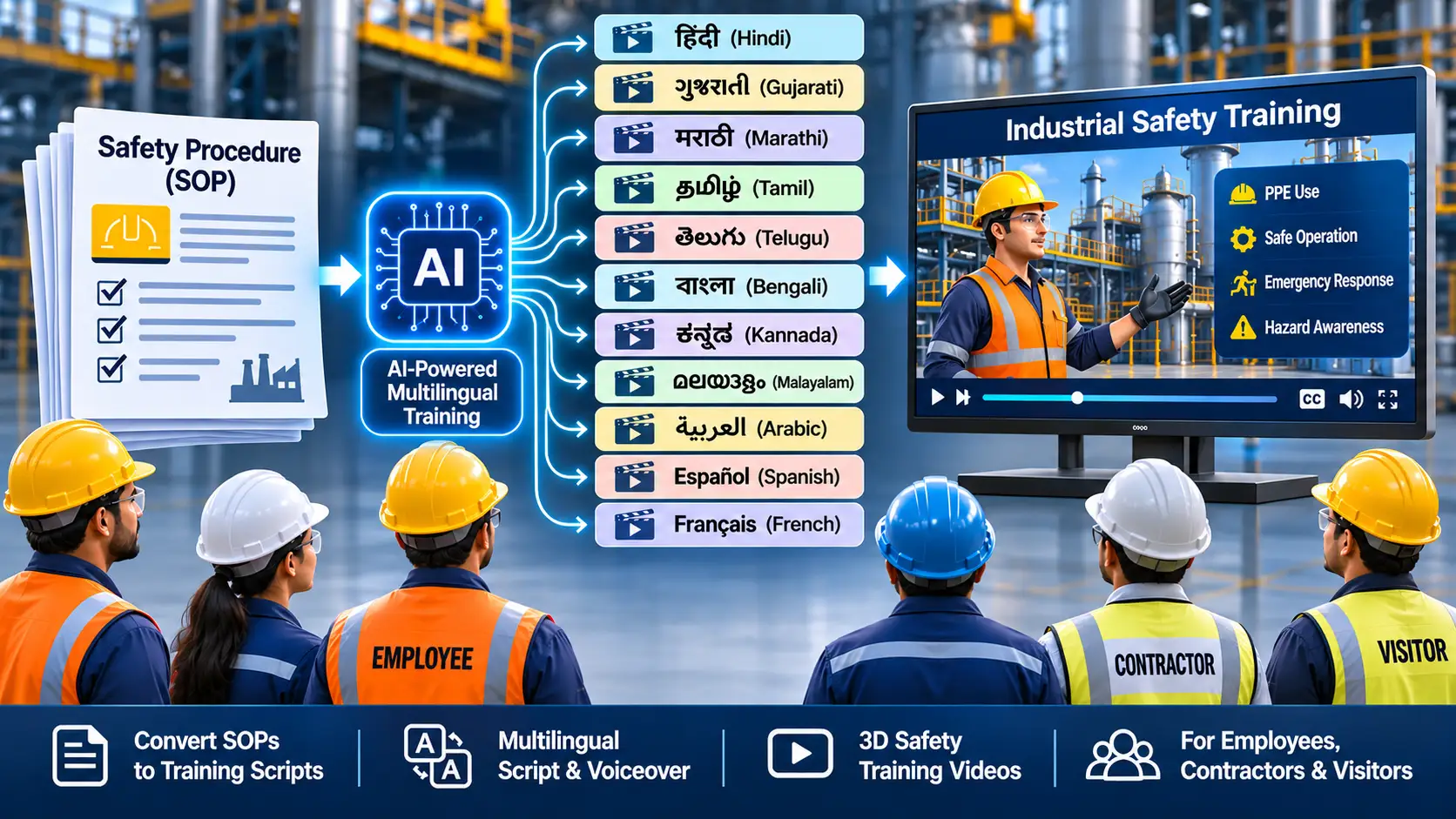
By using Artificial Intelligence (AI), organisations can convert existing safety procedures, Standard Operating Procedures (SOPs), and induction materials into multilingual training scripts. These scripts can then be used to develop safety training videos and induction videos in the regional languages or mother tongues of the intended audience.
Instead of expecting every stakeholder to understand one common language, organisations can communicate the same safety message in languages that their workforce understands comfortably.
This approach makes safety communication more accessible, consistent, and easier to follow across different departments, locations, and workforce groups.
Why Multilingual Safety Training Matters in Industrial Workplaces
Industrial workplaces bring together people with different educational backgrounds, regional languages, and levels of technical understanding.
For example, a manufacturing facility in India may have:
- Production operators who primarily communicate in Gujarati, Hindi, Marathi, or another regional language.
- Maintenance technicians who understand technical instructions better in their mother tongue.
- Contractors and temporary workers from different states.
- Supervisors and engineers who commonly use English for technical documentation.
- International visitors and stakeholders who require safety instructions in their preferred language.
If everyone receives the same English-language safety induction video, some participants may understand the instructions immediately, while others may struggle with technical terminology or unfamiliar expressions.
This does not necessarily mean that employees lack the ability to understand safety procedures. The issue may simply be the language in which the information is communicated.
Safety training should focus on understanding, not just information delivery.
According to the US Occupational Safety and Health Administration (OSHA), safety training should be provided in a language and vocabulary that employees can understand. Its guidance also highlights the importance of adapting training materials to participants’ literacy levels and everyday language.
Reference: OSHA – Resource for Development and Delivery of Training to Workers.
This makes multilingual safety training an important consideration for organisations managing a diverse workforce.
How AI Helps Convert Safety Procedures into Multilingual Training Scripts
Traditionally, converting safety documentation into multiple languages involves manual translation, separate script preparation, and coordination with language experts.
For organisations operating across multiple locations, this process can take considerable time and effort.
AI can simplify this workflow by helping transform existing safety documents into structured training scripts and adapting them for different language audiences.
Rather than translating individual sentences word for word, AI can help reorganise the information into a conversational, easy-to-follow training format while retaining the original safety instructions.
Here are some ways AI supports this process.
Converting Existing Safety Documents into Training Scripts
Most organisations already have safety-related documentation, including:
- Standard Operating Procedures (SOPs).
- Emergency response procedures.
- Job Safety Analysis (JSA).
- Risk Assessment documents.
- Permit-to-Work (PTW) procedures.
- PPE guidelines.
- Equipment operating instructions.
- Visitor and contractor safety guidelines.
AI tools can analyse these documents and help convert them into structured video scripts.
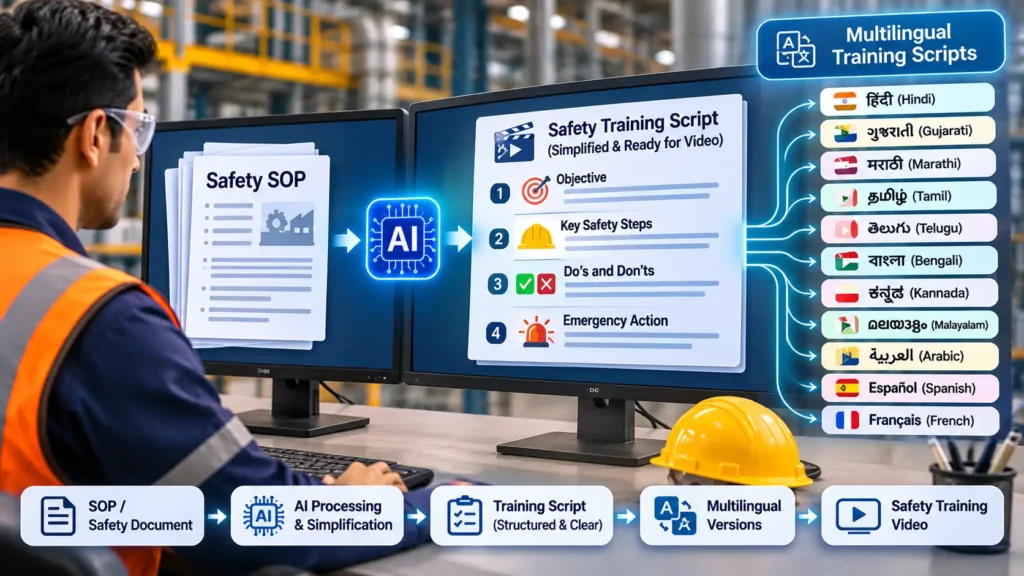
For example, an existing SOP explaining the safe operation of an industrial machine can be converted into a training script covering:
- Introduction to the machine and its purpose.
- Potential hazards during operation.
- Required Personal Protective Equipment (PPE).
- Pre-operation safety checks.
- Safe operating procedures.
- Emergency shutdown instructions.
- Actions to take in case of an incident.
The same approved information can then become the foundation for training scripts in multiple languages.
This reduces the need to prepare every language version independently.
Beyond script preparation, AI can also support the visual development process by helping organise scenes and narration when converting SOPs into visual safety animation.
Translating Scripts into Regional Languages and Mother Tongues
One of the most useful applications of AI is its ability to assist with multilingual content adaptation.
Once the original safety training script is approved, AI can help create versions in languages such as:
- Hindi
- Gujarati
- Marathi
- Tamil
- Telugu
- Bengali
- Kannada
- Malayalam
- Arabic
- Spanish
- French
For example, a manufacturing company may have employees from Gujarat, Maharashtra, and Tamil Nadu working at the same facility.
Instead of preparing one common-language safety induction video, the organisation can develop three versions using the same approved safety content.
Each version communicates identical safety requirements but uses the language familiar to its intended audience.
Importantly, the objective is not simply to translate words. It is to communicate the intended safety instruction in a way that the audience can understand in its everyday language.
Simplifying Technical Language for Better Understanding
Direct translation is not always sufficient, particularly when safety procedures contain complex engineering terminology.
Words such as isolation, hazardous energy, confined space, lockout, interlocking, and emergency shutdown may require additional explanation.
AI can help simplify these concepts by:
- Replacing unnecessarily complex sentences with simpler expressions.
- Explaining technical terms in familiar language.
- Breaking lengthy instructions into smaller steps.
- Converting formal documentation into conversational narration.
- Maintaining consistent terminology throughout the script.
For example:
Original technical instruction:
“Ensure that the equipment is isolated from all energy sources and apply the lockout/tagout procedure before commencing maintenance activities.”
Simplified training explanation:
“Before starting maintenance, switch off the equipment, disconnect all energy sources, and follow the lockout/tagout procedure. Never begin maintenance until the equipment is confirmed safe.”
The simplified version can then be adapted into the required regional language.
However, simplification must never remove technical requirements, warnings, or critical safety steps.
Adapting Scripts for Different Stakeholders
Not everyone entering an industrial facility needs the same level of safety information.
An employee operating machinery, a maintenance technician, a contractor, and a visitor have different responsibilities and exposure to workplace hazards.
AI can help create audience-specific versions of the same safety information.
| Stakeholder | Training content |
|---|---|
| Employees | Workplace hazards, PPE, safe work practices and emergency procedures |
| Contractors | Site-specific hazards, permit requirements and restricted areas |
| Visitors | Entry guidelines, PPE requirements, restricted zones and evacuation procedures |
| Maintenance teams | Equipment isolation, LOTO, maintenance hazards and emergency shutdown |
| Supervisors | Safety responsibilities, incident reporting and hazard monitoring |
These scripts can also be adapted into the preferred languages of each stakeholder group.
This makes safety induction more relevant without compromising consistency in the organisation’s safety standards.
How AI-Powered Multilingual Scripts Are Used in Safety Training Videos
Once the scripts are prepared and validated, they can be converted into visual training materials.
This is where AI-assisted script development and 3D safety animation can work together.
A multilingual script provides the narration, while visuals demonstrate the actual safety procedures, workplace conditions, and expected actions.
Some important applications include:
Multilingual Safety Induction Videos
Safety induction is often the first interaction employees, contractors, and visitors have with an organisation’s safety requirements.
An AI-assisted multilingual approach allows organisations to prepare induction videos in multiple languages using the same visual foundation.
Topics may include:
- Introduction to workplace safety rules.
- Mandatory PPE requirements.
- Site access and restricted areas.
- Emergency exits and assembly points.
- Fire safety procedures.
- Hazard identification and reporting.
- Visitor movement guidelines.
For example, a visitor entering a chemical manufacturing facility can watch the same induction video in Hindi, Gujarati, Marathi, Arabic, Spanish or English, depending on their language preference.
The visuals remain consistent, while the narration and subtitles change according to the selected language.
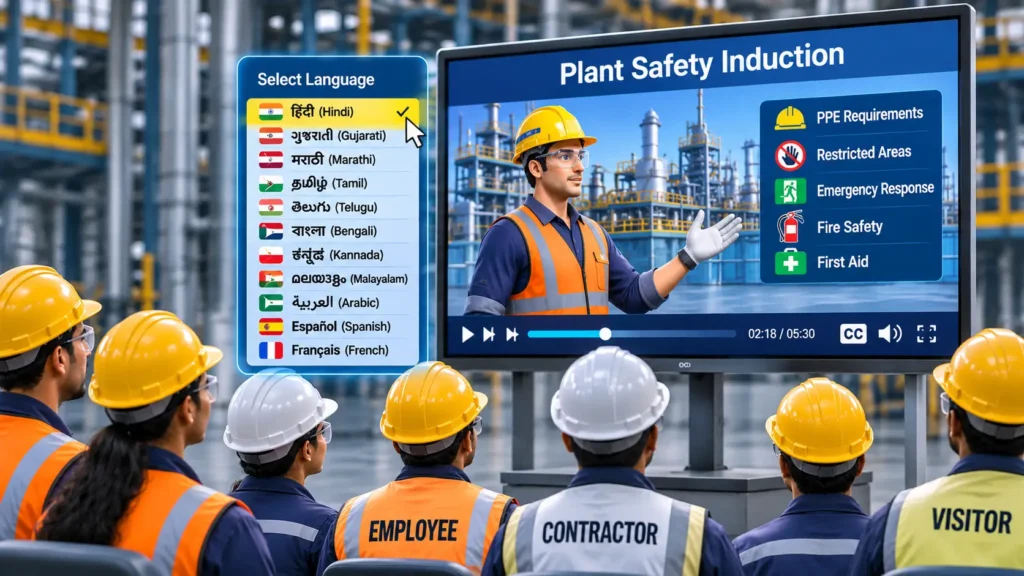
For contractor onboarding, organisations can also use safety induction animation for industrial contractors to demonstrate site access requirements, PPE guidelines, restricted areas, and emergency procedures.
Equipment-Specific Safety Training Videos
Equipment operating procedures often involve technical instructions that must be understood precisely.
AI can help convert equipment manuals and operating procedures into multilingual scripts explaining:
- Machine start-up and shutdown.
- Safe operating limits.
- Moving parts and pinch points.
- Emergency stop locations.
- Maintenance precautions.
- Hazardous energy isolation.
3D industrial animation can demonstrate these procedures visually, making it easier for employees to understand what they need to do.
Complex operating procedures involving hazardous machinery, chemicals, and industrial equipment can be communicated more effectively by visualising high-risk industrial procedures through 3D safety animation.
Emergency Response and Evacuation Training
Emergency instructions must be communicated clearly and quickly.
AI can help prepare multilingual scripts for:
- Fire emergency response.
- Chemical spill management.
- Gas leakage response.
- Emergency evacuation.
- First-aid procedures.
- Assembly point instructions.
When combined with 3D safety animation, these scripts can demonstrate evacuation routes, emergency equipment locations, and the correct sequence of actions.
This is particularly useful for organisations with multilingual workforces, where everyone needs to understand the same emergency response process.
Organisations can further strengthen emergency preparedness through 3D safety animation for emergency response training, which visually demonstrates emergency situations and the correct sequence of response actions.
PPE Awareness and Workplace Hazard Training
PPE instructions can differ depending on the work environment and associated hazards.
AI-assisted multilingual scripts can explain the correct selection, inspection, and use of:
- Safety helmets.
- Protective gloves.
- Safety shoes.
- Respiratory protection.
- Safety goggles.
- Hearing protection.
- Full-body harnesses.
Visual demonstrations can show both correct and incorrect PPE practices, helping employees understand the importance of following safety requirements.
A Step-by-Step Workflow for Creating Multilingual Safety Training Scripts Using AI
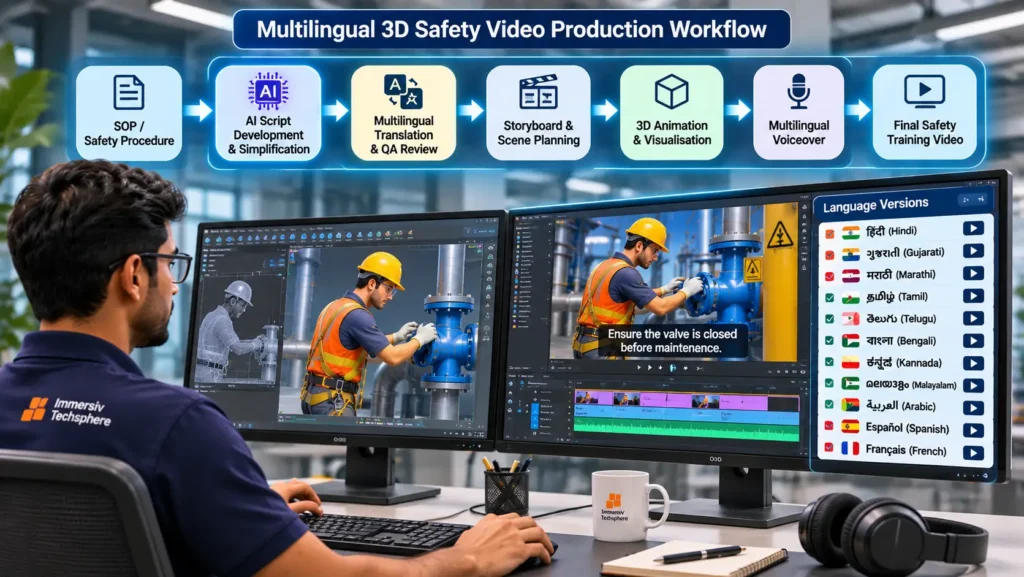
Organisations can follow a structured workflow to develop multilingual safety training content.
Step 1: Collect Existing Safety Documentation
Gather approved SOPs, risk assessments, safety manuals, induction materials, and equipment operating procedures.
Step 2: Identify Stakeholders and Language Requirements
Identify the target audience, their preferred languages, technical familiarity, and literacy levels.
Step 3: Use AI to Generate the Master Script
Convert the source documents into a structured script with narration, scene descriptions, safety instructions, and visual references.
Step 4: Adapt the Script into Regional Languages
Use AI translation tools to prepare language-specific versions while retaining approved technical terminology and safety instructions.
Step 5: Review and Validate Translations
Get the translated scripts checked by competent bilingual reviewers, subject-matter experts, and the organisation’s EHS team.
Step 6: Develop Video Narration and Visuals
Prepare voiceovers, subtitles, 3D animations, and supporting visual demonstrations for each language version.
Step 7: Test Comprehension and Publish
Test the training with representative employees and stakeholders. Incorporate feedback before releasing the final videos.
This workflow allows organisations to create multiple language versions while maintaining a common source of approved safety information.
Important Considerations When Using AI for Multilingual Safety Training
AI can accelerate script preparation and translation, but safety communication requires accuracy and contextual understanding.
A mistranslated instruction can create confusion, particularly when it concerns emergency actions, equipment operation, hazardous substances, or isolation procedures.
Organisations should consider the following factors.
Do Not Depend on Direct Machine Translation Alone
AI-generated translations should be treated as drafts, not automatically approved safety instructions.
Technical terms, regional expressions, and industry-specific terminology must be reviewed by qualified people who understand both the language and the safety subject.
Maintain Consistency Across All Language Versions
All language versions must communicate the same approved safety requirements.
For example, if an English induction video instructs employees to maintain a specific exclusion zone, the translated versions must communicate the same restriction without changing its meaning.
Consider Regional Dialects and Everyday Language
A language may have different regional variations.
An AI-generated Gujarati or Hindi script, for example, should be reviewed to ensure that the vocabulary is familiar to the intended workforce.
The goal is to avoid overly formal translations that are technically correct but difficult for employees to follow.
Use Visual Demonstrations Alongside Narration
Language adaptation should not be limited to voiceovers.
Visual demonstrations, warning symbols, animated sequences, and on-screen instructions can reinforce the message.
This is particularly important for employees with limited reading ability or those who understand visual demonstrations more easily than written explanations.
Provide Opportunities to Confirm Understanding
Watching a video does not automatically mean that an employee has understood the instructions.
Organisations should include short assessments, practical demonstrations, discussions, or supervisor-led checks to confirm comprehension.
AI can assist with preparing language-specific quiz questions, but practical competency must be evaluated appropriately.
Keep Training Content Updated
Safety procedures may change when equipment, processes, workplace layouts, or regulatory requirements are updated.
When the approved source procedure changes, the corresponding master script and all translated versions should be reviewed and updated before reuse.
A controlled version-management process helps prevent outdated safety instructions from circulating.
Benefits of AI-Assisted Multilingual Safety Training Videos
Combining AI-assisted script development with multilingual safety videos offers several advantages for organisations managing diverse workforces.
| Benefit | How it helps organisations |
|---|---|
| Better understanding | Employees receive safety instructions in familiar languages. |
| Faster content development | AI reduces the manual effort involved in preparing multiple script versions. |
| Consistent communication | All language versions follow the same approved safety procedures. |
| Improved accessibility | Workers with different language and literacy levels can access training more easily. |
| Easier onboarding | New employees, contractors, and visitors can receive language-specific induction videos. |
| Scalable training | Organisations can extend existing training content to additional languages and locations. |
| Simplified updates | Revised source scripts can be used to generate updated language versions. |
The biggest advantage is that organisations no longer need to depend on one common language for communicating every safety instruction.
Instead, they can build a multilingual training system that makes safety information accessible to different stakeholders while maintaining consistency in the underlying procedures.
How Immersiv Techsphere Supports Multilingual Safety Training Video Development
At Immersiv Techsphere, we develop industrial safety animations, EHS training videos, and safety induction videos that help organisations communicate workplace safety procedures through visual storytelling.
We understand that effective safety training requires more than presenting information. Employees, contractors, and visitors must be able to understand the hazards, recognise unsafe conditions, and identify the correct actions to take.
AI-assisted script development can support this process by helping organisations adapt their existing safety documentation into structured training scripts for different language audiences.
Our support includes:
1. Safety Procedure to Training Script Development
We help transform existing SOPs, safety manuals, and workplace procedures into structured video scripts with narration and visual scene descriptions.
2. Multilingual Script Adaptation
AI-assisted translation and language adaptation can help prepare scripts for different regional and international audiences. Language-specific versions can be reviewed to maintain technical accuracy and clarity.
3. 3D EHS and Safety Animation
We develop 3D animated sequences to demonstrate workplace hazards, PPE requirements, safe operating practices, emergency procedures, and accident scenarios.
4. Safety Induction Video Development
We create visual induction content for employees, contractors, and visitors covering site-specific safety requirements, restricted areas, emergency exits, and workplace guidelines.
5. Multilingual Video Production Support
Approved language-specific scripts can be used to prepare corresponding voiceovers, subtitles, and video versions while maintaining consistent visuals and safety messaging.
By combining engineering understanding, industrial animation, and AI-assisted content workflows, Immersiv Techsphere helps organisations develop safety training materials that communicate important instructions more clearly to diverse audiences.
Our objective is simple: make workplace safety information easier to understand, regardless of the language spoken by the person receiving the training.
If your organisation is planning to develop multilingual safety induction videos or EHS training animations, connect with Immersiv Techsphere to discuss your requirements.
Frequently Asked Questions (FAQs)
AI can analyse existing Standard Operating Procedures (SOPs), safety manuals, and induction documents to generate structured training scripts. These scripts can be translated and adapted into regional languages while retaining the original safety instructions and technical requirements.
Yes. AI can help convert approved safety SOPs into scripts in languages such as Hindi, Gujarati, Marathi, Tamil, Telugu, and Bengali. These scripts can then be used to develop multilingual safety training videos with language-specific narration and subtitles.
AI can help convert complex technical instructions into simpler, conversational language without changing their intended meaning. This makes safety procedures easier to understand for employees, contractors, and workers with different levels of technical knowledge.
Yes. Organisations can reuse the same 3D animation and visual sequences across multiple language versions. The narration, voiceovers, and subtitles can be adapted to the preferred language of each workforce group, reducing the need to produce separate animations.
AI-generated scripts and translations should be reviewed by EHS professionals, subject-matter experts, and competent language reviewers. This ensures that technical terminology, hazard descriptions, emergency instructions, and safety requirements remain accurate across all language versions.
AI-assisted multilingual scripts can be used to develop various industrial safety training videos, including:
– Employee safety induction videos.
– Contractor and visitor induction videos.
– PPE awareness and compliance videos.
– Fire and emergency response training videos.
– Machine and equipment safety videos.
– Chemical handling and hazardous material training videos.
– Working at height and confined space safety videos.
– Lockout/Tagout (LOTO) training videos.
Conclusion
Effective workplace safety training depends on how well people understand the information being communicated.
In multilingual industrial environments, relying on a single common language can create unnecessary communication gaps, particularly when explaining technical procedures, workplace hazards, and emergency response instructions.
AI offers organisations a practical way to convert existing safety documentation into multilingual training scripts, making it easier to develop safety training videos and induction videos in the regional languages and mother tongues of different stakeholders.
However, AI should support the process, not replace technical validation. Accurate translations, human review, relevant visual demonstrations, and comprehension assessments remain essential.
By combining AI-assisted multilingual script development with 3D safety animation, organisations can make safety communication more accessible, consistent, and effective across their workforce.
Because workplace safety instructions should be understood by everyone, not just those who speak the organisation’s common language.
Have a Project in Mind?
Need help with 3D animation, industrial visualization, HSE training animation, or product visualization? Tell us about your project and our team will get back to you.